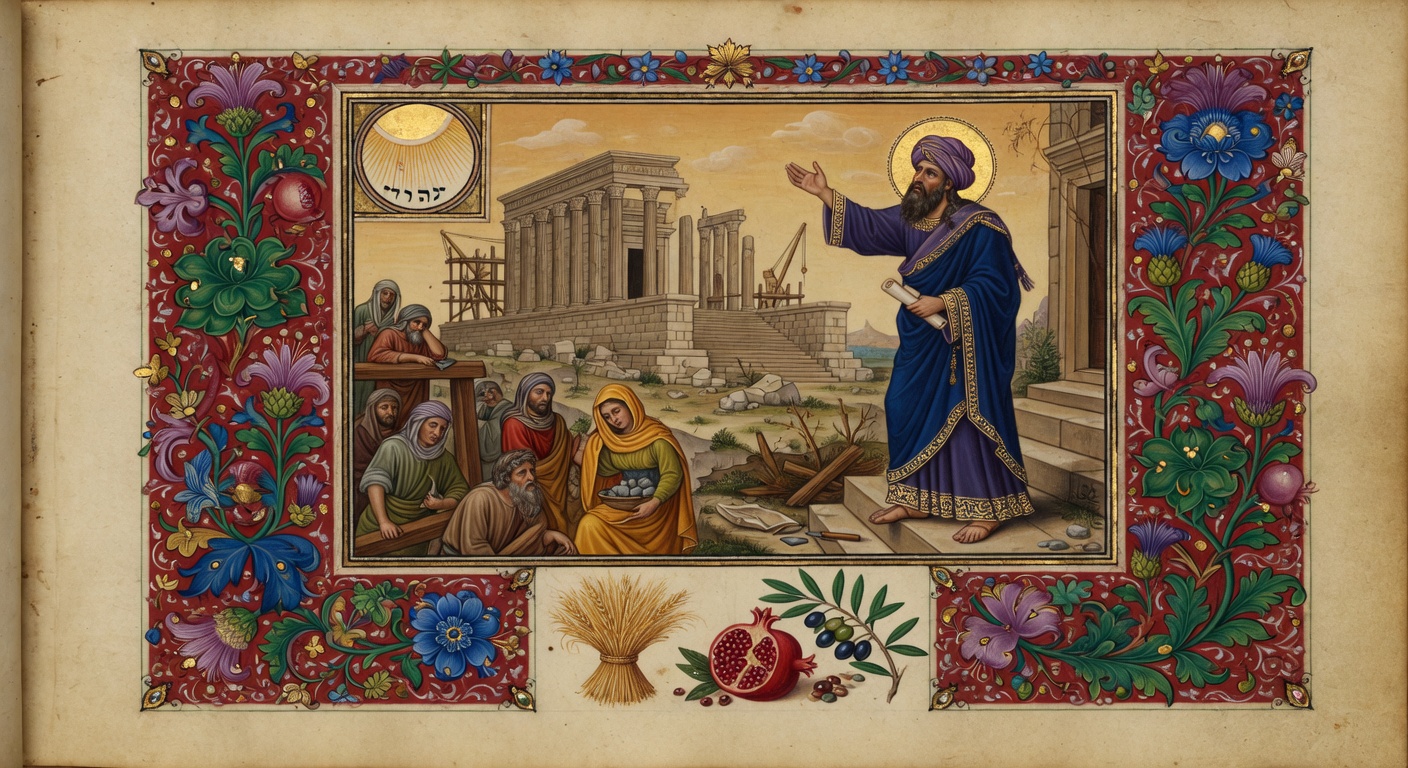
Haggai 1 KJV
A Call to Rebuild the Temple
A Call to Rebuild the Temple
The precise dating to the first day of the sixth month in Darius's second year situates the oracle within the Persian administrative calendar, underscoring that divine initiative now operates under foreign imperial oversight rather than native kingship.
 1n the second year of Darius the king, in the sixth month, in the first day of the month, came the word of the LORD by Haggai the prophet unto Zerubbabel the son of Shealtiel, governor of Judah, and to Joshua the son of Josedech, the high priest, saying,
2 Thus speaketh the LORD of hosts, saying, This people say, The time is not come, the time that the LORD’s house should be built.
3 Then came the word of the LORD by Haggai the prophet, saying,
4 Is it time for you, O ye, to dwell in your cieled houses, and this house lie waste?
5 Now therefore thus saith the LORD of hosts; Consider your ways.
6 Ye have sown much, and bring in little; ye eat, but ye have not enough; ye drink, but ye are not filled with drink; ye clothe you, but there is none warm; and he that earneth wages earneth wages to put it into a bag with holes.
7 Thus saith the LORD of hosts; Consider your ways.
8 Go up to the mountain, and bring wood, and build the house; and I will take pleasure in it, and I will be glorified, saith the LORD.
9 Ye looked for much, and lo, it came to little; and when ye brought it home, I did blow upon it. Why? saith the LORD of hosts. Because of mine house that is waste, and ye run every man unto his own house.
10 Therefore the heaven over you is stayed from dew, and the earth is stayed from her fruit.
11 And I called for a drought upon the land, and upon the mountains, and upon the corn, and upon the new wine, and upon the oil, and upon that which the ground bringeth forth, and upon men, and upon cattle, and upon all the labour of the hands.
12 Then Zerubbabel the son of Shealtiel, and Joshua the son of Josedech, the high priest, with all the remnant of the people, obeyed the voice of the LORD their God, and the words of Haggai the prophet, as the LORD their God had sent him, and the people did fear before the LORD.
13 Then spake Haggai the LORD’s messenger in the LORD’s message unto the people, saying, I am with you, saith the LORD.
14 And the LORD stirred up the spirit of Zerubbabel the son of Shealtiel, governor of Judah, and the spirit of Joshua the son of Josedech, the high priest, and the spirit of all the remnant of the people; and they came and did work in the house of the LORD of hosts, their God,
15 In the four and twentieth day of the sixth month, in the second year of Darius the king.
← → arrow keys to navigate chapters · spacebar to play/pause audio
Did You Know?
The precise dating to the first day of the sixth month in Darius's second year situates the oracle within the Persian administrative calendar, underscoring that divine initiative now operates under foreign imperial oversight rather than native kingship.
The economic frustrations listed echo the covenant curses of Deuteronomy 28 yet are applied to a post-exilic community, showing that the Mosaic covenant's sanctions remained operative even after the return from Babylon.
By addressing both Zerubbabel the governor and Joshua the high priest together, the chapter presents a deliberately dyarchic leadership model that anticipates the balanced royal-priestly vision later developed in Zechariah.
The phrase 'this people' in verse 2 deliberately distances God from Israel, a rhetorical shift from the usual 'my people' that signals ruptured relationship caused by misplaced priorities.
The call to bring timber from 'the mountain' reuses the same sourcing language used for Solomon's temple, implying that the Second Temple project is meant to resume an interrupted sacred history rather than begin anew.
The prophet's repeated use of the phrase 'consider your ways' invokes the covenantal logic of Deuteronomy 28, linking the returned exiles' crop failures and wage shortages directly to their delay in rebuilding the temple rather than to Persian imperial policy.
In Haggai 2:23, God declares Zerubbabel His signet ring, symbolically reversing the judgment on Jehoiachin in Jeremiah 22:24 and restoring Davidic authority under foreign rule.
The city has been destroyed at least twice, besieged 23 times, and captured 44 times.
Through these accounts Persia reveals how the Lord sovereignly directs even mighty Gentile kingdoms to preserve his people and advance the promises of restoration.
Commentary & Study Notes Jamieson-Fausset-Brown (1871) · Public Domain second year of Darius — Hystaspes, the king of Medo-Persia, the second of the world empires, Babylon having been overthrown by the Persian Cyrus. The Jews having no king of their o…
Classic verse-by-verse commentary on Haggai 1 from Jamieson, Fausset & Brown (1871). Covers: Haggai calls the people to consider their ways in neglecting to build God's house: the evil of this neglect to themselves: the honor to God of attending to it: the people's penitent obedience under zerubbabel followed by God's gracious assurance.
- 1
- second year of Darius — Hystaspes, the king of Medo-Persia, the second of the world empires, Babylon having been overthrown by the Persian Cyrus. The Jews having no king of their own, dated by the reign of the world kings to whom they were subject. Darius was a common name of the Persian kings, as Pharaoh of those of Egypt, and Cæsar of those of Rome. The name in the cuneiform inscriptions at Persepolis is written Daryawus, from the root Darh, "to preserve," the Conservator [LASSEN]. HERODOTUS [6.98] explains it Coercer. Often opposite attributes are assigned to the same god; in which light the Persians viewed their king. Ezr 4:24 harmonizes with Haggai in making this year the date of the resumption of the building. sixth month — of the Hebrew year, not of Darius' reign (compare Zec 1:7; 7:1, 3; 8:19). Two months later ("the eighth month," Zec 1:1) Zechariah began to prophesy, seconding Haggai. the Lord — Hebrew, JEHOVAH: God's covenant title, implying His unchangeableness, the guarantee of His faithfulness in keeping His promises to His people. by Haggai — Hebrew, "in the hand of Haggai"; God being the real speaker, His prophet but the instrument (compare Ac 7:35; Ga 3:19). Zerubbabel — called also Shesh-bazzar in Ezr 1:8; 5:14, 16, where the same work is attributed to Shesh-bazzar that in Ezr 3:8 is attributed to Zerubbabel. Shesh-bazzar is probably his Chaldean name; as Belteshazzar was that of Daniel. Zerubbabel, his Hebrew name, means "one born in Babylon." son of Shealtiel — or Salathiel. But 1Ch 3:17, 19 makes Pedaiah his father. Probably he was adopted by his uncle Salathiel, or Shealtiel, at the death of his father (compare Mt 1:12; Lu 3:27). governor of Judah — to which office Cyrus had appointed him. The Hebrew Pechah is akin to the original of the modern Turkish Pasha; one ruling a region of the Persian empire of less extent than that under a satrap. Joshua — called Jeshua (Ezr 2:2); so the son of Nun in Ne 8:17. Josedech — or Jehozadak (1Ch 6:15), one of those carried captive by Nebuchadnezzar. Haggai addresses the civil and the religious representatives of the people, so as to have them as his associates in giving God's commands; thus priest, prophet, and ruler jointly testify in God's name.
- 2
- the Lord of hosts — Jehovah, Lord of the powers of heaven and earth, and therefore requiring implicit obedience. This people — "This" sluggish and selfish "people." He does not say, My people, since they had neglected the service of God. The time — the proper time for building the temple. Two out of the seventy predicted years of captivity (dating from the destruction of the temple, 558 B.C., 2Ki 25:9) were yet unexpired; this they make their plea for delay [HENDERSON]. The seventy years of captivity were completed long ago in the first year of Cyrus, 536 B.C. (Jer 29:10); dating from 606 B.C., Jehoiakim's captivity (2Ch 36:6). The seventy years to the completion of the temple (Jer 25:12) were completed this very year, the second of Darius [VATABLUS]. Ingenious in excuses, they pretended that the interruption in the work caused by their enemies proved it was not yet the proper time; whereas their real motive was selfish dislike of the trouble, expense, and danger from enemies. "God," say they, "hath interposed many difficulties to punish our rash haste" [CALVIN]. Smerdis' interdict was no longer in force, now that Darius the rightful king was on the throne; therefore they had no real excuse for not beginning at once to build. AUBERLEN denies that by "Artaxerxes" in Ezr 4:7-22 is meant Smerdis. Whether Smerdis or Artaxerxes Longimanus be meant, the interdict referred only to the rebuilding of the city, which the Persian kings feared might, if rebuilt, cause them trouble to subdue; not to the rebuilding of the temple. But the Jews were easily turned aside from the work. Spiritually, like the Jews, men do not say they will never be religious, but, It is not time yet. So the great work of life is left undone.
Read all 13 notes on Haggai 1 →