Isaiah 47 KJV
The Fall of Babylon
The Fall of Babylon
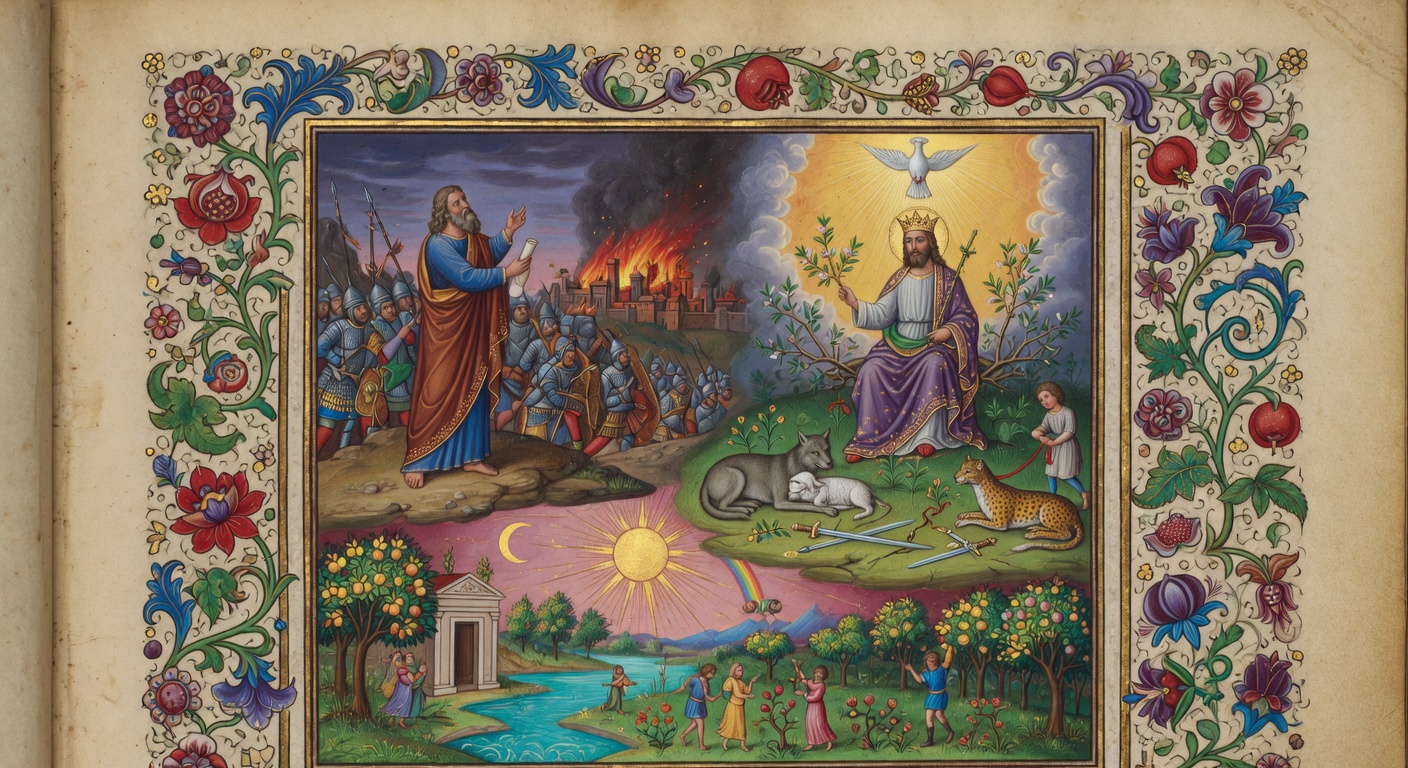
The chapter's portrayal of Babylon grinding meal at the millstone inverts ancient Mesopotamian gender and class norms, where such labor was reserved for female slaves or war captives, underscoring prophetic reversal of imperial privilege.
 1ome down, and sit in the dust, O virgin daughter of Babylon, sit on the ground: there is no throne, O daughter of the Chaldeans: for thou shalt no more be called tender and delicate.
2 Take the millstones, and grind meal: uncover thy locks, make bare the leg, uncover the thigh, pass over the rivers.
3 Thy nakedness shall be uncovered, yea, thy shame shall be seen: I will take vengeance, and I will not meet thee as a man.
4 As for our redeemer, the LORD of hosts is his name, the Holy One of Israel.
5 Sit thou silent, and get thee into darkness, O daughter of the Chaldeans: for thou shalt no more be called, The lady of kingdoms.
6 I was wroth with my people, I have polluted mine inheritance, and given them into thine hand: thou didst shew them no mercy; upon the ancient hast thou very heavily laid thy yoke.
7 And thou saidst, I shall be a lady for ever: so that thou didst not lay these things to thy heart, neither didst remember the latter end of it.
8 Therefore hear now this, thou that art given to pleasures, that dwellest carelessly, that sayest in thine heart, I am, and none else beside me; I shall not sit as a widow, neither shall I know the loss of children:
9 But these two things shall come to thee in a moment in one day, the loss of children, and widowhood: they shall come upon thee in their perfection for the multitude of thy sorceries, and for the great abundance of thine enchantments.
10 For thou hast trusted in thy wickedness: thou hast said, None seeth me. Thy wisdom and thy knowledge, it hath perverted thee; and thou hast said in thine heart, I am, and none else beside me.
11 Therefore shall evil come upon thee; thou shalt not know from whence it riseth: and mischief shall fall upon thee; thou shalt not be able to put it off: and desolation shall come upon thee suddenly, which thou shalt not know.
12 Stand now with thine enchantments, and with the multitude of thy sorceries, wherein thou hast laboured from thy youth; if so be thou shalt be able to profit, if so be thou mayest prevail.
13 Thou art wearied in the multitude of thy counsels. Let now the astrologers, the stargazers, the monthly prognosticators, stand up, and save thee from these things that shall come upon thee.
14 Behold, they shall be as stubble; the fire shall burn them; they shall not deliver themselves from the power of the flame: there shall not be a coal to warm at, nor fire to sit before it.
15 Thus shall they be unto thee with whom thou hast laboured, even thy merchants, from thy youth: they shall wander every one to his quarter; none shall save thee.
← → arrow keys to navigate chapters · spacebar to play/pause audio
Did You Know?
The chapter's portrayal of Babylon grinding meal at the millstone inverts ancient Mesopotamian gender and class norms, where such labor was reserved for female slaves or war captives, underscoring prophetic reversal of imperial privilege.
Verse 6's reference to God having 'polluted' his inheritance by handing Israel to Babylon introduces a rare theological tension, implying divine self-implication in covenant defilement before exacting retribution on the instrument.
The dismissal of Babylonian 'astrologers, stargazers, and monthly prognosticators' targets the empire's state-sponsored celestial divination system, which guided royal decisions via omen texts like Enuma Anu Enlil, rendering their epistemic foundation void.
The double command to 'sit in the dust' and 'sit on the ground' without a throne echoes Ugaritic and Akkadian mourning rites for fallen deities or cities, framing Babylon's fall as a cosmic descent rather than mere political defeat.
The unique clustering of widowhood, childlessness, and sorcery motifs links this oracle to ancient Near Eastern curse formulas against rival goddesses, subverting Babylon's self-identification with Ishtar while evoking covenant lawsuit patterns from Deuteronomy.
Jewish tradition preserved in the Babylonian Talmud and Ascension of Isaiah reports that the prophet was sawn in half under King Manasseh, an execution method possibly alluded to in the list of faithful sufferers in Hebrews 11:37.
After being told by Isaiah that he would die from his illness, Hezekiah prayed and received both a fifteen-year extension of life and the miraculous reversal of the sun's shadow on Ahaz's stairway as a divine sign, details recorded in both 2 Kings 20 and Isaiah 38.
Jesus exclusively taught the crowds in parables to fulfill Isaiah's prophecy of hearing without understanding, reserving explanations for his disciples alone as described in Mark 4.
Three major world religions consider Jerusalem a holy city.
The city fell to Persia in 539 BC exactly as Daniel prophesied. Conquered without a battle.
In this way, Assyria plays a pivotal role in the unfolding redemptive narrative, illustrating both the severity of divine judgment and the breadth of divine compassion.
Commentary & Study Notes Jamieson-Fausset-Brown (1871) · Public Domain in the dust — (See on Isa 3:26; Job 2:13; La 2:10). virgin — that is, heretofore uncaptured [HERODOTUS, 1.191]. daughter of Babylon — Babylon and its inhabitants (see on Isa 1:8; I…
Classic verse-by-verse commentary on Isaiah 47 from Jamieson, Fausset & Brown (1871). Covers: The destruction of Babylon is represented under the image of a royal virgin brought down in a moment from her magnificent throne to the extreme of degradation.
- 1
- in the dust — (See on Isa 3:26; Job 2:13; La 2:10). virgin — that is, heretofore uncaptured [HERODOTUS, 1.191]. daughter of Babylon — Babylon and its inhabitants (see on Isa 1:8; Isa 37:22). no throne — The seat of empire was transferred to Shushan. Alexander intended to have made Babylon his seat of empire, but Providence defeated his design. He soon died; and Seleucia, being built near, robbed it of its inhabitants, and even of its name, which was applied to Seleucia. delicate — alluding to the effeminate debauchery and prostitution of all classes at banquets and religious rites [CURTIUS, 5.1; HERODOTUS, 1.199; BARUCH, 6.43].
- 2
- millstones — like the querns or hand-mills, found in this country, before the invention of water mills and windmills: a convex stone, made by the hand to turn in a concave stone, fitted to receive it, the corn being ground between them: the office of a female slave in the East; most degrading (Job 31:10; Mt 24:41). uncover thy locks — rather, "take off thy veil" [HORSLEY]: perhaps the removal of the plaited hair worn round the women's temples is included; it, too, is a covering (1Co 11:15); to remove it and the veil is the badge of the lowest female degradation; in the East the head is the seat of female modesty; the face of a woman is seldom, the whole head almost never, seen bare (see on Isa 22:8). make bare the leg — rather "lift up (literally, 'uncover'; as in lifting up the train the leg is uncovered) thy flowing train." In Mesopotamia, women of low rank, as occasion requires, wade across the rivers with stript legs, or else entirely put off their garments and swim across. "Exchange thy rich, loose, queenly robe, for the most abject condition, that of one going to and fro through rivers as a slave, to draw water," &c. uncover... thigh — gather up the robe, so as to wade across.
Read all 15 notes on Isaiah 47 →