Psalms 110 KJV
The Lord Says to My Lord
About This Psalm
The most quoted psalm in the NT. The LORD said to my Lord - a messianic prophecy of Christ as priest-king.
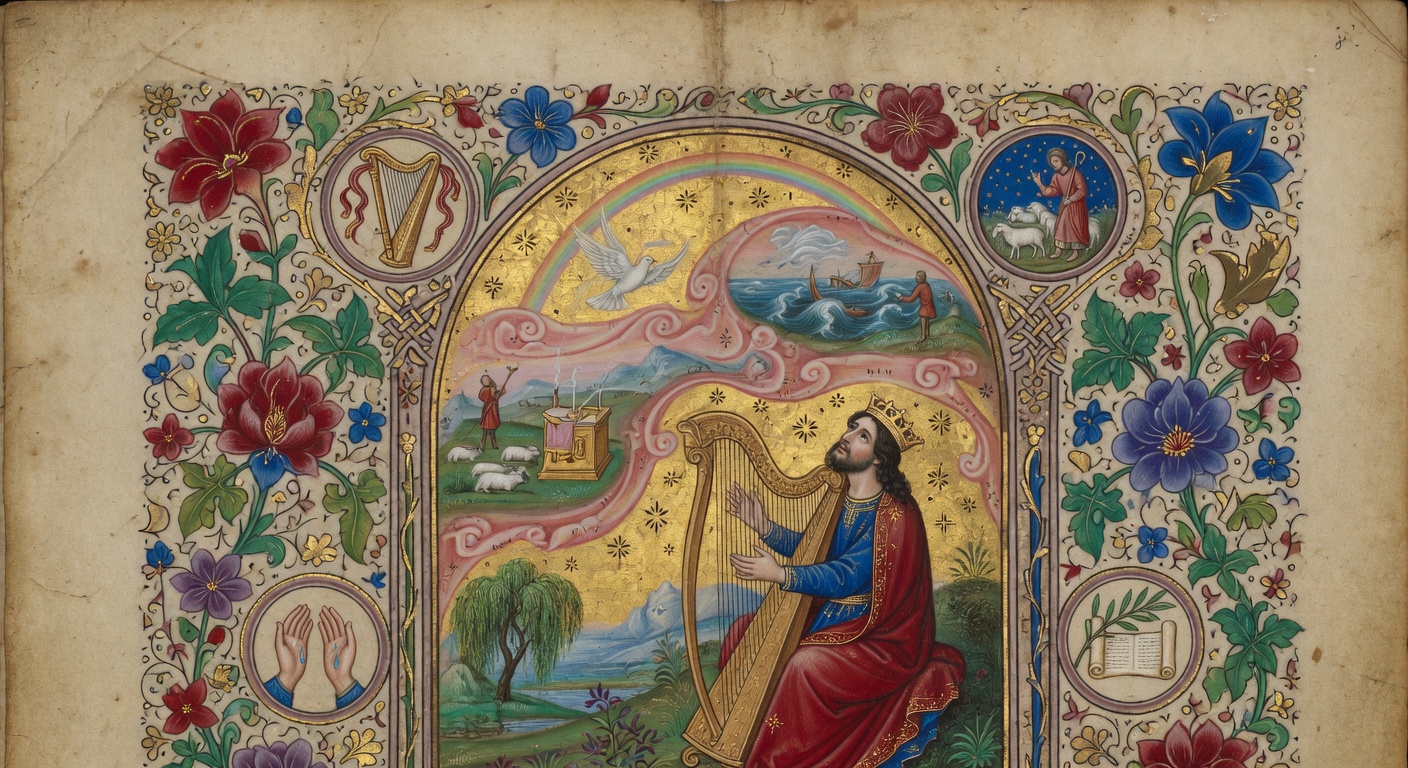
 1he LORD said unto my Lord, Sit thou at my right hand, until I make thine enemies thy footstool.
2 The LORD shall send the rod of thy strength out of Zion: rule thou in the midst of thine enemies.
3 Thy people shall be willing in the day of thy power, in the beauties of holiness from the womb of the morning: thou hast the dew of thy youth.
4 The LORD hath sworn, and will not repent, Thou art a priest for ever after the order of Melchizedek.
5 The Lord at thy right hand shall strike through kings in the day of his wrath.
6 He shall judge among the heathen, he shall fill the places with the dead bodies; he shall wound the heads over many countries.
7 He shall drink of the brook in the way: therefore shall he lift up the head.
← → arrow keys to navigate chapters · spacebar to play/pause audio
Did You Know?
Psalm 110 uniquely fuses Davidic kingship with an eternal Melchizedekian priesthood, a combination absent from other royal psalms and later invoked in Hebrews to argue that Jesus transcends Levitical limitations.
The opening oracle reverses ancient Near Eastern protocol by seating the Davidic king at YHWH's right hand, a position normally reserved for the deity's vizier or warrior god, thereby elevating the human ruler to co-regent status.
Verse 3's enigmatic phrase 'the dew of thy youth' echoes Ugaritic and Egyptian motifs of divine generation through morning dew, suggesting the king's perpetual vitality originates from heavenly rather than earthly succession.
The psalm's closing image of the king drinking from a brook 'in the way' alludes to a post-battle purification rite attested in Canaanite texts, transforming a local Jerusalem custom into a foreshadowing of messianic triumph.
Despite traditional Davidic attribution, the psalm's silence on Zion theology and its focus on an international priest-king points to composition during the united monarchy's engagement with Jebusite royal ideology in pre-Israelite Jerusalem.
While fleeing Saul, David sought refuge among the Philistines and feigned madness before King Achish of Gath by scribbling on the city gates and letting saliva run down his beard, successfully avoiding recognition.
Solomon conscripted 30,000 Israelite men for monthly rotations of forced labor in Lebanon to harvest cedar and cypress timber for the temple, while assigning an additional 150,000 Canaanite laborers to quarry and transport stone, reflecting the ancient Near Eastern practice of corvée labor systems.
The New Testament further develops this imagery to portray the heavenly Jerusalem where believers gather to the living God.
Jerusalem sits at about 2,500 feet elevation. Higher than most surrounding areas.
Commentary & Study Notes Jamieson-Fausset-Brown (1871) · Public Domain The Lord said — literally, "A saying of the Lord," (compare Ps 36:1), a formula, used in prophetic or other solemn or express declarations. my Lord — That the Jews understood this…
Classic verse-by-verse commentary on Psalms 110 from Jamieson, Fausset & Brown (1871). Covers: The explicit application of this psalm to our saviour, by him (mt 22:42-45) and by the apostles (ac 2:34; 1co 15:25; Heb 1:13), and their frequent reference to its language and purport (eph 1:20-22; Php 2:9-11; Heb 10:12, 13), leave no doubt of its purely prophetic character. Not only was there nothing in the position or character, personal or official, of David or any other descendant, to justify a reference to either, but utter severance from the royal office of all priestly functions (so clearly assigned the subject of this psalm) positively forbids such a reference. The psalm celebrates the exaltation of Christ to the throne of an eternal and increasing kingdom, and a perpetual priesthood (zec 6:13), involving the subjugation of his enemies and the multiplication of his subjects, and rendered infallibly certain by the word and oath of almighty God.
- 1
- The Lord said — literally, "A saying of the Lord," (compare Ps 36:1), a formula, used in prophetic or other solemn or express declarations. my Lord — That the Jews understood this term to denote the Messiah their traditions show, and Christ's mode of arguing on such an assumption (Mt 22:44) also proves. Sit... at my right hand — not only a mark of honor (1Ki 2:19), but also implied participation of power (Ps 45:9; Mr 16:19; Eph 1:20). Sit — as a king (Ps 29:10), though the position rather than posture is intimated (compare Ac 7:55, 56). until I make, &c. — The dominion of Christ over His enemies, as commissioned by God, and entrusted with all power (Mt 28:18) for their subjugation, will assuredly be established (1Co 15:24-28). This is neither His government as God, nor that which, as the incarnate Saviour, He exercises over His people, of whom He will ever be Head. thine enemies thy footstool — an expression taken from the custom of Eastern conquerors (compare Jos 10:24; Jud 1:7) to signify a complete subjection.
- 2
- the rod of thy strength — the rod of correction (Isa 9:4; 10:15; Jer 48:12), by which Thy strength will be known. This is His Word of truth (Isa 2:3; 11:4), converting some and confounding others (compare 2Th 2:8). out of Zion — or, the Church, in which God dwells by His Spirit, as once by a visible symbol in the tabernacle on Zion (compare Ps 2:6). rule thou, &c. — over enemies now conquered. in the midst — once set upon, as by ferocious beasts (Ps 22:16), now humbly, though reluctantly, confessed as Lord (Php 2:10, 11).
Read all 7 notes on Psalms 110 →