Psalms 40 KJV
A Song of Praise and Prayer
About This Psalm
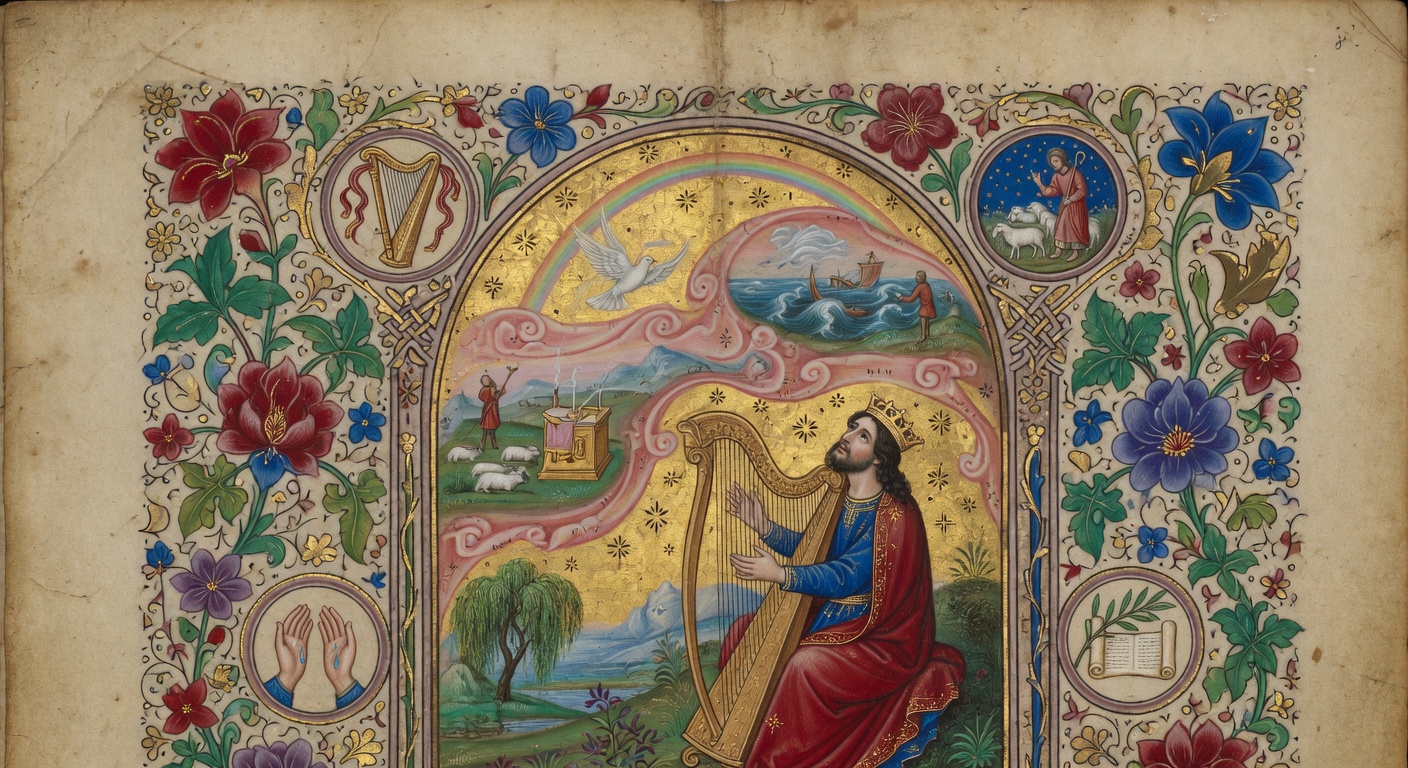
Waiting patiently for God and being rewarded. He lifted me out of the pit and put a new song in my mouth.
 1 waited patiently for the LORD; and he inclined unto me, and heard my cry.
2 He brought me up also out of an horrible pit, out of the miry clay, and set my feet upon a rock, and established my goings.
3 And he hath put a new song in my mouth, even praise unto our God: many shall see it, and fear, and shall trust in the LORD.
4 Blessed is that man that maketh the LORD his trust, and respecteth not the proud, nor such as turn aside to lies.
5 Many, O LORD my God, are thy wonderful works which thou hast done, and thy thoughts which are to us-ward: they cannot be reckoned up in order unto thee: if I would declare and speak of them, they are more than can be numbered.
6 Sacrifice and offering thou didst not desire; mine ears hast thou opened: burnt offering and sin offering hast thou not required.
7 Then said I, Lo, I come: in the volume of the book it is written of me,
8 I delight to do thy will, O my God: yea, thy law is within my heart.
9 I have preached righteousness in the great congregation: lo, I have not refrained my lips, O LORD, thou knowest.
10 I have not hid thy righteousness within my heart; I have declared thy faithfulness and thy salvation: I have not concealed thy lovingkindness and thy truth from the great congregation.
11 Withhold not thou thy tender mercies from me, O LORD: let thy lovingkindness and thy truth continually preserve me.
12 For innumerable evils have compassed me about: mine iniquities have taken hold upon me, so that I am not able to look up; they are more than the hairs of mine head: therefore my heart faileth me.
13 Be pleased, O LORD, to deliver me: O LORD, make haste to help me.
14 Let them be ashamed and confounded together that seek after my soul to destroy it; let them be driven backward and put to shame that wish me evil.
15 Let them be desolate for a reward of their shame that say unto me, Aha, aha.
16 Let all those that seek thee rejoice and be glad in thee: let such as love thy salvation say continually, The LORD be magnified.
17 But I am poor and needy; yet the Lord thinketh upon me: thou art my help and my deliverer; make no tarrying, O my God.
← → arrow keys to navigate chapters · spacebar to play/pause audio
Did You Know?
The phrase 'mine ears hast thou opened' in verse 6 alludes to the ritual of boring a servant's ear in Exodus 21:6, reframing obedience to God as voluntary, lifelong servitude rather than mere ritual compliance.
Verses 6-8 are quoted verbatim in Hebrews 10:5-7 but with the Septuagint's 'a body hast thou prepared me' instead of 'mine ears hast thou opened,' enabling the author to present Christ as the ultimate obedient servant who supersedes the sacrificial system.
Psalm 40:13-17 is reproduced almost word-for-word as the entirety of Psalm 70, indicating that an editor of the Psalter likely extracted a lament segment to create a standalone communal prayer for urgent deliverance.
The 'horrible pit' and 'miry clay' of verse 2 echo both Mesopotamian descent-to-the-underworld motifs and the literal cisterns used as prisons in the ancient Near East, layering David's personal rescue with cosmic overtones of resurrection from Sheol.
By juxtaposing the rejection of sacrifice (vv. 6-8) with the command to proclaim God's righteousness in the great congregation (vv. 9-10), the psalm anticipates the prophetic critique in 1 Samuel 15:22 and Hosea 6:6 while modeling verbal testimony as the true response to grace.
While fleeing Saul, David sought refuge among the Philistines and feigned madness before King Achish of Gath by scribbling on the city gates and letting saliva run down his beard, successfully avoiding recognition.
Solomon conscripted 30,000 Israelite men for monthly rotations of forced labor in Lebanon to harvest cedar and cypress timber for the temple, while assigning an additional 150,000 Canaanite laborers to quarry and transport stone, reflecting the ancient Near Eastern practice of corvée labor systems.
In the prophetic writings it stands as the center of God's redemptive plan, embodying covenant faithfulness and the expectation of a coming Messiah who would rule from Zion in justice and peace.
Jerusalem is mentioned over 800 times in the Bible. More than any other city.
Commentary & Study Notes Jamieson-Fausset-Brown (1871) · Public Domain The figures for deep distress are illustrated in Jeremiah's history (Jer 38:6-12). Patience and trust manifested in distress, deliverance in answer to prayer, and the blessed effec…
Classic verse-by-verse commentary on Psalms 40 from Jamieson, Fausset & Brown (1871). Covers: In this psalm a celebration of God's deliverance is followed by a profession of devotion to his service. Then follows a prayer for relief from imminent dangers, involving the overthrow of enemies and the rejoicing of sympathizing friends. In heb 10:5, &c., paul quotes ps 40:6-8 as the words of Christ, offering himself as a better sacrifice. Some suppose paul thus accommodated David's words to express Christ's sentiments. But the value of his quotation would be thus destroyed, as it would have no force in his argument, unless regarded by his readers as the original sense of the passage in the old testament. Others suppose the psalm describes David's feelings in suffering and joy; But the language quoted by paul, in the sense given by him, could not apply to David in any of his relations, for as a type the language is not adapted to describe any event or condition of David's career, and as an individual representing the pious generally, neither he nor they could properly use it (see on ps 40:7, below). The psalm must be taken then, as the sixteenth, to express the feelings of Christ's human nature. The difficulties pertinent to this view will be considered as they occur.
- 1-3
- The figures for deep distress are illustrated in Jeremiah's history (Jer 38:6-12). Patience and trust manifested in distress, deliverance in answer to prayer, and the blessed effect of it in eliciting praise from God's true worshippers, teach us that Christ's suffering is our example, and His deliverance our encouragement (Heb 5:7, 8; 12:3; 1Pe 4:12-16). inclined — (the ear, Ps 17:6), as if to catch the faintest sigh.
- 3
- a new song — (See on Ps 33:3). fear, and... trust — revere with love and faith.
Read all 14 notes on Psalms 40 →