Psalms 43 KJV
A Prayer for Vindication
About This Psalm
Send out your light and truth - let them lead me back to you. A short prayer for guidance when you feel cut off from God.
 1udge me, O God, and plead my cause against an ungodly nation: O deliver me from the deceitful and unjust man.
2 For thou art the God of my strength: why dost thou cast me off? why go I mourning because of the oppression of the enemy?
3 O send out thy light and thy truth: let them lead me; let them bring me unto thy holy hill, and to thy tabernacles.
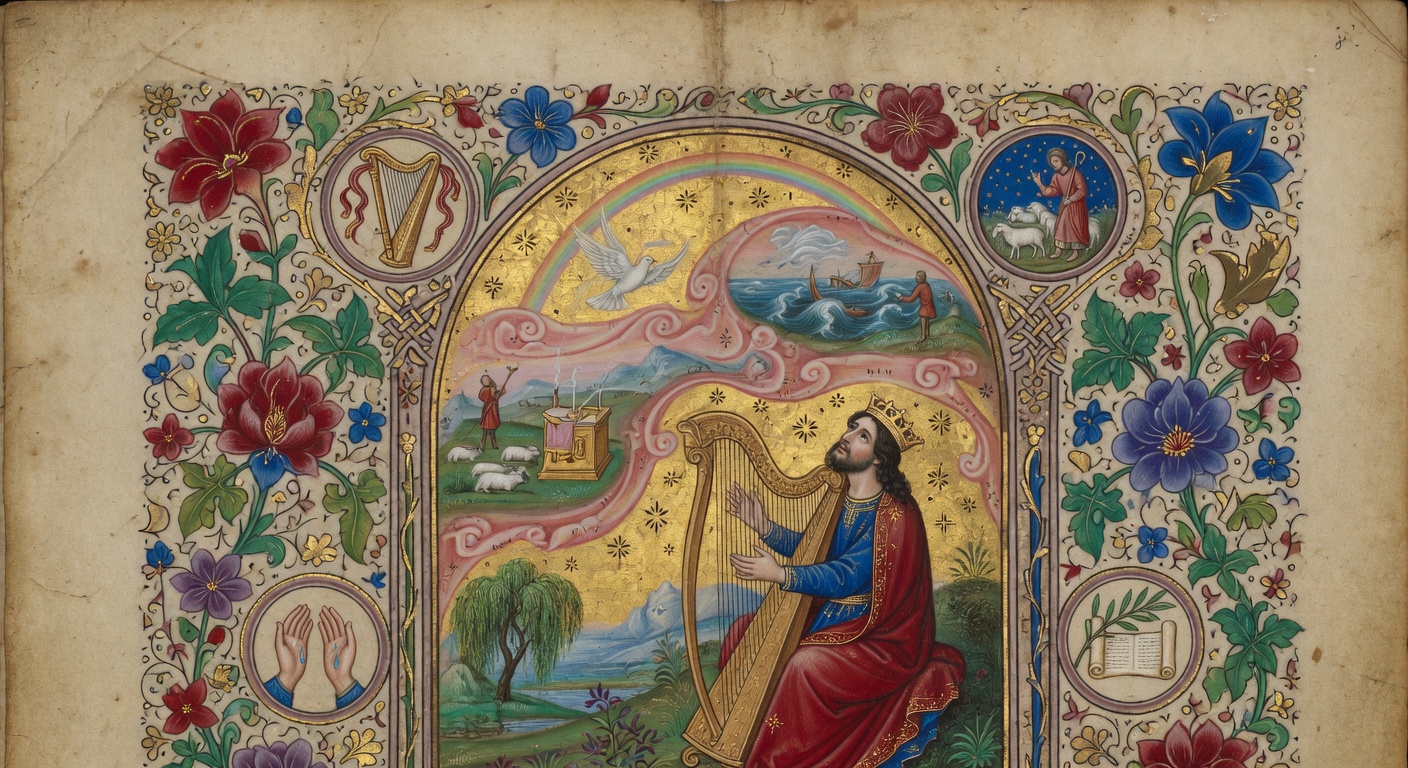
4 Then will I go unto the altar of God, unto God my exceeding joy: yea, upon the harp will I praise thee, O God my God.
5 Why art thou cast down, O my soul? and why art thou disquieted within me? hope in God: for I shall yet praise him, who is the health of my countenance, and my God.
← → arrow keys to navigate chapters · spacebar to play/pause audio
Did You Know?
Psalm 43 lacks any superscription in the Masoretic Text, a rarity that signals it was composed as an integral continuation of Psalm 42 rather than a standalone work.
The psalm personifies divine 'light' and 'truth' as active emissaries dispatched to escort the suppliant to the sanctuary, echoing ancient Near Eastern motifs of guiding divine attributes.
Unlike most lament psalms seeking vindication, it contains no imprecatory language against enemies, directing all attention toward restored temple access instead.
The threefold refrain shared with Psalm 42 functions as a liturgical hinge, allowing the piece to be performed antiphonally between soloist and choir in ancient worship.
The plural 'tabernacles' in verse 4 may reflect post-exilic awareness of the multiple temple courts or structures, hinting at a date after the return from Babylon.
David twice spared Saul's life in the wilderness, once cutting off a piece of his robe in the En Gedi cave and later removing his spear and water jug while he slept, demonstrating restraint amid pursuit.
The Queen of Sheba traveled roughly 1,200 miles from her Arabian kingdom with a caravan of camels carrying spices, gold, and stones to test Solomon's wisdom with riddles, then exchanged lavish gifts including 120 talents of gold that funded further temple adornments.
In the prophetic writings it stands as the center of God's redemptive plan, embodying covenant faithfulness and the expectation of a coming Messiah who would rule from Zion in justice and peace.
Three major world religions consider Jerusalem a holy city.
Commentary & Study Notes Jamieson-Fausset-Brown (1871) · Public Domain Judge — or, "vindicate" (Ps 10:18). plead, &c. — (Ps 35:1). ungodly — neither in character or condition objects of God's favor (compare Ps 4:3).
Classic verse-by-verse commentary on Psalms 43 from Jamieson, Fausset & Brown (1871). Covers: Excepting the recurrence of the refrain, there is no good reason to suppose this a part of the preceding, though the scope is the same. It has always been placed separate.
- 1
- Judge — or, "vindicate" (Ps 10:18). plead, &c. — (Ps 35:1). ungodly — neither in character or condition objects of God's favor (compare Ps 4:3).
- 2
- God of my strength — by covenant relation my stronghold (Ps 18:1). cast me off — in scorn. because — or, "in," that is, in such circumstances of oppression.
Read all 4 notes on Psalms 43 →