Psalms 45 KJV
A Royal Wedding Song
About This Psalm
A royal wedding song - the king and his bride. Traditionally read as Christ and His church. Love poetry with eternal significance.
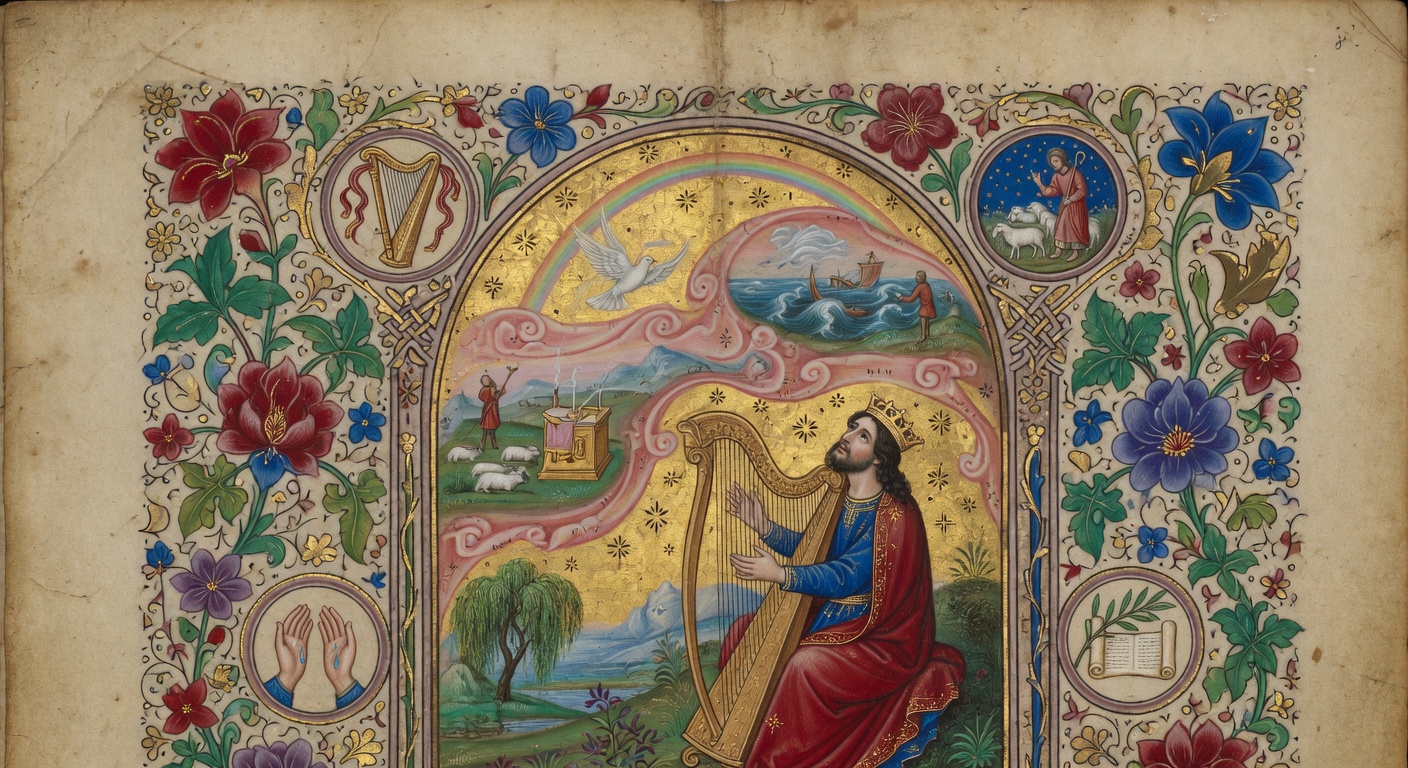
 1y heart is inditing a good matter: I speak of the things which I have made touching the king: my tongue is the pen of a ready writer.
2 Thou art fairer than the children of men: grace is poured into thy lips: therefore God hath blessed thee for ever.
3 Gird thy sword upon thy thigh, O most mighty, with thy glory and thy majesty.
4 And in thy majesty ride prosperously because of truth and meekness and righteousness; and thy right hand shall teach thee terrible things.
5 Thine arrows are sharp in the heart of the king’s enemies; whereby the people fall under thee.
6 Thy throne, O God, is for ever and ever: the sceptre of thy kingdom is a right sceptre.
7 Thou lovest righteousness, and hatest wickedness: therefore God, thy God, hath anointed thee with the oil of gladness above thy fellows.
8 All thy garments smell of myrrh, and aloes, and cassia, out of the ivory palaces, whereby they have made thee glad.
9 Kings’ daughters were among thy honourable women: upon thy right hand did stand the queen in gold of Ophir.
10 Hearken, O daughter, and consider, and incline thine ear; forget also thine own people, and thy father’s house;
11 So shall the king greatly desire thy beauty: for he is thy Lord; and worship thou him.
12 And the daughter of Tyre shall be there with a gift; even the rich among the people shall intreat thy favour.
13 The king’s daughter is all glorious within: her clothing is of wrought gold.
14 She shall be brought unto the king in raiment of needlework: the virgins her companions that follow her shall be brought unto thee.
15 With gladness and rejoicing shall they be brought: they shall enter into the king’s palace.
16 Instead of thy fathers shall be thy children, whom thou mayest make princes in all the earth.
17 I will make thy name to be remembered in all generations: therefore shall the people praise thee for ever and ever.
← → arrow keys to navigate chapters · spacebar to play/pause audio
Did You Know?
The direct address to the king as 'O God' in verse 6 stands out as the clearest instance in the Hebrew Bible where a human ruler receives divine language, later leveraged in Hebrews 1 to argue Christ's superiority over angels.
The reference to 'ivory palaces' aligns with archaeological finds of Samaria's 8th-century ivory carvings, pointing to possible composition during the Omride dynasty and its Phoenician alliances rather than Solomon's era.
The bride is instructed to 'forget also thine own people and thy father's house,' a phrase that deliberately echoes the Abrahamic call narrative and frames royal marriage as a covenantal rupture akin to Israel's separation from surrounding nations.
Though attributed to the sons of Korah, whose psalms usually emphasize temple liturgy or communal lament, this one uniquely adopts the voice of a court poet delivering a secular wedding ode later canonized as scripture.
The king's 'arrows' that are 'sharp in the heart of the king's enemies' draw on ancient Near Eastern divine-warrior iconography, yet the psalm immediately pivots to eternal righteousness, creating tension between martial conquest and moral rule absent in typical ANE parallels.
While fleeing Saul, David sought refuge among the Philistines and feigned madness before King Achish of Gath by scribbling on the city gates and letting saliva run down his beard, successfully avoiding recognition.
Solomon conscripted 30,000 Israelite men for monthly rotations of forced labor in Lebanon to harvest cedar and cypress timber for the temple, while assigning an additional 150,000 Canaanite laborers to quarry and transport stone, reflecting the ancient Near Eastern practice of corvée labor systems.
This location became the focal point of national worship and divine promises, later extending symbolically to encompass the Temple Mount where Solomon built the house of the Lord.
The city has been destroyed at least twice, besieged 23 times, and captured 44 times.
Commentary & Study Notes Jamieson-Fausset-Brown (1871) · Public Domain An animated preface indicative of strong emotion. Literally, "My heart overflows: a good matter I speak; the things which I have made," &c. inditing — literally, "boiling up,"…
Classic verse-by-verse commentary on Psalms 45 from Jamieson, Fausset & Brown (1871). Covers: Shoshannim--literally, "lilies," either descriptive of an instrument so shaped, or denoting some tune or air so called, after which the psalm was to be sung (see on ps 8:1, title). A song of loves, or, of beloved ones (plural and feminine)--a conjugal song. Maschil--(see on ps 32:1, title, and ps 42:1, title) denotes the didactic character of the psalm; That it gives instruction, the song being of allegorical, and not literal, import. The union and glories of Christ and his church are described. He is addressed as a king possessed of all essential graces, as a conqueror exalted on the throne of a righteous and eternal government, and as a bridegroom arrayed in nuptial splendor. The church is portrayed in the purity and loveliness of a royally adorned and attended bride, invited to forsake her home and share the honors of her affianced Lord. The picture of an oriental wedding thus opened is filled up by representing the complimentary gifts of the wealthy with which the occasion is honored, the procession of the bride clothed in splendid raiment, attended by her virgin companions, and the entrance of the joyous throng into the palace of the king. A prediction of a numerous and distinguished progeny, instead of the complimentary wish for it usually expressed (compare ge 24:60; Ru 4:11, 12), and an assurance of a perpetual fame, closes the psalm. All ancient jewish and christian interpreters regarded this psalm as an allegory of the purport above named. In the song of songs the allegory is carried out more fully. Hosea (ho 1:1-3:5) treats the relation of God and his people under the same figure, and its use to set forth the relation of Christ and his church runs through both parts of the bible (compare isa 54:5; 62:4, 5; Mt 22:3; 25:1; Joh 3:29; Eph 5:25-32, &c.). Other methods of exposition have been suggested. Several jewish monarchs, from solomon to the wicked ahab, and various foreign princes, have been named as the hero of the song. But to none of them can the terms here used be shown to apply, and it is hardly probable that any mere nuptial song, especially of a heathen king, would be permitted a place in the sacred songs of the jews. The advocates for any other than the messianic interpretation have generally silenced each other in succession, while the application of the most rigorous rules of a fair system of interpretation has but strengthened the evidences in its favor. The scope of the psalm above given is easy and sustained by the explication of its details. The quotation of ps 45:6, 7 by paul (heb 1:8, 9), as applicable to Christ, ought to be conclusive, and their special exposition shows the propriety of such an application.
- 1
- An animated preface indicative of strong emotion. Literally, "My heart overflows: a good matter I speak; the things which I have made," &c. inditing — literally, "boiling up," as a fountain overflows. my tongue is the pen — a mere instrument of God's use. of a ready writer — that is, it is fluent. The theme is inspiring and language flows fast.
- 2
- To rich personal attractions is added grace of the lips, captivating powers of speech. This is given, and becomes a source of power and proves a blessing. Christ is a prophet (Lu 4:22).
Read all 16 notes on Psalms 45 →