2 Chronicles 16 KJV
Asa's Final Years
Asa's Final Years
Hanani's rebuke explicitly ties Asa's Syrian alliance to the earlier victory over the Cushites and Lubims, framing reliance on foreign kings as a direct repudiation of the covenant faithfulness that once brought divine deliverance.
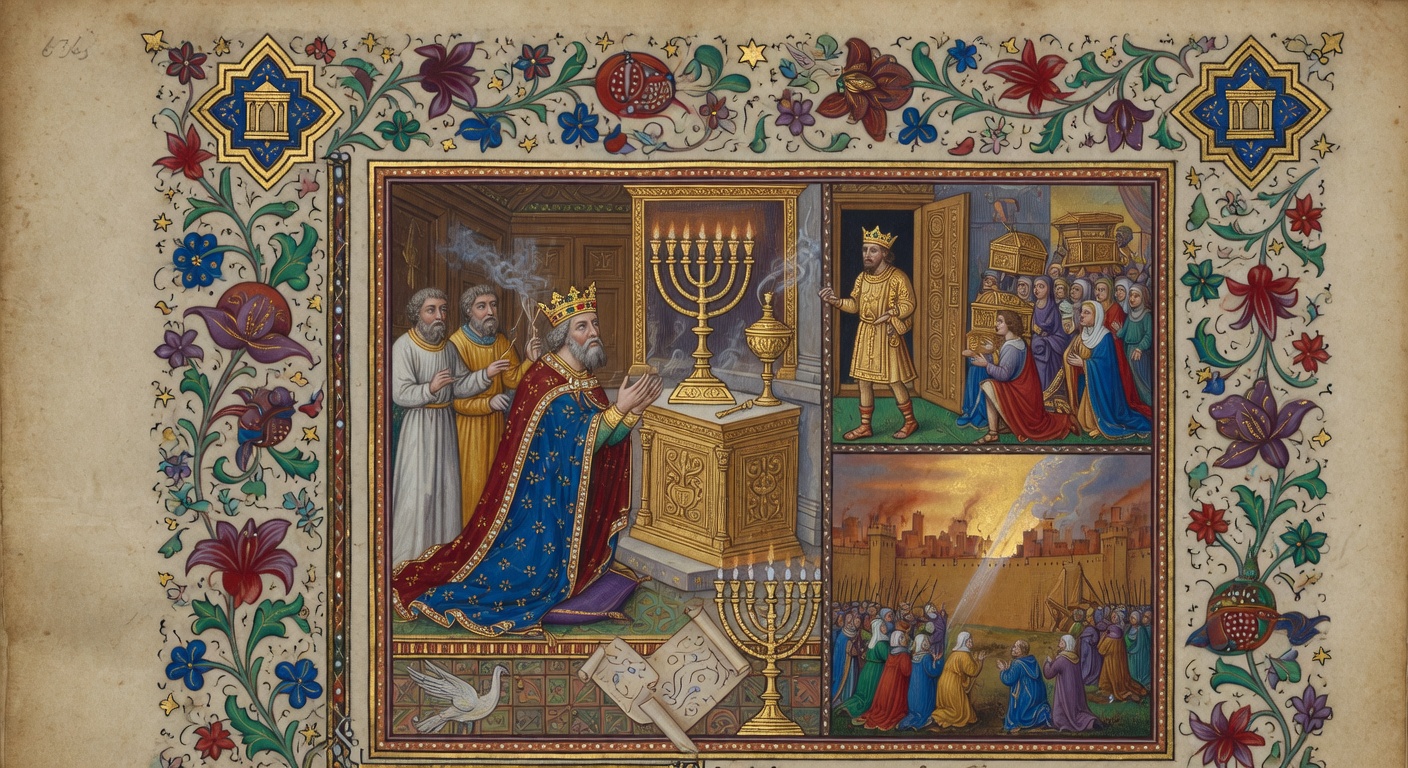
 1n the six and thirtieth year of the reign of Asa Baasha king of Israel came up against Judah, and built Ramah, to the intent that he might let none go out or come in to Asa king of Judah.
2 Then Asa brought out silver and gold out of the treasures of the house of the LORD and of the king’s house, and sent to Benhadad king of Syria, that dwelt at Damascus, saying,
3 There is a league between me and thee, as there was between my father and thy father: behold, I have sent thee silver and gold; go, break thy league with Baasha king of Israel, that he may depart from me.
4 And Benhadad hearkened unto king Asa, and sent the captains of his armies against the cities of Israel; and they smote Ijon, and Dan, and Abelmaim, and all the store cities of Naphtali.
5 And it came to pass, when Baasha heard it, that he left off building of Ramah, and let his work cease.
6 Then Asa the king took all Judah; and they carried away the stones of Ramah, and the timber thereof, wherewith Baasha was building; and he built therewith Geba and Mizpah.
7 And at that time Hanani the seer came to Asa king of Judah, and said unto him, Because thou hast relied on the king of Syria, and not relied on the LORD thy God, therefore is the host of the king of Syria escaped out of thine hand.
8 Were not the Ethiopians and the Lubims a huge host, with very many chariots and horsemen? yet, because thou didst rely on the LORD, he delivered them into thine hand.
9 For the eyes of the LORD run to and fro throughout the whole earth, to shew himself strong in the behalf of them whose heart is perfect toward him. Herein thou hast done foolishly: therefore from henceforth thou shalt have wars.
10 Then Asa was wroth with the seer, and put him in a prison house; for he was in a rage with him because of this thing. And Asa oppressed some of the people the same time.
11 And, behold, the acts of Asa, first and last, lo, they are written in the book of the kings of Judah and Israel.
12 And Asa in the thirty and ninth year of his reign was diseased in his feet, until his disease was exceeding great: yet in his disease he sought not to the LORD, but to the physicians.
13 And Asa slept with his fathers, and died in the one and fortieth year of his reign.
14 And they buried him in his own sepulchres, which he had made for himself in the city of David, and laid him in the bed which was filled with sweet odours and divers kinds of spices prepared by the apothecaries’ art: and they made a very great burning for him.
← → arrow keys to navigate chapters · spacebar to play/pause audio
Did You Know?
Hanani's rebuke explicitly ties Asa's Syrian alliance to the earlier victory over the Cushites and Lubims, framing reliance on foreign kings as a direct repudiation of the covenant faithfulness that once brought divine deliverance.
The chapter presents one of the few cases in Chronicles of a Judahite king imprisoning a prophet, with Asa's rage against Hanani illustrating how political expediency can escalate into active suppression of divine warning.
By emptying temple and palace treasuries to bribe Ben-hadad, Asa diverts resources originally associated with sacred dedication, revealing a reversal from his earlier temple-restoration zeal to treating holy stores as diplomatic currency.
The unique Chronicler addition of Hanani's speech invokes the motif of the Lord's 'eyes running to and fro' throughout the earth, underscoring a theology of continual divine scrutiny that rewards or judges the heart's integrity in real time.
Asa's foot disease, treated solely through physicians rather than seeking the Lord, functions as a physical emblem of his spiritual condition, with the two-year affliction marking the final stage of a king whose earlier reforms had given way to self-reliance.
Faced with an invasion by Zerah the Cushite commanding one million troops and three hundred chariots, Asa cried out to God for deliverance and routed the vastly superior force near Mareshah, seizing enormous spoil.
Biblical tradition attributes 3,000 proverbs and 1,005 songs to Solomon, along with expertise in botany and zoology covering everything from cedar trees to hyssop and from livestock to birds, fish, and reptiles, yet only fragments survive in Proverbs, Ecclesiastes, and Song of Songs.
To withstand Sennacherib's siege, Hezekiah commissioned a 533-meter tunnel carved through bedrock to channel the Gihon Spring inside Jerusalem's walls, an engineering project whose original Hebrew inscription was recovered in 1880 and confirms the biblical account in 2 Kings 20.
The scroll discovered by high priest Hilkiah during temple repairs prompted Josiah to consult the prophetess Huldah rather than any male prophet, and her oracle both confirmed coming judgment on Judah and promised Josiah a peaceful death because of his responsive humility.
Jerusalem is mentioned over 800 times in the Bible. More than any other city.
In the prophetic writings it stands as the center of God's redemptive plan, embodying covenant faithfulness and the expectation of a coming Messiah who would rule from Zion in justice and peace.
Babylon's walls were reportedly wide enough for two chariots to pass side by side.
Commentary & Study Notes Jamieson-Fausset-Brown (1871) · Public Domain In the six and thirtieth year of the reign of Asa, Baasha... came up against Judah — Baasha had died several years before this date (1Ki 15:33), and the best biblical critics are a…
Classic verse-by-verse commentary on 2 Chronicles 16 from Jamieson, Fausset & Brown (1871). Covers: Asa, by a league with the syrians, diverts baasha from building ramah.
- 1-6
- In the six and thirtieth year of the reign of Asa, Baasha... came up against Judah — Baasha had died several years before this date (1Ki 15:33), and the best biblical critics are agreed in considering this date to be calculated from the separation of the kingdoms, and coincident with the sixteenth year of Asa's reign. This mode of reckoning was, in all likelihood, generally followed in the book of the kings of Judah and Israel, the public annals of the time (2Ch 16:11), the source from which the inspired historian drew his account. Baasha... built Ramah — that is, fortified it. The blessing of God which manifestly rested at this time on the kingdom of Judah, the signal victory of Asa, the freedom and purity of religious worship, and the fame of the late national covenant, were regarded with great interest throughout Israel, and attracted a constantly increasing number of emigrants to Judah. Baasha, alarmed at this movement, determined to stem the tide; and as the high road to and from Jerusalem passed by Ramah, he made that frontier town, about six miles north of Asa's capital, a military station, where the vigilance of his sentinels would effectually prevent all passage across the boundary of the kingdom (see on 1Ki 15:16-22; also Jer 41:9).
- 4
- Ben-hadad... sent the captains of his armies... and they smote... Abelmaim — "The meadow of waters," supposed to have been situated on the marshy plain near the uppermost lake of the Jordan. The other two towns were also in the northern district of Palestine. These unexpected hostilities of his Syrian ally interrupted Baasha's fortifications at Ramah, and his death, happening soon after, prevented his resuming them.
Read all 6 notes on 2 Chronicles 16 →