Uzziah (Azariah)
Ask about Uzziah (Azariah)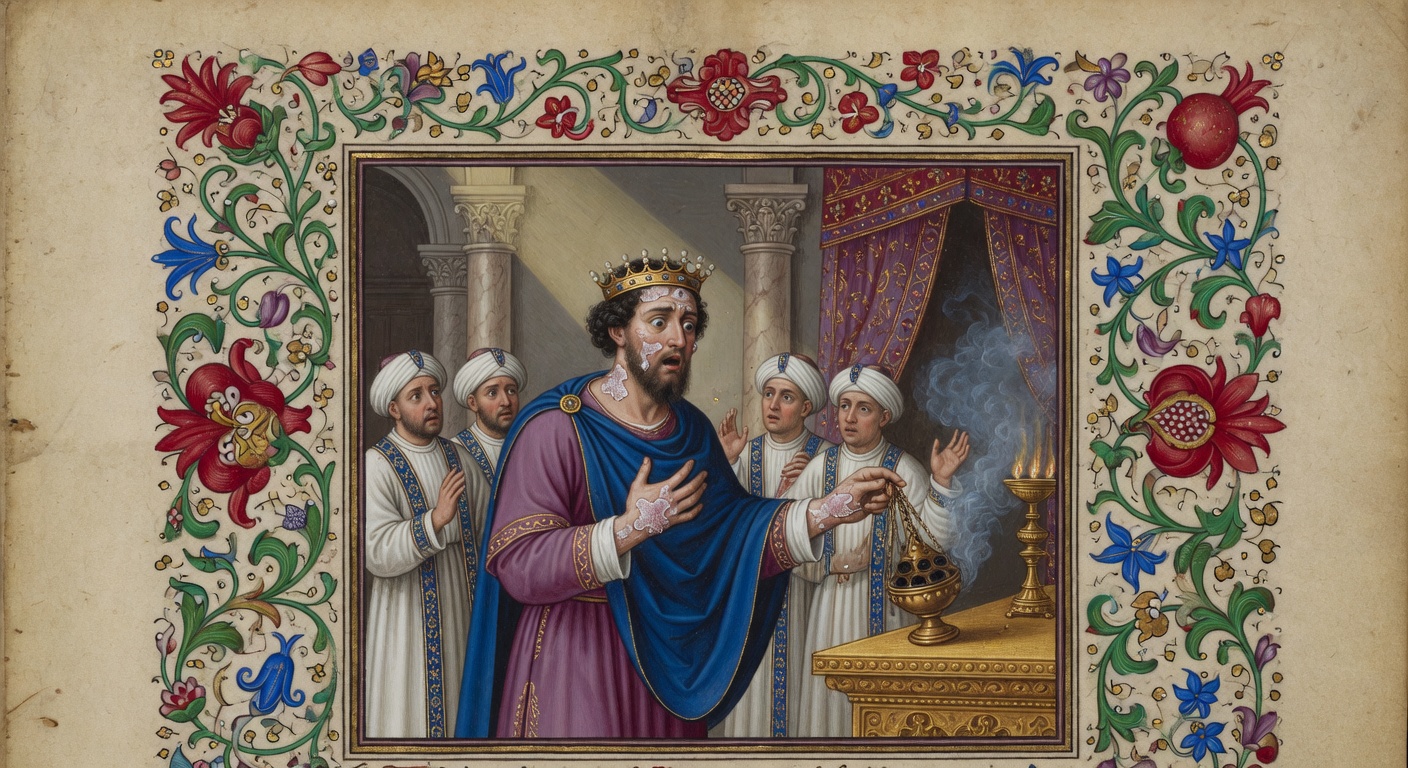
Uzziah, also known as Azariah, reigned over Judah for fifty-two years and initially walked in the ways of the Lord, strengthening the kingdom through military success and agricultural development. His story turns when pride prompted him to enter the temple sanctuary and burn incense, an act belonging only to the consecrated priests, which brought immediate judgment in the form of leprosy upon his forehead. This affliction set him apart from the house of the Lord and from his people for the remainder of his life, underscoring how even a mostly faithful king could trespass sacred boundaries and thereby illustrate the need for a mediator who would perfectly honor both kingship and priesthood.
Biography
- Born
- c. 809 BC, Jerusalem
- Died
- c. 740 BC, Jerusalem
- Age
- 68 years
- Occupation
- King of Judah
- Tribe
- Judah
- Father
- Amaziah
- Mother
- Jecoliah
- Children
- Jotham
- Era
- Divided Kingdom (c. 792-740 BC)
- Nationality
- Israelite (Judah)
- Also Known As
- Azariah
Family
Did You Know?
Uzziah engineered innovative war machines, including catapult-like devices mounted on Jerusalem's towers and corners that could hurl arrows and massive stones, a technological advancement credited to his personal oversight in 2 Chronicles 26:15.
Despite ruling for 52 years, Uzziah spent his final decade in isolation due to leprosy, yet continued to influence policy indirectly while his son Jotham served as co-regent handling daily affairs.
Uzziah's agricultural projects included hewing cisterns in the Negev wilderness and establishing royal vineyards and livestock operations in the Judean foothills, dramatically expanding the kingdom's food production and wealth.
The seismic event during Uzziah's reign, referenced in Amos 1:1, likely coincided with the moment he was struck with leprosy inside the temple, an earthquake so significant it was still recalled centuries later.
An ancient limestone plaque discovered in 1931 near the Mount of Olives bears an Aramaic inscription noting the relocation of Uzziah's bones, providing extrabiblical confirmation of his burial practices and the enduring memory of his afflicted end.
Uzziah engineered innovative siege equipment including catapults mounted on towers that could hurl both arrows and heavy stones, devices crafted by skilled artisans to strengthen Jerusalem's defenses during the Divided Kingdom period.
While 2 Chronicles records that Uzziah dug numerous cisterns in the wilderness and promoted large-scale agriculture and viticulture, royal lmlk-type seals bearing his name have been unearthed on wine-jar handles, confirming his economic reach.
Uzziah's 52-year reign began when he was only sixteen, and after contracting leprosy he was forced to live in isolation while his son Jotham governed as co-regent, a detail that explains the overlapping royal chronologies in 2 Kings.
The year of Uzziah's death (c. 740 BC) is the precise historical marker for Isaiah's temple vision in Isaiah 6:1, linking the king's mortality to the prophet's commissioning amid Judah's shifting political fortunes.
A first-century stone plaque discovered on the Mount of Olives bears the Aramaic inscription 'To the bones of Uzziah, king of Judah, rest here,' evidencing that later Jews still honored the long-deceased monarch by relocating his remains.
Key Chapters
Key Passages
Uzziah's Pride and Leprosy
2 Chronicles 26:16-21
This passage shows how pride can blind us to God’s boundaries, inviting painful consequences that call us back to humble dependence on Him.
 16ut when he was strong, his heart was lifted up to his destruction: for he transgressed against the LORD his God, and went into the temple of the LORD to burn incense upon the altar of incense.
Uzziah's Prosperity
2 Chronicles 26:4-15
This passage reveals how wholehearted devotion to God brings practical blessing, strength, and wise success in every area of life.
 4nd he did that which was right in the sight of the LORD, according to all that his father Amaziah did.
In the Year King Uzziah Died
Isaiah 6:1
This passage shows that even amid loss and earthly change, God remains the unchanging King who draws us closer to Himself.
 1n the year that king Uzziah died I saw also the LORD sitting upon a throne, high and lifted up, and his train filled the temple.