Leviticus 17 KJV
The Sacredness of Blood
Echoes & Connections 1 connections
The Sacredness of Blood
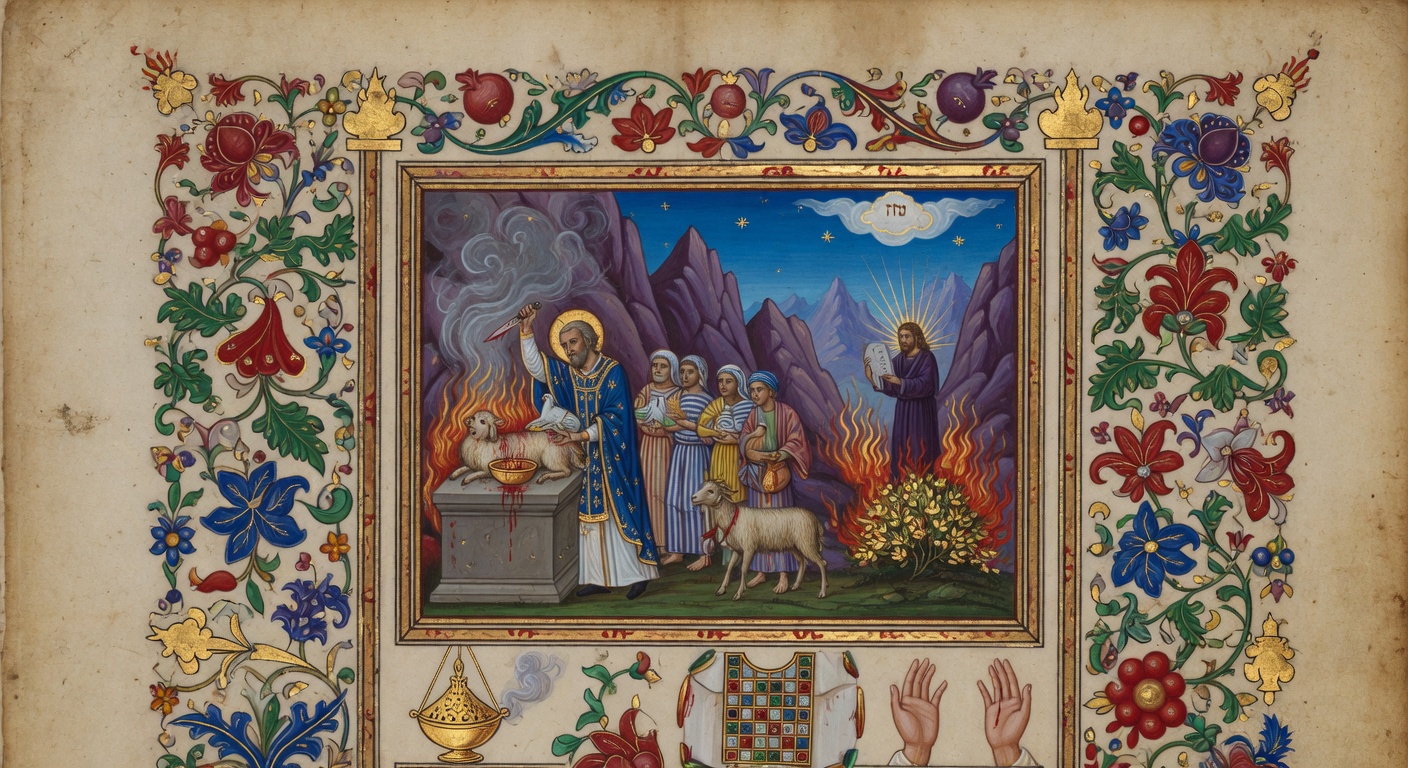
The chapter's insistence that all slaughter for meat must occur at the tabernacle door transforms everyday hunting and herding into acts of worship, effectively abolishing private altars that could easily blend with Canaanite high-place rituals.
 1nd the LORD spake unto Moses, saying,
2 Speak unto Aaron, and unto his sons, and unto all the children of Israel, and say unto them; This is the thing which the LORD hath commanded, saying,
3 What man soever there be of the house of Israel, that killeth an ox, or lamb, or goat, in the camp, or that killeth it out of the camp,
4 And bringeth it not unto the door of the tabernacle of the congregation, to offer an offering unto the LORD before the tabernacle of the LORD; blood shall be imputed unto that man; he hath shed blood; and that man shall be cut off from among his people:
5 To the end that the children of Israel may bring their sacrifices, which they offer in the open field, even that they may bring them unto the LORD, unto the door of the tabernacle of the congregation, unto the priest, and offer them for peace offerings unto the LORD.
6 And the priest shall sprinkle the blood upon the altar of the LORD at the door of the tabernacle of the congregation, and burn the fat for a sweet savour unto the LORD.
7 And they shall no more offer their sacrifices unto devils, after whom they have gone a whoring. This shall be a statute for ever unto them throughout their generations.
8 And thou shalt say unto them, Whatsoever man there be of the house of Israel, or of the strangers which sojourn among you, that offereth a burnt offering or sacrifice,
9 And bringeth it not unto the door of the tabernacle of the congregation, to offer it unto the LORD; even that man shall be cut off from among his people.
10 And whatsoever man there be of the house of Israel, or of the strangers that sojourn among you, that eateth any manner of blood; I will even set my face against that soul that eateth blood, and will cut him off from among his people.
11 For the life of the flesh is in the blood: and I have given it to you upon the altar to make an atonement for your souls: for it is the blood that maketh an atonement for the soul.cf.
12 Therefore I said unto the children of Israel, No soul of you shall eat blood, neither shall any stranger that sojourneth among you eat blood.
13 And whatsoever man there be of the children of Israel, or of the strangers that sojourn among you, which hunteth and catcheth any beast or fowl that may be eaten; he shall even pour out the blood thereof, and cover it with dust.
14 For it is the life of all flesh; the blood of it is for the life thereof: therefore I said unto the children of Israel, Ye shall eat the blood of no manner of flesh: for the life of all flesh is the blood thereof: whosoever eateth it shall be cut off.
15 And every soul that eateth that which died of itself, or that which was torn with beasts, whether it be one of your own country, or a stranger, he shall both wash his clothes, and bathe himself in water, and be unclean until the even: then shall he be clean.
16 But if he wash them not, nor bathe his flesh; then he shall bear his iniquity.
← → arrow keys to navigate chapters · spacebar to play/pause audio
Did You Know?
The chapter's insistence that all slaughter for meat must occur at the tabernacle door transforms everyday hunting and herding into acts of worship, effectively abolishing private altars that could easily blend with Canaanite high-place rituals.
By equating the blood of both sacrificial and non-sacrificial animals with the divine life-force, the text creates a single theological boundary that applies equally to Israelites and resident aliens, foreshadowing later universal ethical norms in Acts 15.
The reference to "devils" (se'irim) in verse 7 is the only Pentateuchal mention of goat-demon worship, revealing an otherwise unattested wilderness-era practice of Israelites offering blood sacrifices to desert spirits rather than to YHWH.
The repeated formula "I will set my face against that soul" ties the consumption of blood directly to the same language of divine rejection used for Molech worship and sexual taboos, framing dietary violation as covenant treason rather than mere ritual infraction.
Verses 15-16 extend blood taboos to animals that die naturally or are torn by beasts, requiring both washing and evening purification, which subtly links forensic purity with moral accountability for accidental contact with unsanctioned blood.
Upon descending Mount Sinai with the second tablets, Moses' face emitted such intense radiance from his direct encounter with God that he was forced to wear a veil when addressing the Israelites, a detail highlighting ancient Near Eastern concepts of divine glory as physically transformative.
The high priestly garments designed for Aaron included a breastplate with twelve precious stones representing the tribes of Israel and an ephod woven with gold thread, reflecting both tribal unity and divine craftsmanship in ancient Israelite worship.
Eleazar joined Moses in conducting the second wilderness census on the plains of Moab, directly shaping the land allotments and military organization for the upcoming conquest of Canaan.
Jewish tradition says the mountain was chosen because it was the humblest. Not the tallest.
Commentary & Study Notes Jamieson-Fausset-Brown (1871) · Public Domain What man... killeth an ox — The Israelites, like other people living in the desert, would not make much use of animal food; and when they did kill a lamb or a kid for food, it woul…
Classic verse-by-verse commentary on Leviticus 17 from Jamieson, Fausset & Brown (1871). Covers: Blood of beasts must be offered at the tabernacle door.
- 3,4
- What man... killeth an ox — The Israelites, like other people living in the desert, would not make much use of animal food; and when they did kill a lamb or a kid for food, it would almost always be, as in Abraham's entertainment of the angels [Ge 18:7], an occasion of a feast, to be eaten in company. This was what was done with the peace offerings, and accordingly it is here enacted, that the same course shall be followed in slaughtering the animals as in the case of those offerings, namely, that they should be killed publicly, and after being devoted to God, partaken of by the offerers. This law, it is obvious, could only be observable in the wilderness while the people were encamped within an accessible distance from the tabernacle. The reason for it is to be found in the strong addictedness of the Israelites to idolatry at the time of their departure from Egypt; and as it would have been easy for any by killing an animal to sacrifice privately to a favorite object of worship, a strict prohibition was made against their slaughtering at home. (See on De 12:15).
- 5
- To the end that the children of Israel may bring their sacrifices, which they offer in the open field — "They" is supposed by some commentators to refer to the Egyptians, so that the verse will stand thus: "the children of Israel may bring their sacrifices which they (the Egyptians) offer in the open field." The law is thought to have been directed against those whose Egyptian habits led them to imitate this idolatrous practice.
Read all 8 notes on Leviticus 17 →