Numbers 17 KJV
Aaron's Staff Buds
Aaron's Staff Buds
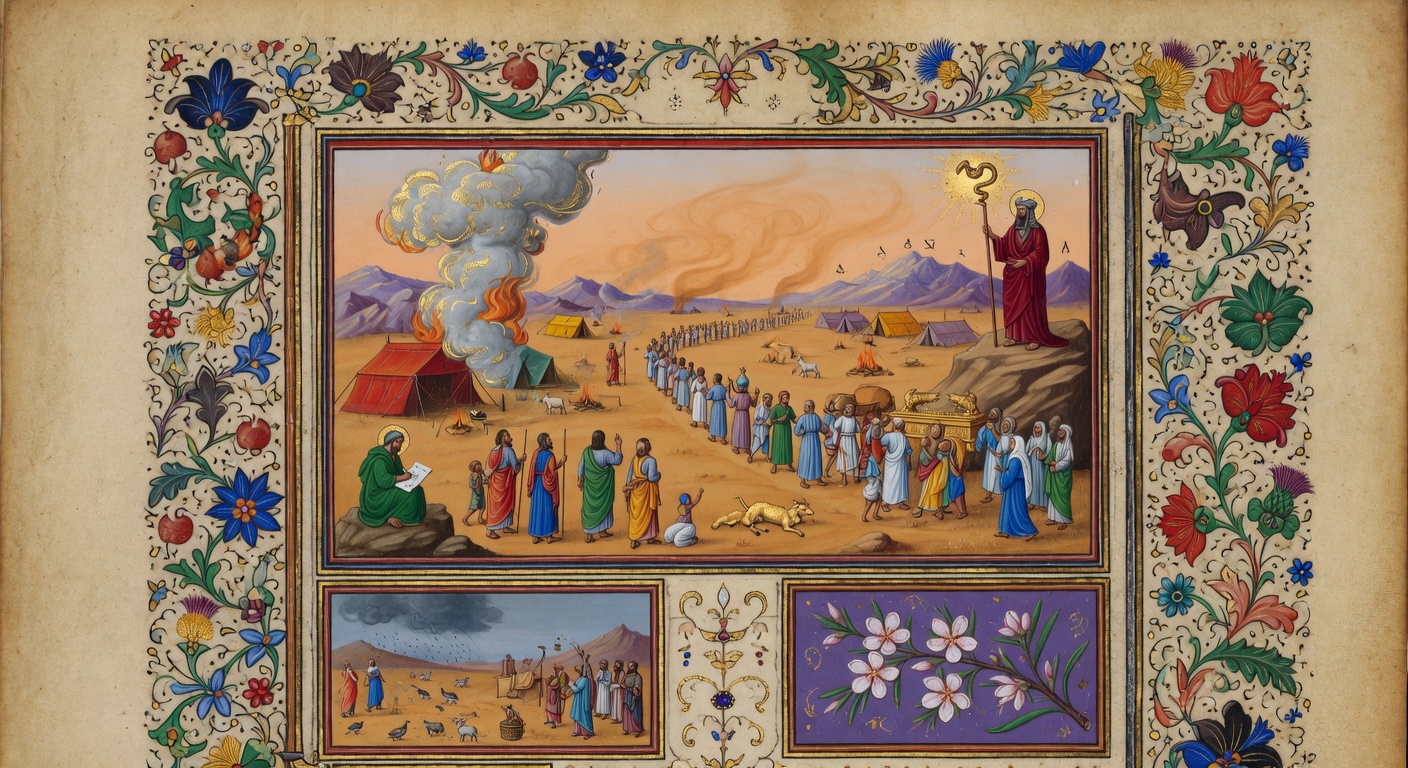
The overnight transformation of Aaron's rod into a living almond branch. Complete with buds, blossoms, and ripe fruit. Echoes the almond's Hebrew root shaqad (to watch or hasten), portraying the priesthood as under God's vigilant oversight rather than mere human appointment.
 1nd the LORD spake unto Moses, saying,
2 Speak unto the children of Israel, and take of every one of them a rod according to the house of their fathers, of all their princes according to the house of their fathers twelve rods: write thou every man’s name upon his rod.
3 And thou shalt write Aaron’s name upon the rod of Levi: for one rod shall be for the head of the house of their fathers.
4 And thou shalt lay them up in the tabernacle of the congregation before the testimony, where I will meet with you.
5 And it shall come to pass, that the man’s rod, whom I shall choose, shall blossom: and I will make to cease from me the murmurings of the children of Israel, whereby they murmur against you.
6 And Moses spake unto the children of Israel, and every one of their princes gave him a rod apiece, for each prince one, according to their fathers’ houses, even twelve rods: and the rod of Aaron was among their rods.
7 And Moses laid up the rods before the LORD in the tabernacle of witness.
8 And it came to pass, that on the morrow Moses went into the tabernacle of witness; and, behold, the rod of Aaron for the house of Levi was budded, and brought forth buds, and bloomed blossoms, and yielded almonds.
9 And Moses brought out all the rods from before the LORD unto all the children of Israel: and they looked, and took every man his rod.
10 And the LORD said unto Moses, Bring Aaron’s rod again before the testimony, to be kept for a token against the rebels; and thou shalt quite take away their murmurings from me, that they die not.
11 And Moses did so: as the LORD commanded him, so did he.
12 And the children of Israel spake unto Moses, saying, Behold, we die, we perish, we all perish.
13 Whosoever cometh any thing near unto the tabernacle of the LORD shall die: shall we be consumed with dying?
← → arrow keys to navigate chapters · spacebar to play/pause audio
Did You Know?
The overnight transformation of Aaron's rod into a living almond branch. Complete with buds, blossoms, and ripe fruit. Echoes the almond's Hebrew root shaqad (to watch or hasten), portraying the priesthood as under God's vigilant oversight rather than mere human appointment.
Positioned immediately after Korah's rebellion, the rod miracle functions as a botanical theophany that reverses the earth's prior opening in judgment, using vegetative life to affirm priestly mediation instead of further destruction.
By requiring rods from all twelve tribal heads yet preserving only Aaron's in the Ark (as cross-referenced in Hebrews 9:4), the narrative subtly establishes an ongoing visual hierarchy within Israel, distinguishing Levi's staff from those of political leaders like Judah.
The event's focus on a single night's growth contrasts with typical Near Eastern divination rods or staffs, which were inert symbols; here the rod's fertility demonstrates that true authority derives from generative divine power, not ritual manipulation.
Aaron's rod is never described as returning to its original state, implying its permanent alteration serves as a perpetual sign that the priestly office itself has been supernaturally vitalized and cannot revert to ordinary tribal status.
The high priestly garments designed for Aaron included a breastplate with twelve precious stones representing the tribes of Israel and an ephod woven with gold thread, reflecting both tribal unity and divine craftsmanship in ancient Israelite worship.
Upon descending Mount Sinai with the second tablets, Moses' face emitted such intense radiance from his direct encounter with God that he was forced to wear a veil when addressing the Israelites, a detail highlighting ancient Near Eastern concepts of divine glory as physically transformative.
In Numbers 12, Miriam joins Aaron in challenging Moses' exclusive prophetic authority over his marriage to a Cushite woman, resulting in her being struck with leprosy while Aaron receives only a rebuke, underscoring gender disparities in the narrative.
Caleb offered his daughter Achsah in marriage to the warrior who captured Debir; after Othniel succeeded, Achsah herself boldly petitioned her father for upper and lower springs of water to sustain the land.
This episode illustrates the scriptural consequences of disobedience and lack of faith while marking the decisive turning point that prolonged Israel's wilderness period.
This site holds profound significance in Scripture as a symbol of divine promise, human limitation, and the transition of authority to Joshua for the conquest of the land.
Later it offered David a place of refuge for his parents during his flight from Saul, illustrating how God wove even foreign soil into the redemptive purposes centered on Israel.
Commentary & Study Notes Jamieson-Fausset-Brown (1871) · Public Domain Speak unto the children of Israel — The controversy with Moses and Aaron about the priesthood was of such a nature and magnitude as required a decisive and authoritative settlement…
Classic verse-by-verse commentary on Numbers 17 from Jamieson, Fausset & Brown (1871). Covers: Aaron's rod flourishes.
- 2-5
- Speak unto the children of Israel — The controversy with Moses and Aaron about the priesthood was of such a nature and magnitude as required a decisive and authoritative settlement. For the removal of all doubts and the silencing of all murmuring in the future regarding the holder of the office, a miracle was wrought of a remarkable character and permanent duration; and in the manner of performing it, all the people were made to have a direct and special interest. take of every one... princes... twelve rods — As the princes, being the oldest sons of the chief family, and heads of their tribes, might have advanced the best claims to the priesthood, if that sacred dignity was to be shared among all the tribes, they were therefore selected, and being twelve in number — that of Joseph being counted only one — Moses was ordered to see that the name of each was inscribed — a practice borrowed from the Egyptians — upon his rod or wand of office. The name of Aaron rather than of Levi was used, as the latter name would have opened a door of controversy among the Levites; and as there was to be one rod only for the head of each tribe, the express appointment of a rod for Aaron determined him to be the head of that tribe, as well as that branch or family of the tribe to which the priestly dignity should belong. These rods were to be laid in the tabernacle close to the ark (compare Nu 17:10 and Heb 9:4), where a divine token was promised that would for all time terminate the dispute.
- 6
- the rod of Aaron was among their rods — either one of the twelve, or, as many suppose, a thirteenth in the midst (Heb 9:4). The rods were of dry sticks or wands, probably old, as transmitted from one head of the family to a succeeding.
Read all 6 notes on Numbers 17 →