Ruth 3 KJV
Ruth at the Threshing Floor
Ruth at the Threshing Floor
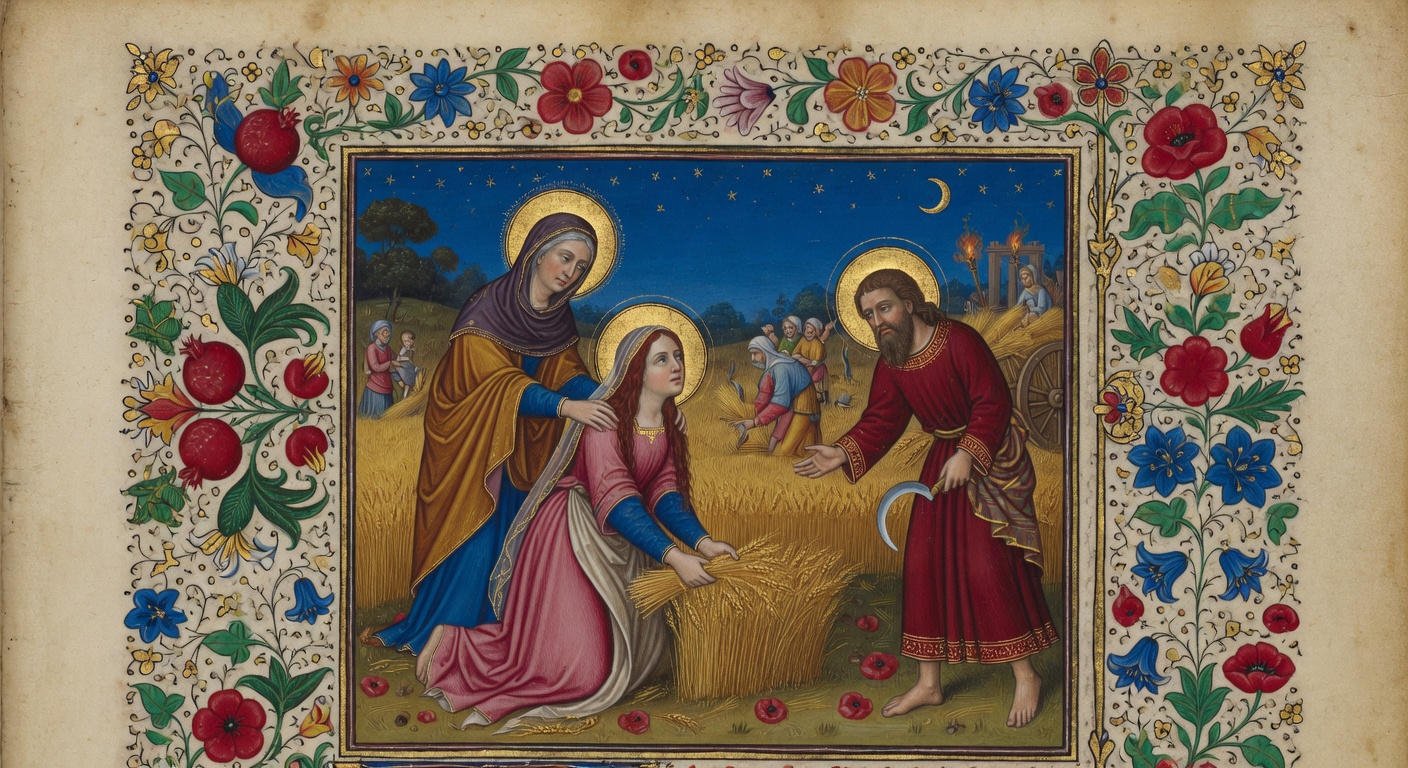
Ruth's request that Boaz 'spread thy skirt over thine handmaid' invokes covenantal language also found in Ezekiel 16:8, transforming a marriage proposal into an explicit appeal for redemptive protection under Israel's God.
 1hen Naomi her mother in law said unto her, My daughter, shall I not seek rest for thee, that it may be well with thee?
2 And now is not Boaz of our kindred, with whose maidens thou wast? Behold, he winnoweth barley to night in the threshingfloor.
3 Wash thyself therefore, and anoint thee, and put thy raiment upon thee, and get thee down to the floor: but make not thyself known unto the man, until he shall have done eating and drinking.
4 And it shall be, when he lieth down, that thou shalt mark the place where he shall lie, and thou shalt go in, and uncover his feet, and lay thee down; and he will tell thee what thou shalt do.
5 And she said unto her, All that thou sayest unto me I will do.
6 And she went down unto the floor, and did according to all that her mother in law bade her.
7 And when Boaz had eaten and drunk, and his heart was merry, he went to lie down at the end of the heap of corn: and she came softly, and uncovered his feet, and laid her down.
8 And it came to pass at midnight, that the man was afraid, and turned himself: and, behold, a woman lay at his feet.
9 And he said, Who art thou? And she answered, I am Ruth thine handmaid: spread therefore thy skirt over thine handmaid; for thou art a near kinsman.
10 And he said, Blessed be thou of the LORD, my daughter: for thou hast shewed more kindness in the latter end than at the beginning, inasmuch as thou followedst not young men, whether poor or rich.
11 And now, my daughter, fear not; I will do to thee all that thou requirest: for all the city of my people doth know that thou art a virtuous woman.
12 And now it is true that I am thy near kinsman: howbeit there is a kinsman nearer than I.
13 Tarry this night, and it shall be in the morning, that if he will perform unto thee the part of a kinsman, well; let him do the kinsman’s part: but if he will not do the part of a kinsman to thee, then will I do the part of a kinsman to thee, as the LORD liveth: lie down until the morning.
14 And she lay at his feet until the morning: and she rose up before one could know another. And he said, Let it not be known that a woman came into the floor.
15 Also he said, Bring the vail that thou hast upon thee, and hold it. And when she held it, he measured six measures of barley, and laid it on her: and she went into the city.
16 And when she came to her mother in law, she said, Who art thou, my daughter? And she told her all that the man had done to her.
17 And she said, These six measures of barley gave he me; for he said to me, Go not empty unto thy mother in law.
18 Then said she, Sit still, my daughter, until thou know how the matter will fall: for the man will not be in rest, until he have finished the thing this day.
← → arrow keys to navigate chapters · spacebar to play/pause audio
Did You Know?
Ruth's request that Boaz 'spread thy skirt over thine handmaid' invokes covenantal language also found in Ezekiel 16:8, transforming a marriage proposal into an explicit appeal for redemptive protection under Israel's God.
Boaz's nighttime blessing that Ruth has come to 'trust under the wings' of the Lord subtly echoes the earlier imagery of Ruth gleaning under divine favor, underscoring how human initiative and providence converge at the threshing floor.
The scene subverts the Moabite origins narrative of Genesis 19 by having a Moabite woman seek legitimate redemption rather than illicit union, presenting Ruth's boldness as a reversal that leads to Israel's royal line.
Boaz's reference to a nearer kinsman creates immediate legal tension rooted in Deuteronomy 25 levirate customs, yet his willingness to act reveals an expansive understanding of hesed that exceeds strict obligation.
Naomi's instruction for Ruth to anoint and dress herself at the threshing floor draws on ancient Israelite harvest-rite customs, positioning the encounter as both agricultural and betrothal ritual that foreshadows royal Davidic ancestry.
At the threshing floor, Ruth's bold nighttime proposal invoked the levirate duty (Deuteronomy 25), yet Boaz insisted on first offering the redemption right to a nearer relative, revealing precise adherence to Israelite inheritance law over personal desire.
Despite her losses, Naomi is shown nursing Obed in Ruth 4:16 and receiving the title of his nurse from neighboring women, an unusual detail that positions her as the direct link connecting Moabite ancestry to the future Davidic monarchy.
The narrative specifies that Ruth and Naomi arrived in Bethlehem at the beginning of the barley harvest, setting the stage for the dramatic events during the seven-week period leading to the wheat harvest.
The kinsman's anonymity in the narrative functions as deliberate literary contrast, underscoring Boaz's hesed while erasing the closer relative from both the text and the genealogy that leads to David, an outcome the man sought to avoid by declining.
Bethlehem means 'House of Bread' in Hebrew. Fitting for the birthplace of the 'Bread of Life'.
Moab emerged from the lineage of Lot, Abraham's nephew, whose descendants settled east of the Dead Sea after the judgment on Sodom.
Commentary & Study Notes Jamieson-Fausset-Brown (1871) · Public Domain he winnoweth barley to-night in the threshing-floor — The winnowing process is performed by throwing up the grain, after being trodden down, against the wind with a shovel. The thr…
Classic verse-by-verse commentary on Ruth 3 from Jamieson, Fausset & Brown (1871). Covers: By naomi's instructions, ruth lies at boaz's feet, who acknowledges the duty of a kinsman.
- 2
- he winnoweth barley to-night in the threshing-floor — The winnowing process is performed by throwing up the grain, after being trodden down, against the wind with a shovel. The threshing-floor, which was commonly on the harvest-field, was carefully leveled with a large cylindric roller and consolidated with chalk, that weeds might not spring up, and that it might not chop with drought. The farmer usually remained all night in harvest-time on the threshing-floor, not only for the protection of his valuable grain, but for the winnowing. That operation was performed in the evening to catch the breezes which blow after the close of a hot day, and which continue for the most part of the night. This duty at so important a season the master undertakes himself; and, accordingly, in the simplicity of ancient manners, Boaz, a person of considerable wealth and high rank, laid himself down to sleep on the barn floor, at the end of the heap of barley he had been winnowing.
- 4
- go in, and uncover his feet and lay thee down — Singular as these directions may appear to us, there was no impropriety in them, according to the simplicity of rural manners in Beth-lehem. In ordinary circumstances these would have seemed indecorous to the world; but in the case of Ruth, it was a method, doubtless conformable to prevailing usage, of reminding Boaz of the duty which devolved on him as the kinsman of her deceased husband. Boaz probably slept upon a mat or skin; Ruth lay crosswise at his feet — a position in which Eastern servants frequently sleep in the same chamber or tent with their master; and if they want a covering, custom allows them that benefit from part of the covering on their master's bed. Resting, as the Orientals do at night, in the same clothes they wear during the day, there was no indelicacy in a stranger, or even a woman, putting the extremity of this cover over her.
Read all 5 notes on Ruth 3 →