1 Samuel 2 KJV
Hannah's Prayer
Hannah's Prayer
Hannah's prayer anticipates monarchy by explicitly referencing God's future strengthening of 'his king' and exaltation of 'his anointed' (v.10), an anachronistic prophecy centuries before Israel's kingship emerges under Saul.
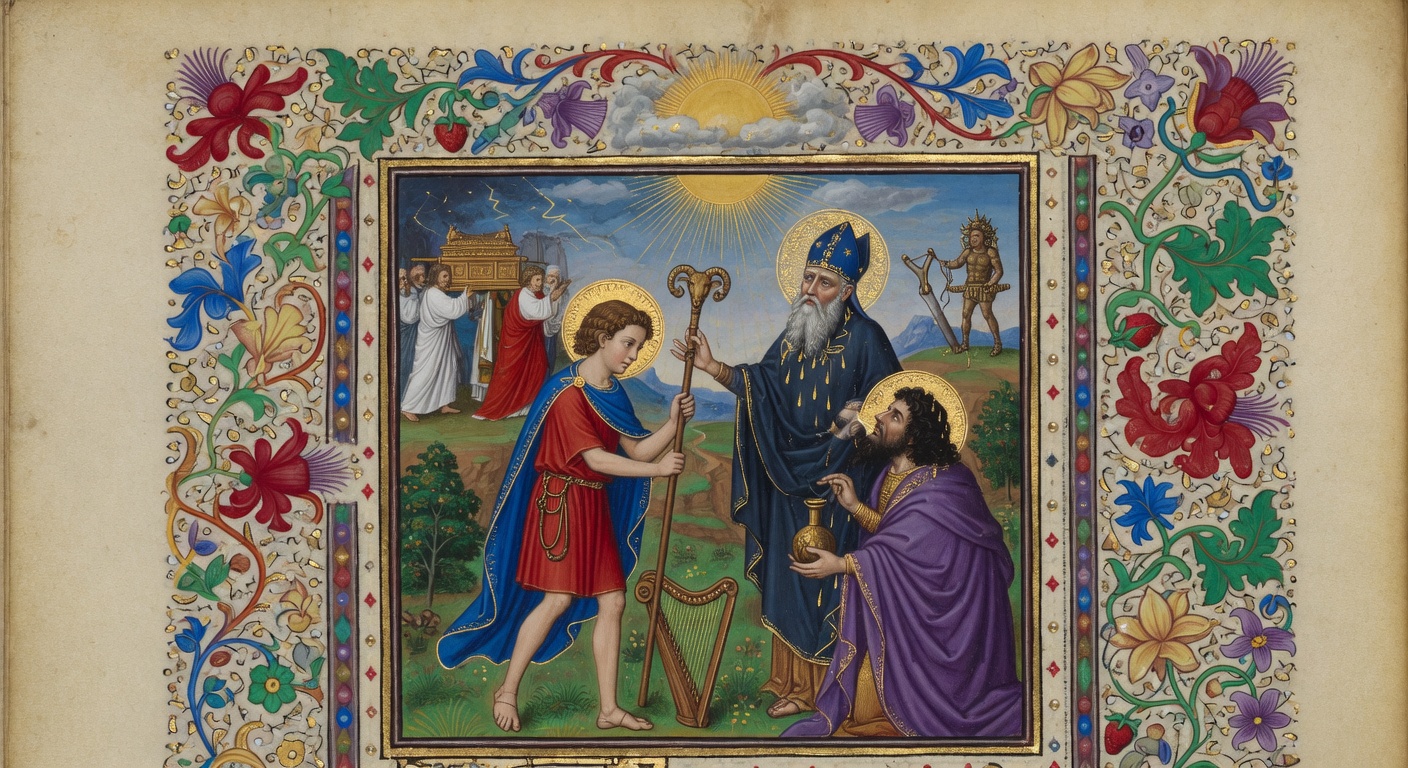
 1nd Hannah prayed, and said, My heart rejoiceth in the LORD, mine horn is exalted in the LORD: my mouth is enlarged over mine enemies; because I rejoice in thy salvation.
2 There is none holy as the LORD: for there is none beside thee: neither is there any rock like our God.
3 Talk no more so exceeding proudly; let not arrogancy come out of your mouth: for the LORD is a God of knowledge, and by him actions are weighed.
4 The bows of the mighty men are broken, and they that stumbled are girded with strength.
5 They that were full have hired out themselves for bread; and they that were hungry ceased: so that the barren hath born seven; and she that hath many children is waxed feeble.
6 The LORD killeth, and maketh alive: he bringeth down to the grave, and bringeth up.
7 The LORD maketh poor, and maketh rich: he bringeth low, and lifteth up.
8 He raiseth up the poor out of the dust, and lifteth up the beggar from the dunghill, to set them among princes, and to make them inherit the throne of glory: for the pillars of the earth are the LORD’s, and he hath set the world upon them.
9 He will keep the feet of his saints, and the wicked shall be silent in darkness; for by strength shall no man prevail.
10 The adversaries of the LORD shall be broken to pieces; out of heaven shall he thunder upon them: the LORD shall judge the ends of the earth; and he shall give strength unto his king, and exalt the horn of his anointed.
11 And Elkanah went to Ramah to his house. And the child did minister unto the LORD before Eli the priest.
12 Now the sons of Eli were sons of Belial; they knew not the LORD.
13 And the priests’ custom with the people was, that, when any man offered sacrifice, the priest’s servant came, while the flesh was in seething, with a fleshhook of three teeth in his hand;
14 And he struck it into the pan, or kettle, or caldron, or pot; all that the fleshhook brought up the priest took for himself. So they did in Shiloh unto all the Israelites that came thither.
15 Also before they burnt the fat, the priest’s servant came, and said to the man that sacrificed, Give flesh to roast for the priest; for he will not have sodden flesh of thee, but raw.
16 And if any man said unto him, Let them not fail to burn the fat presently, and then take as much as thy soul desireth; then he would answer him, Nay; but thou shalt give it me now: and if not, I will take it by force.
17 Wherefore the sin of the young men was very great before the LORD: for men abhorred the offering of the LORD.
18 But Samuel ministered before the LORD, being a child, girded with a linen ephod.
19 Moreover his mother made him a little coat, and brought it to him from year to year, when she came up with her husband to offer the yearly sacrifice.
20 And Eli blessed Elkanah and his wife, and said, The LORD give thee seed of this woman for the loan which is lent to the LORD. And they went unto their own home.
21 And the LORD visited Hannah, so that she conceived, and bare three sons and two daughters. And the child Samuel grew before the LORD.
22 Now Eli was very old, and heard all that his sons did unto all Israel; and how they lay with the women that assembled at the door of the tabernacle of the congregation.
23 And he said unto them, Why do ye such things? for I hear of your evil dealings by all this people.
24 Nay, my sons; for it is no good report that I hear: ye make the LORD’s people to transgress.
25 If one man sin against another, the judge shall judge him: but if a man sin against the LORD, who shall intreat for him? Notwithstanding they hearkened not unto the voice of their father, because the LORD would slay them.
26 And the child Samuel grew on, and was in favour both with the LORD, and also with men.
27 And there came a man of God unto Eli, and said unto him, Thus saith the LORD, Did I plainly appear unto the house of thy father, when they were in Egypt in Pharaoh’s house?
28 And did I choose him out of all the tribes of Israel to be my priest, to offer upon mine altar, to burn incense, to wear an ephod before me? and did I give unto the house of thy father all the offerings made by fire of the children of Israel?
29 Wherefore kick ye at my sacrifice and at mine offering, which I have commanded in my habitation; and honourest thy sons above me, to make yourselves fat with the chiefest of all the offerings of Israel my people?
30 Wherefore the LORD God of Israel saith, I said indeed that thy house, and the house of thy father, should walk before me for ever: but now the LORD saith, Be it far from me; for them that honour me I will honour, and they that despise me shall be lightly esteemed.
31 Behold, the days come, that I will cut off thine arm, and the arm of thy father’s house, that there shall not be an old man in thine house.
32 And thou shalt see an enemy in my habitation, in all the wealth which God shall give Israel: and there shall not be an old man in thine house for ever.
33 And the man of thine, whom I shall not cut off from mine altar, shall be to consume thine eyes, and to grieve thine heart: and all the increase of thine house shall die in the flower of their age.
34 And this shall be a sign unto thee, that shall come upon thy two sons, on Hophni and Phinehas; in one day they shall die both of them.
35 And I will raise me up a faithful priest, that shall do according to that which is in mine heart and in my mind: and I will build him a sure house; and he shall walk before mine anointed for ever.
36 And it shall come to pass, that every one that is left in thine house shall come and crouch to him for a piece of silver and a morsel of bread, and shall say, Put me, I pray thee, into one of the priests’ offices, that I may eat a piece of bread.
← → arrow keys to navigate chapters · spacebar to play/pause audio
Did You Know?
Hannah's prayer anticipates monarchy by explicitly referencing God's future strengthening of 'his king' and exaltation of 'his anointed' (v.10), an anachronistic prophecy centuries before Israel's kingship emerges under Saul.
The reversal motif in verses 4-8 (warriors stumbling while the feeble are armed, the poor raised from dust to sit with princes) draws on ancient Near Eastern royal ideology but subverts it by attributing all upheaval solely to YHWH rather than human rulers.
Eli's sons are inserted mid-prayer narrative (vv.12-17) to contrast Hannah's faithful vow-keeping with priestly corruption at Shiloh, underscoring the chapter's theme of divine judgment on misused sacred office.
Verse 8's image of YHWH setting 'the pillars of the earth' blends temple cosmology with ethical reversal, implying the world's stability rests not on chaos forces but on God's weighing of human conduct.
The prayer's closing military imagery of shattering enemies (v.10) foreshadows Samuel's later role as judge-prophet who anoints kings, linking personal thanksgiving to national political transformation.
Hannah alone among biblical mothers explicitly vowed her unborn son as a lifelong Nazirite, stipulating that "no razor shall touch his head," a detail Samuel fulfilled even though the more famous Nazirite Samson ultimately violated the same vow.
The news of their death and the Ark's loss killed their aged father Eli, who fell backward and broke his neck, and sent Phinehas's widow into fatal labor - she named the child Ichabod, 'the glory is departed.'
Samuel organized formal companies of prophets at Ramah, Naioth, Bethel, and Gilgal that trained disciples in music, ecstatic utterance, and Torah study, creating institutional structures later used by Elijah and Elisha.
Saul erected Israel's first recorded royal altar after his victory over the Philistines at Michmash, yet this act of devotion contrasted sharply with his later failure to fully execute the ban on Amalek, revealing inconsistencies in his religious observance.
In Scripture, Shiloh underscores themes of God's dwelling among his people, covenant faithfulness, and eventual judgment for Israel's disobedience.
Key events included Samuel anointing Saul as Israel's first king and later David as his successor, underscoring Ramah's role in establishing the Davidic line central to biblical history.
In prophetic literature, Hosea references Gibeah's sin as a byword for Israel's moral corruption, demonstrating how the town's dark history continued to resonate as a warning throughout Scripture.
Commentary & Study Notes Jamieson-Fausset-Brown (1871) · Public Domain Hannah prayed, and said — Praise and prayer are inseparably conjoined in Scripture (Col 4:2; 1Ti 2:1). This beautiful song was her tribute of thanks for the divine goodness in answ…
Classic verse-by-verse commentary on 1 Samuel 2 from Jamieson, Fausset & Brown (1871). Covers: Hannah's song in thankfulness to God; The sin of ell's sons; Samuel's ministry; A prophecy against eli's house.
- 1
- Hannah prayed, and said — Praise and prayer are inseparably conjoined in Scripture (Col 4:2; 1Ti 2:1). This beautiful song was her tribute of thanks for the divine goodness in answering her petition. mine horn is exalted in the Lord — Allusion is here made to a peculiarity in the dress of Eastern women about Lebanon, which seems to have obtained anciently among the Israelite women, that of wearing a tin or silver horn on the forehead, on which their veil is suspended. Wives, who have no children, wear it projecting in an oblique direction, while those who become mothers forthwith raise it a few inches higher, inclining towards the perpendicular, and by this slight but observable change in their headdress, make known, wherever they go, the maternal character which they now bear.
- 5
- they that were hungry ceased — that is, to hunger. the barren hath born seven — that is, many children.
Read all 16 notes on 1 Samuel 2 →