Deuteronomy 21 KJV
Various Laws
Echoes & Connections 1 connections
Various Laws
The unsolved murder ritual transfers bloodguilt from the community to an untilled valley through a beheaded heifer whose blood is never covered, echoing the ground's cry in Genesis 4 while establishing that unsolved violence threatens the land's fertility under covenant curse.
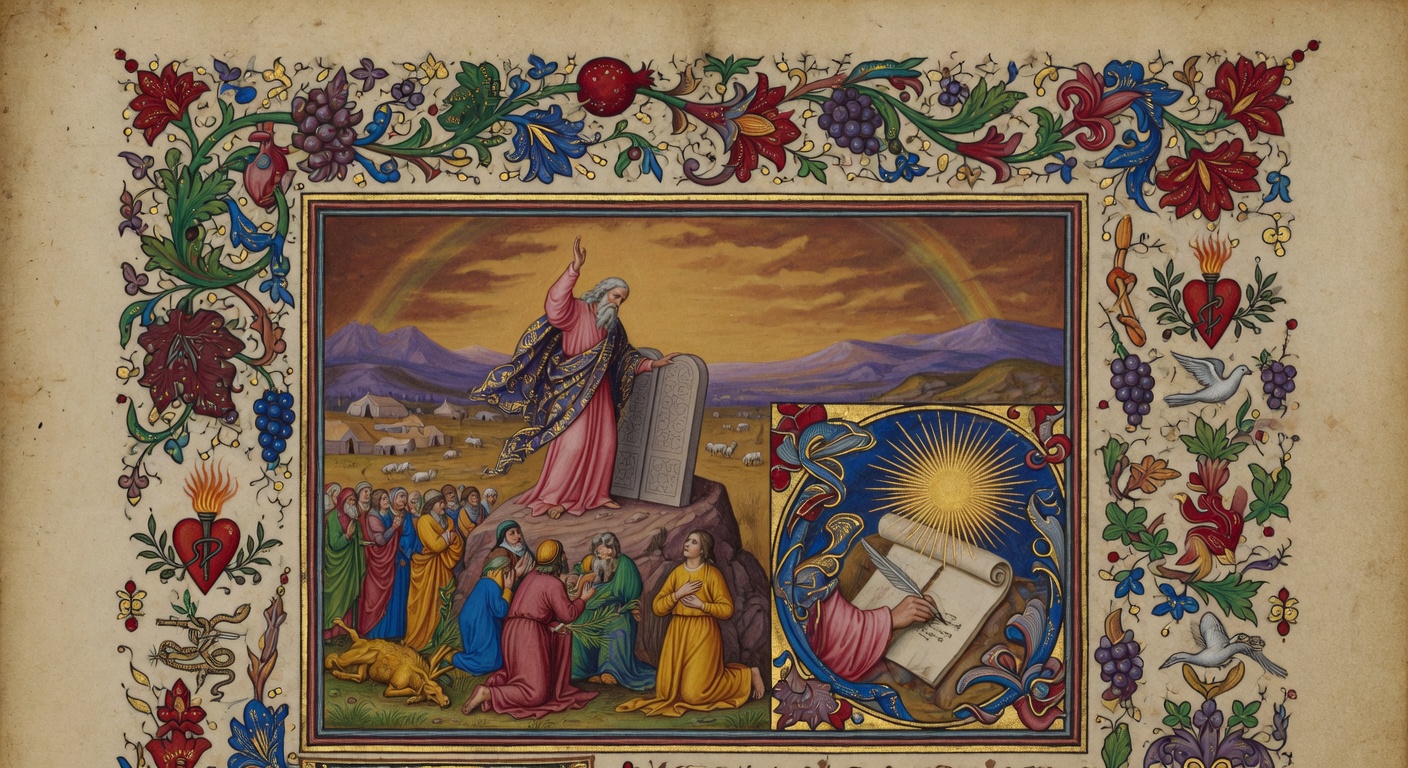
 1f one be found slain in the land which the LORD thy God giveth thee to possess it, lying in the field, and it be not known who hath slain him:
2 Then thy elders and thy judges shall come forth, and they shall measure unto the cities which are round about him that is slain:
3 And it shall be, that the city which is next unto the slain man, even the elders of that city shall take an heifer, which hath not been wrought with, and which hath not drawn in the yoke;
4 And the elders of that city shall bring down the heifer unto a rough valley, which is neither eared nor sown, and shall strike off the heifer’s neck there in the valley:
5 And the priests the sons of Levi shall come near; for them the LORD thy God hath chosen to minister unto him, and to bless in the name of the LORD; and by their word shall every controversy and every stroke be tried:
6 And all the elders of that city, that are next unto the slain man, shall wash their hands over the heifer that is beheaded in the valley:
7 And they shall answer and say, Our hands have not shed this blood, neither have our eyes seen it.
8 Be merciful, O LORD, unto thy people Israel, whom thou hast redeemed, and lay not innocent blood unto thy people of Israel’s charge. And the blood shall be forgiven them.
9 So shalt thou put away the guilt of innocent blood from among you, when thou shalt do that which is right in the sight of the LORD.
10 When thou goest forth to war against thine enemies, and the LORD thy God hath delivered them into thine hands, and thou hast taken them captive,
11 And seest among the captives a beautiful woman, and hast a desire unto her, that thou wouldest have her to thy wife;
12 Then thou shalt bring her home to thine house; and she shall shave her head, and pare her nails;
13 And she shall put the raiment of her captivity from off her, and shall remain in thine house, and bewail her father and her mother a full month: and after that thou shalt go in unto her, and be her husband, and she shall be thy wife.
14 And it shall be, if thou have no delight in her, then thou shalt let her go whither she will; but thou shalt not sell her at all for money, thou shalt not make merchandise of her, because thou hast humbled her.
15 If a man have two wives, one beloved, and another hated, and they have born him children, both the beloved and the hated; and if the firstborn son be hers that was hated:
16 Then it shall be, when he maketh his sons to inherit that which he hath, that he may not make the son of the beloved firstborn before the son of the hated, which is indeed the firstborn:
17 But he shall acknowledge the son of the hated for the firstborn, by giving him a double portion of all that he hath: for he is the beginning of his strength; the right of the firstborn is his.
18 If a man have a stubborn and rebellious son, which will not obey the voice of his father, or the voice of his mother, and that, when they have chastened him, will not hearken unto them:
19 Then shall his father and his mother lay hold on him, and bring him out unto the elders of his city, and unto the gate of his place;
20 And they shall say unto the elders of his city, This our son is stubborn and rebellious, he will not obey our voice; he is a glutton, and a drunkard.
21 And all the men of his city shall stone him with stones, that he die: so shalt thou put evil away from among you; and all Israel shall hear, and fear.
22 And if a man have committed a sin worthy of death, and he be to be put to death, and thou hang him on a tree:
23 His body shall not remain all night upon the tree, but thou shalt in any wise bury him that day; (for he that is hanged is accursed of God;) that thy land be not defiled, which the LORD thy God giveth thee for an inheritance.
← → arrow keys to navigate chapters · spacebar to play/pause audio
Did You Know?
The unsolved murder ritual transfers bloodguilt from the community to an untilled valley through a beheaded heifer whose blood is never covered, echoing the ground's cry in Genesis 4 while establishing that unsolved violence threatens the land's fertility under covenant curse.
The captive woman law mandates a thirty-day mourning period with head-shaving and nail-paring before consummation, functioning less as hygiene and more as a deliberate disruption of immediate sexual conquest that forces the Israelite to confront her humanity and the ethics of holy war.
Inheritance rules protect the literal firstborn's double portion even when born to the hated wife, directly countering the patriarchal pattern of displacing elder sons for favorites seen in Genesis, thereby subordinating paternal emotion to covenantal order.
The rebellious son statute demands both parents jointly bring the accusation to the city elders, creating a procedural safeguard that prevents either parent from unilaterally invoking capital punishment and underscoring communal rather than purely familial authority over life.
The requirement to bury a hanged criminal's body the same day lest the land be defiled anticipates the later Pauline reading of Deuteronomy 21:23 in Galatians 3, transforming an impurity regulation into a theological hinge for understanding Christ's accursed death.
Moses initially resisted his divine commission at the burning bush by citing a speech impediment, prompting God to designate Aaron as his official spokesman while Moses retained ultimate authority in conveying messages to Pharaoh.
Only Joshua and Caleb survived the forty-year wilderness period among the adults who left Egypt, because they alone trusted God's promise about the land (Numbers 14:30).
This site holds profound significance in Scripture as a symbol of divine promise, human limitation, and the transition of authority to Joshua for the conquest of the land.
Moab emerged from the lineage of Lot, Abraham's nephew, whose descendants settled east of the Dead Sea after the judgment on Sodom.
The Jordan River drops over 3,000 feet from its source to the Dead Sea.
Commentary & Study Notes Jamieson-Fausset-Brown (1871) · Public Domain 1-6. If one be found slain... lying in the field, and it be not known who hath slain him — The ceremonies here ordained to be observed on the discovery of a slaughtered corpse show…
Classic verse-by-verse commentary on Deuteronomy 21 from Jamieson, Fausset & Brown (1871). Covers: Expiation of uncertain murder; The treatment of a captive taken to wife.
- 10-14
- When thou goest to war... and seest among the captives a beautiful woman... that thou wouldest have her to thy wife — According to the war customs of all ancient nations, a female captive became the slave of the victor, who had the sole and unchallengeable control of right to her person. Moses improved this existing usage by special regulations on the subject. He enacted that, in the event that her master was captivated by her beauty and contemplated a marriage with her, a month should be allowed to elapse, during which her perturbed feelings might be calmed, her mind reconciled to her altered condition, and she might bewail the loss of her parents, now to her the same as dead. A month was the usual period of mourning with the Jews, and the circumstances mentioned here were the signs of grief — the shaving of the head, the allowing the nails to grow uncut, the putting off her gorgeous dress in which ladies, on the eve of being captured, arrayed themselves to be the more attractive to their captors. The delay was full of humanity and kindness to the female slave, as well as a prudential measure to try the strength of her master's affections. If his love should afterwards cool and he become indifferent to her person, he was not to lord it over her, neither to sell her in the slave market, nor retain her in a subordinate condition in his house; but she was to be free to go where her inclinations led her.
- 15-17
- If a man have two wives, one beloved, and another hated — In the original and all other translations, the words are rendered "have had," referring to events that have already taken place; and that the "had" has, by some mistake, been omitted in our version, seems highly probable from the other verbs being in the past tense — "hers that was hated," not "hers that is hated"; evidently intimating that she (the first wife) was dead at the time referred to. Moses, therefore, does not here legislate upon the case of a man who has two wives at the same time, but on that of a man who has married twice in succession, the second wife after the decease of the first; and there was an obvious necessity for legislation in these circumstances; for the first wife, who was hated, was dead, and the second wife, the favorite, was alive; and with the feelings of a stepmother, she would urge her husband to make her own son the heir. This case has no bearing upon polygamy, which there is no evidence that the Mosaic code legalized.
Read all 4 notes on Deuteronomy 21 →