Ecclesiastes 3 KJV
A Time for Everything
A Time for Everything
The 14 antithetical pairs in verses 2-8 form a complete merism encompassing all human activity, mirroring the heptadic structure of creation in Genesis while underscoring that every polarity occurs within God's sovereign appointments rather than random fortune.
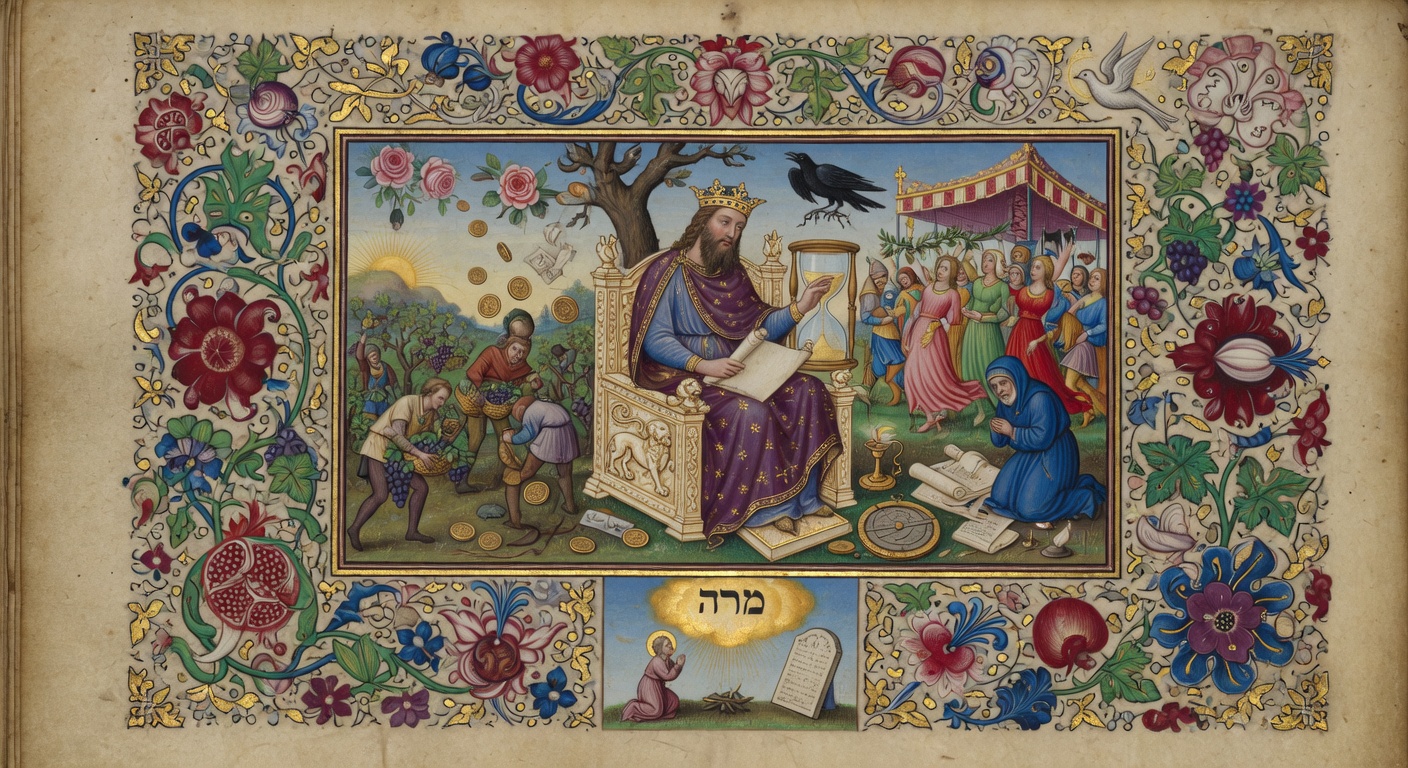
 1o every thing there is a season, and a time to every purpose under the heaven:
2 A time to be born, and a time to die; a time to plant, and a time to pluck up that which is planted;
3 A time to kill, and a time to heal; a time to break down, and a time to build up;
4 A time to weep, and a time to laugh; a time to mourn, and a time to dance;
5 A time to cast away stones, and a time to gather stones together; a time to embrace, and a time to refrain from embracing;
6 A time to get, and a time to lose; a time to keep, and a time to cast away;
7 A time to rend, and a time to sew; a time to keep silence, and a time to speak;
8 A time to love, and a time to hate; a time of war, and a time of peace.
9 What profit hath he that worketh in that wherein he laboureth?
10 I have seen the travail, which God hath given to the sons of men to be exercised in it.
11 He hath made every thing beautiful in his time: also he hath set the world in their heart, so that no man can find out the work that God maketh from the beginning to the end.
12 I know that there is no good in them, but for a man to rejoice, and to do good in his life.
13 And also that every man should eat and drink, and enjoy the good of all his labour, it is the gift of God.
14 I know that, whatsoever God doeth, it shall be for ever: nothing can be put to it, nor any thing taken from it: and God doeth it, that men should fear before him.
15 That which hath been is now; and that which is to be hath already been; and God requireth that which is past.
16 And moreover I saw under the sun the place of judgment, that wickedness was there; and the place of righteousness, that iniquity was there.
17 I said in mine heart, God shall judge the righteous and the wicked: for there is a time there for every purpose and for every work.
18 I said in mine heart concerning the estate of the sons of men, that God might manifest them, and that they might see that they themselves are beasts.
19 For that which befalleth the sons of men befalleth beasts; even one thing befalleth them: as the one dieth, so dieth the other; yea, they have all one breath; so that a man hath no preeminence above a beast: for all is vanity.
20 All go unto one place; all are of the dust, and all turn to dust again.
21 Who knoweth the spirit of man that goeth upward, and the spirit of the beast that goeth downward to the earth?
22 Wherefore I perceive that there is nothing better, than that a man should rejoice in his own works; for that is his portion: for who shall bring him to see what shall be after him?
← → arrow keys to navigate chapters · spacebar to play/pause audio
Did You Know?
The 14 antithetical pairs in verses 2-8 form a complete merism encompassing all human activity, mirroring the heptadic structure of creation in Genesis while underscoring that every polarity occurs within God's sovereign appointments rather than random fortune.
Verse 11's rendering of 'olam as 'world' in the KJV subtly conveys humanity's implanted sense of eternity as an existential burden, explaining why finite minds cannot grasp the full arc of divine activity from beginning to end.
Verses 16-17 juxtapose the perversion of justice in earthly courts with an appointed future 'time' for divine judgment, positioning Qoheleth's skepticism within the prophetic tradition of delayed but certain retribution found in texts like Malachi.
The rhetorical question in verse 21 about whether the human spirit ascends while the animal's descends leaves the distinction unresolved, reflecting Second Temple period debates on post-mortem existence without affirming a clear doctrine of individual immortality.
Verse 15's assertion that God 'requireth that which is past' evokes legal language of accountability for prior actions, framing history as a closed system under divine audit rather than an open cycle of endless repetition.
The Queen of Sheba traveled roughly 1,200 miles from her Arabian kingdom with a caravan of camels carrying spices, gold, and stones to test Solomon's wisdom with riddles, then exchanged lavish gifts including 120 talents of gold that funded further temple adornments.
David twice spared Saul's life in the wilderness, once cutting off a piece of his robe in the En Gedi cave and later removing his spear and water jug while he slept, demonstrating restraint amid pursuit.
Three major world religions consider Jerusalem a holy city.