Ecclesiastes 8 KJV
Obey the King
Obey the King
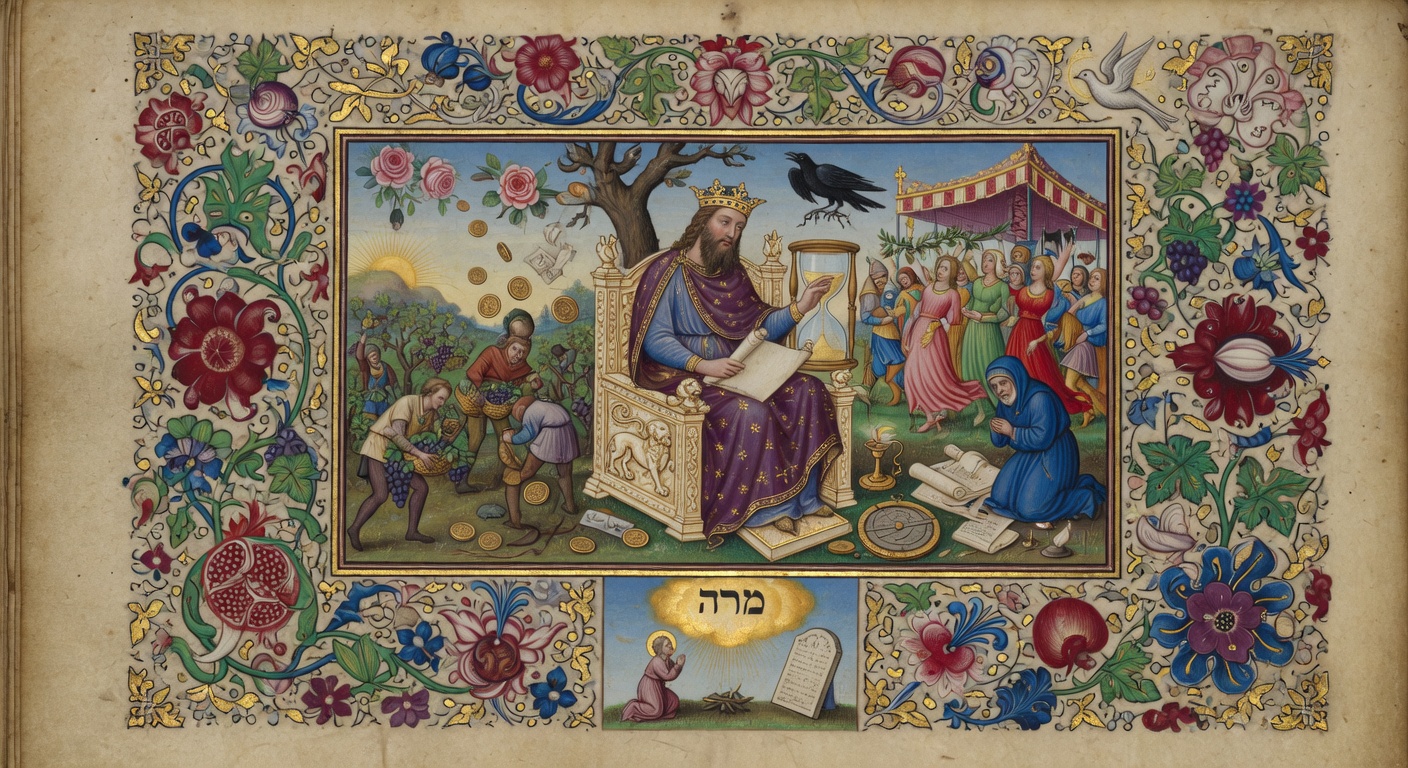
The opening rhetorical question in verse 1 about wisdom causing one's face to shine subtly echoes the theophany motif of Moses' radiant countenance after encountering God (Exodus 34), framing human insight as a reflected divine luminosity rather than innate brilliance.
 1ho is as the wise man? and who knoweth the interpretation of a thing? a man’s wisdom maketh his face to shine, and the boldness of his face shall be changed.
2 I counsel thee to keep the king’s commandment, and that in regard of the oath of God.
3 Be not hasty to go out of his sight: stand not in an evil thing; for he doeth whatsoever pleaseth him.
4 Where the word of a king is, there is power: and who may say unto him, What doest thou?
5 Whoso keepeth the commandment shall feel no evil thing: and a wise man’s heart discerneth both time and judgment.
6 Because to every purpose there is time and judgment, therefore the misery of man is great upon him.
7 For he knoweth not that which shall be: for who can tell him when it shall be?
8 There is no man that hath power over the spirit to retain the spirit; neither hath he power in the day of death: and there is no discharge in that war; neither shall wickedness deliver those that are given to it.
9 All this have I seen, and applied my heart unto every work that is done under the sun: there is a time wherein one man ruleth over another to his own hurt.
10 And so I saw the wicked buried, who had come and gone from the place of the holy, and they were forgotten in the city where they had so done: this is also vanity.
11 Because sentence against an evil work is not executed speedily, therefore the heart of the sons of men is fully set in them to do evil.
12 Though a sinner do evil an hundred times, and his days be prolonged, yet surely I know that it shall be well with them that fear God, which fear before him:
13 But it shall not be well with the wicked, neither shall he prolong his days, which are as a shadow; because he feareth not before God.
14 There is a vanity which is done upon the earth; that there be just men, unto whom it happeneth according to the work of the wicked; again, there be wicked men, to whom it happeneth according to the work of the righteous: I said that this also is vanity.
15 Then I commended mirth, because a man hath no better thing under the sun, than to eat, and to drink, and to be merry: for that shall abide with him of his labour the days of his life, which God giveth him under the sun.
16 When I applied mine heart to know wisdom, and to see the business that is done upon the earth: (for also there is that neither day nor night seeth sleep with his eyes:)
17 Then I beheld all the work of God, that a man cannot find out the work that is done under the sun: because though a man labour to seek it out, yet he shall not find it; yea farther; though a wise man think to know it, yet shall he not be able to find it.
← → arrow keys to navigate chapters · spacebar to play/pause audio
Did You Know?
The opening rhetorical question in verse 1 about wisdom causing one's face to shine subtly echoes the theophany motif of Moses' radiant countenance after encountering God (Exodus 34), framing human insight as a reflected divine luminosity rather than innate brilliance.
Verse 2's reference to obeying the king's command 'because of the oath of God' alludes to ancient Near Eastern suzerain-vassal treaties where royal authority was ratified by divine oaths, positioning political submission within a covenantal theological framework rather than mere pragmatism.
The observation in verses 10-11 that delayed judgment encourages wickedness directly subverts the standard Deuteronomic retribution principle found in Proverbs, presenting a rare biblical acknowledgment that empirical reality often contradicts expected moral causality.
Verse 8's declaration that no one has power to retain the spirit or escape the day of death uses the rare Hebrew term 'ruach' in a way that blurs the boundary between breath and divine spirit, linking human mortality to the uncontrollable divine wind imagery seen in Ezekiel and Job.
The chapter's closing admission (verse 17) that even exhaustive seeking cannot uncover God's work under the sun forms a deliberate inclusio with the prologue's quest motif, underscoring that epistemological humility is itself the fruit of wisdom rather than its failure.
The Queen of Sheba traveled roughly 1,200 miles from her Arabian kingdom with a caravan of camels carrying spices, gold, and stones to test Solomon's wisdom with riddles, then exchanged lavish gifts including 120 talents of gold that funded further temple adornments.
David twice spared Saul's life in the wilderness, once cutting off a piece of his robe in the En Gedi cave and later removing his spear and water jug while he slept, demonstrating restraint amid pursuit.
Jerusalem is mentioned over 800 times in the Bible. More than any other city.