Zechariah 10 KJV
The Lord Will Restore Israel
The Lord Will Restore Israel
The chapter's opening command to seek rain from YHWH rather than teraphim or diviners directly counters post-exilic syncretism, echoing Rachel's theft of household idols in Genesis while framing meteorological blessing as covenant fidelity rather than magical manipulation.
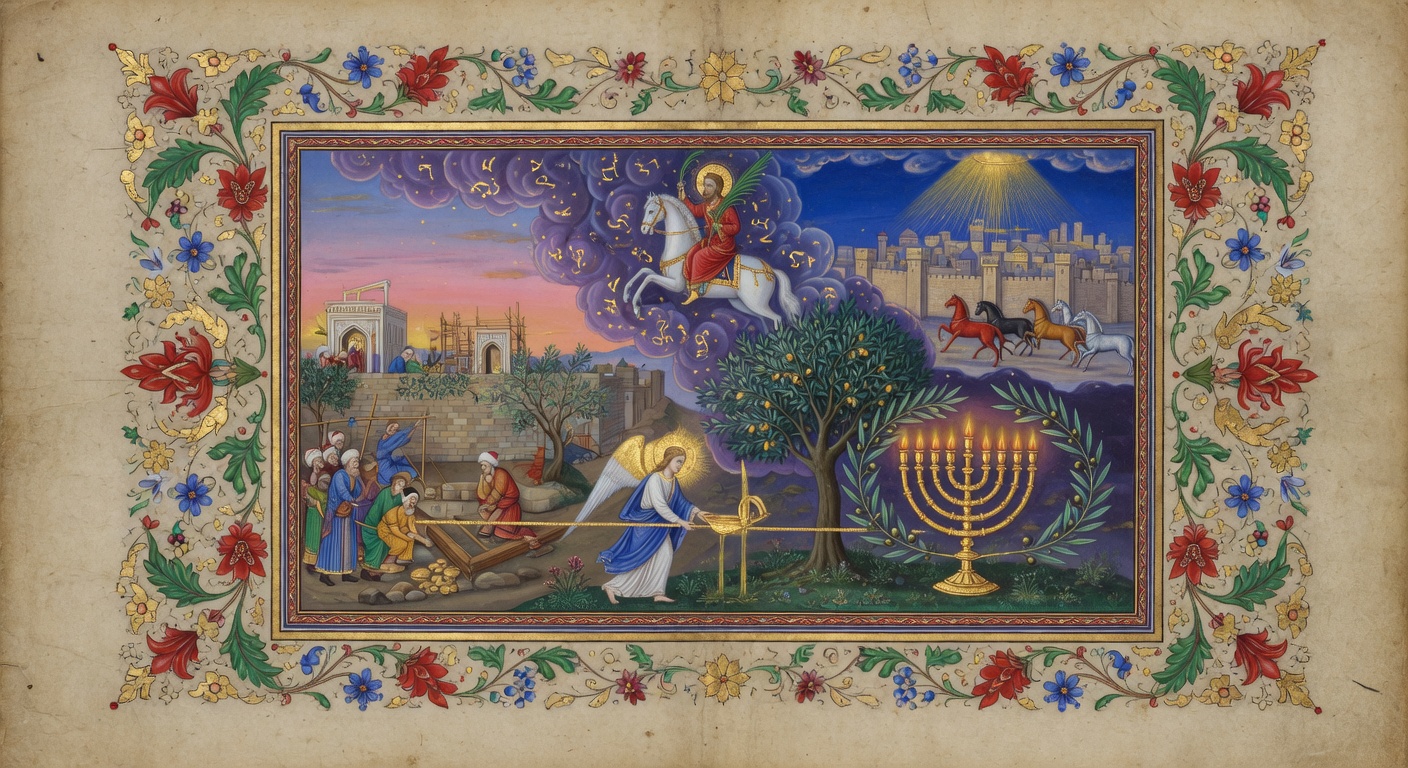
 1sk ye of the LORD rain in the time of the latter rain; so the LORD shall make bright clouds, and give them showers of rain, to every one grass in the field.
2 For the idols have spoken vanity, and the diviners have seen a lie, and have told false dreams; they comfort in vain: therefore they went their way as a flock, they were troubled, because there was no shepherd.
3 Mine anger was kindled against the shepherds, and I punished the goats: for the LORD of hosts hath visited his flock the house of Judah, and hath made them as his goodly horse in the battle.
4 Out of him came forth the corner, out of him the nail, out of him the battle bow, out of him every oppressor together.
5 And they shall be as mighty men, which tread down their enemies in the mire of the streets in the battle: and they shall fight, because the LORD is with them, and the riders on horses shall be confounded.
6 And I will strengthen the house of Judah, and I will save the house of Joseph, and I will bring them again to place them; for I have mercy upon them: and they shall be as though I had not cast them off: for I am the LORD their God, and will hear them.
7 And they of Ephraim shall be like a mighty man, and their heart shall rejoice as through wine: yea, their children shall see it, and be glad; their heart shall rejoice in the LORD.
8 I will hiss for them, and gather them; for I have redeemed them: and they shall increase as they have increased.
9 And I will sow them among the people: and they shall remember me in far countries; and they shall live with their children, and turn again.
10 I will bring them again also out of the land of Egypt, and gather them out of Assyria; and I will bring them into the land of Gilead and Lebanon; and place shall not be found for them.
11 And he shall pass through the sea with affliction, and shall smite the waves in the sea, and all the deeps of the river shall dry up: and the pride of Assyria shall be brought down, and the sceptre of Egypt shall depart away.
12 And I will strengthen them in the LORD; and they shall walk up and down in his name, saith the LORD.
← → arrow keys to navigate chapters · spacebar to play/pause audio
Did You Know?
The chapter's opening command to seek rain from YHWH rather than teraphim or diviners directly counters post-exilic syncretism, echoing Rachel's theft of household idols in Genesis while framing meteorological blessing as covenant fidelity rather than magical manipulation.
Verse 4's clustered metaphors of 'cornerstone,' 'tent peg,' and 'battle bow' allude to Isaiah 22's portrait of Eliakim, creating a typological chain that later Jewish and Christian interpreters read as pointing to a Davidic messiah who both stabilizes and wages war.
By promising to strengthen the 'house of Joseph' alongside Judah and to regather exiles from Egypt and Assyria, the text envisions a full reunification of the divided kingdoms, surpassing the limited return under Zerubbabel and anticipating eschatological restoration of the northern tribes.
The transformation of the people into 'his goodly horse in the battle' inverts prophetic critiques of military horses (Isaiah 31, Hosea 14) by recasting equine imagery as divine empowerment rather than human presumption.
The 'latter rain' petition in verse 1 functions as a double entendre for both literal spring rains vital to barley harvest and an eschatological outpouring, paralleling Joel's promise of the Spirit and linking agricultural and prophetic calendars in Second Temple expectation.
Zechariah was actually the grandson of the priest Iddo who returned from Babylon with Zerubbabel, a detail that explains his priestly perspective and access to temple rituals during the reconstruction period.
Zerubbabel's name, derived from Akkadian meaning 'seed of Babylon,' indicates he was likely born in captivity, underscoring how Persian policy allowed exiled royalty to retain leadership roles upon return.
Jesus' genealogy in Matthew intentionally incorporates four Gentile women. Tamar, Rahab, Ruth, and Uriah's wife. Highlighting the inclusion of outsiders in the messianic lineage contrary to typical Jewish genealogical emphasis on purity.
Jerusalem sits at about 2,500 feet elevation. Higher than most surrounding areas.
Commentary & Study Notes Jamieson-Fausset-Brown (1871) · Public Domain Ask... rain — on which the abundance of "corn" promised by the Lord (Zec 9:17) depends. Jehovah alone can give it, and will give it on being asked (Jer 10:13; 14:22). rain in... ti…
Classic verse-by-verse commentary on Zechariah 10 from Jamieson, Fausset & Brown (1871). Covers: Prayer and promise.
- 1
- Ask... rain — on which the abundance of "corn" promised by the Lord (Zec 9:17) depends. Jehovah alone can give it, and will give it on being asked (Jer 10:13; 14:22). rain in... time of... latter rain — that is, the latter rain in its due time, namely, in spring, about February or March (Job 29:23; Joe 2:23). The latter rain ripened the grain, as the former rain in October tended to fructify the seed. Including all temporal blessings; these again being types of spiritual ones. Though God has begun to bless us, we are not to relax our prayers. The former rain of conversion may have been given, but we must also ask for the latter rain of ripened sanctification. Though at Pentecost there was a former rain on the Jewish Church, a latter rain is still to be looked for, when the full harvest of the nation's conversion shall be gathered in to God. The spirit of prayer in the Church is an index at once of her piety, and of the spiritual blessings she may expect from God. When the Church is full of prayer, God pours out a full blessing. bright clouds — rather, "lightnings," the precursors of rain [MAURER]. showers of rain — literally, "rain of heavy rain." In Job 37:6 the same words occur in inverted order [HENDERSON]. grass — a general term, including both corn for men and grass for cattle.
- 2
- idols — literally, "the teraphim," the household gods, consulted in divination (see on Ho 3:4). Derived by GESENIUS from an Arabic root, "comfort," indicating them as the givers of comfort. Or an Ethiopian root, "relics." Herein Zechariah shows that the Jews by their own idolatry had stayed the grace of God heretofore, which otherwise would have given them all those blessings, temporal and spiritual, which they are now (Zec 10:1) urged to "ask" for. diviners — who gave responses to consulters of the teraphim: opposed to Jehovah and His true prophets. seen a lie — pretending to see what they saw not in giving responses. comfort in vain — literally, "give vapor for comfort"; that is, give comforting promises to consulters which are sure to come to naught (Job 13:4; 16:2; 21:34). therefore they went their way — that is, Israel and Judah were led away captive. as a flock... no shepherd — As sheep wander and are a prey to every injury when without a shepherd, so the Jews had been while they were without Jehovah, the true shepherd; for the false prophets whom they trusted were no shepherds (Eze 34:5). So now they are scattered, while they know not Messiah their shepherd; typified in the state of the disciples, when they had forsaken Jesus and fled (Mt 26:56; compare Zec 13:7).
Read all 12 notes on Zechariah 10 →