Zechariah 13 KJV
Cleansing from Sin
Cleansing from Sin
Verse 7's command to smite the shepherd is quoted verbatim in Matthew 26:31 and Mark 14:27 to explain the disciples' flight, but the Hebrew participle 'fellow' (עמיתי) implies the shepherd shares divine status, creating a stronger Trinitarian implication than the Greek translation captures.
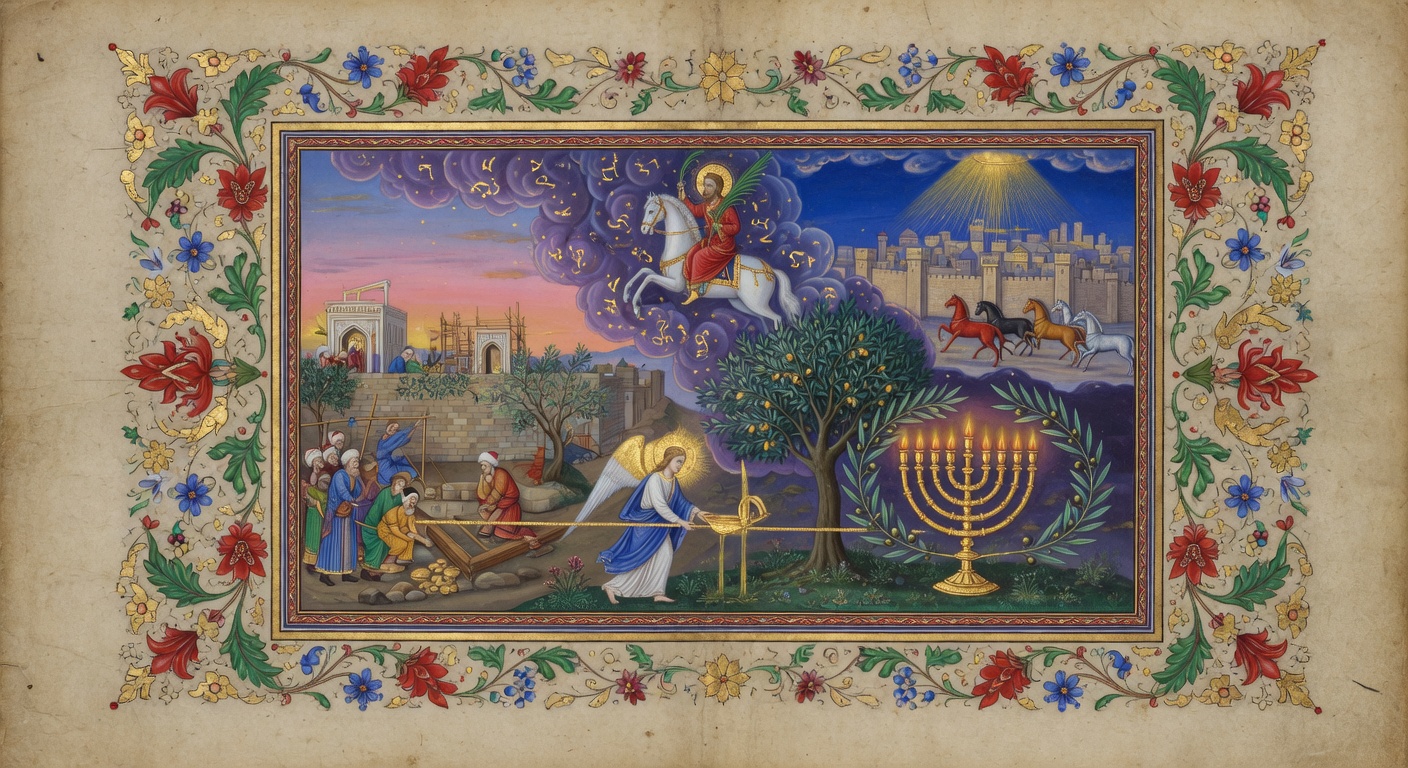
 1n that day there shall be a fountain opened to the house of David and to the inhabitants of Jerusalem for sin and for uncleanness.
2 And it shall come to pass in that day, saith the LORD of hosts, that I will cut off the names of the idols out of the land, and they shall no more be remembered: and also I will cause the prophets and the unclean spirit to pass out of the land.
3 And it shall come to pass, that when any shall yet prophesy, then his father and his mother that begat him shall say unto him, Thou shalt not live; for thou speakest lies in the name of the LORD: and his father and his mother that begat him shall thrust him through when he prophesieth.
4 And it shall come to pass in that day, that the prophets shall be ashamed every one of his vision, when he hath prophesied; neither shall they wear a rough garment to deceive:
5 But he shall say, I am no prophet, I am an husbandman; for man taught me to keep cattle from my youth.
6 And one shall say unto him, What are these wounds in thine hands? Then he shall answer, Those with which I was wounded in the house of my friends.
7 Awake, O sword, against my shepherd, and against the man that is my fellow, saith the LORD of hosts: smite the shepherd, and the sheep shall be scattered: and I will turn mine hand upon the little ones.
8 And it shall come to pass, that in all the land, saith the LORD, two parts therein shall be cut off and die; but the third shall be left therein.
9 And I will bring the third part through the fire, and will refine them as silver is refined, and will try them as gold is tried: they shall call on my name, and I will hear them: I will say, It is my people: and they shall say, The LORD is my God.
← → arrow keys to navigate chapters · spacebar to play/pause audio
Did You Know?
Verse 7's command to smite the shepherd is quoted verbatim in Matthew 26:31 and Mark 14:27 to explain the disciples' flight, but the Hebrew participle 'fellow' (עמיתי) implies the shepherd shares divine status, creating a stronger Trinitarian implication than the Greek translation captures.
The false prophet's claim in verse 5 to be merely a 'husbandman' (אכר) replicates the exact phrasing Amos uses to disclaim prophetic office in Amos 7:14, suggesting Zechariah deliberately invokes an earlier prophetic self-defense tradition to expose inauthentic claimants.
The 'wounds between thine hands' in verse 6 are explained in the Targum and medieval Jewish commentators as self-inflicted marks of ecstatic Baal prophets, yet the same phrase later became a proof-text in Christian polemics for stigmata or crucifixion wounds, showing a striking interpretive reversal across traditions.
Verses 8-9's reduction to a one-third remnant that is refined 'as silver is refined' employs the same metallurgical verb (צרף) found in Malachi 3:2-3, linking two post-exilic prophets in a shared theology of fiery purgation that prepares the remnant for renewed covenant relationship.
The chapter opens with a 'fountain opened' (מקור נפתח) for sin, a phrase that echoes the sudden release of subterranean waters in Genesis 7:11 yet is here redirected from judgment to cleansing, reversing the flood motif into an image of messianic purification.
Zechariah chapters 9-14 contain the earliest biblical references to a future pierced messianic figure and a fountain for cleansing sin, motifs later echoed in New Testament passion narratives.
Ezra 2 lists Zerubbabel returning with nearly 50,000 people including temple servants and livestock, yet the group faced severe economic hardship and identity conflicts with local populations claiming shared heritage.
Jesus appeared to over five hundred people at one time after his resurrection, a mass sighting noted by Paul in 1 Corinthians 15 that provides early corroboration beyond the Gospel accounts.
The city has been destroyed at least twice, besieged 23 times, and captured 44 times.
Commentary & Study Notes Jamieson-Fausset-Brown (1871) · Public Domain Connected with the close of the twelfth chapter. The mourning penitents are here comforted. fountain opened — It has been long opened, but then first it shall be so "to the house o…
Classic verse-by-verse commentary on Zechariah 13 from Jamieson, Fausset & Brown (1871). Covers: Cleansing of the jews from sin; Abolition of idolatry; The shepherd smitten; The people of the land cut off, except a third part refined by trials.
- 1
- Connected with the close of the twelfth chapter. The mourning penitents are here comforted. fountain opened — It has been long opened, but then first it shall be so "to the house of David," &c. (representing all Israel) after their long and weary wanderings. Like Hagar in the wilderness they remain ignorant of the refreshment near them, until God "opens their eyes" (Ge 21:19) [MOORE]. It is not the fountain, but their eyes that need to be opened. It shall be a "fountain" ever flowing; not a laver needing constantly to be replenished with water, such as stood between the tabernacle and altar (Ex 30:18). for sin... uncleanness — that is, judicial guilt and moral impurity. Thus justification and sanctification are implied in this verse as both flowing from the blood of Christ, not from ceremonial sacrifices (1Co 1:30; Heb 9:13, 14; 1Jo 1:7; compare Eze 36:25). Sin in Hebrew is literally a missing the mark or way.
- 2
- Consequences of pardon; not indolence, but the extirpation of sin. names of... idols — Their very names were not to be mentioned; thus the Jews, instead of Mephibaal, said Mephibosheth (Bosheth meaning a contemptible thing) (Ex 23:13; De 12:3; Ps 16:4). out of the land — Judea's two great sins, idolatry and false prophecy, have long since ceased. But these are types of all sin (for example, covetousness, Eph 5:5, a besetting sin of the Jews now). Idolatry, combined with the "spirit" of "Satan," is again to be incarnated in "the man of sin," who is to arise in Judea (2Th 2:3-12), and is to be "consumed with the Spirit of the Lord's mouth." Compare as to Antichrist's papal precursor, "seducing spirits... doctrines of devils," &c., 1Ti 4:1-3; 2Pe 2:1. the unclean spirit — Hebrew, spirit of uncleanness (compare Re 16:13); opposed to "the Spirit of holiness" (Ro 1:4), "spirit of error" (1Jo 4:6). One assuming to be divinely inspired, but in league with Satan.
Read all 9 notes on Zechariah 13 →