Zechariah 4 KJV
The Gold Lampstand and Olive Trees
The Gold Lampstand and Olive Trees
The vision's insistence that the temple will be finished 'not by might, nor by power, but by my spirit' reframes Zerubbabel's rebuilding project as a direct repudiation of Persian imperial ideology that equated temple construction with royal military strength.
 1nd the angel that talked with me came again, and waked me, as a man that is wakened out of his sleep,
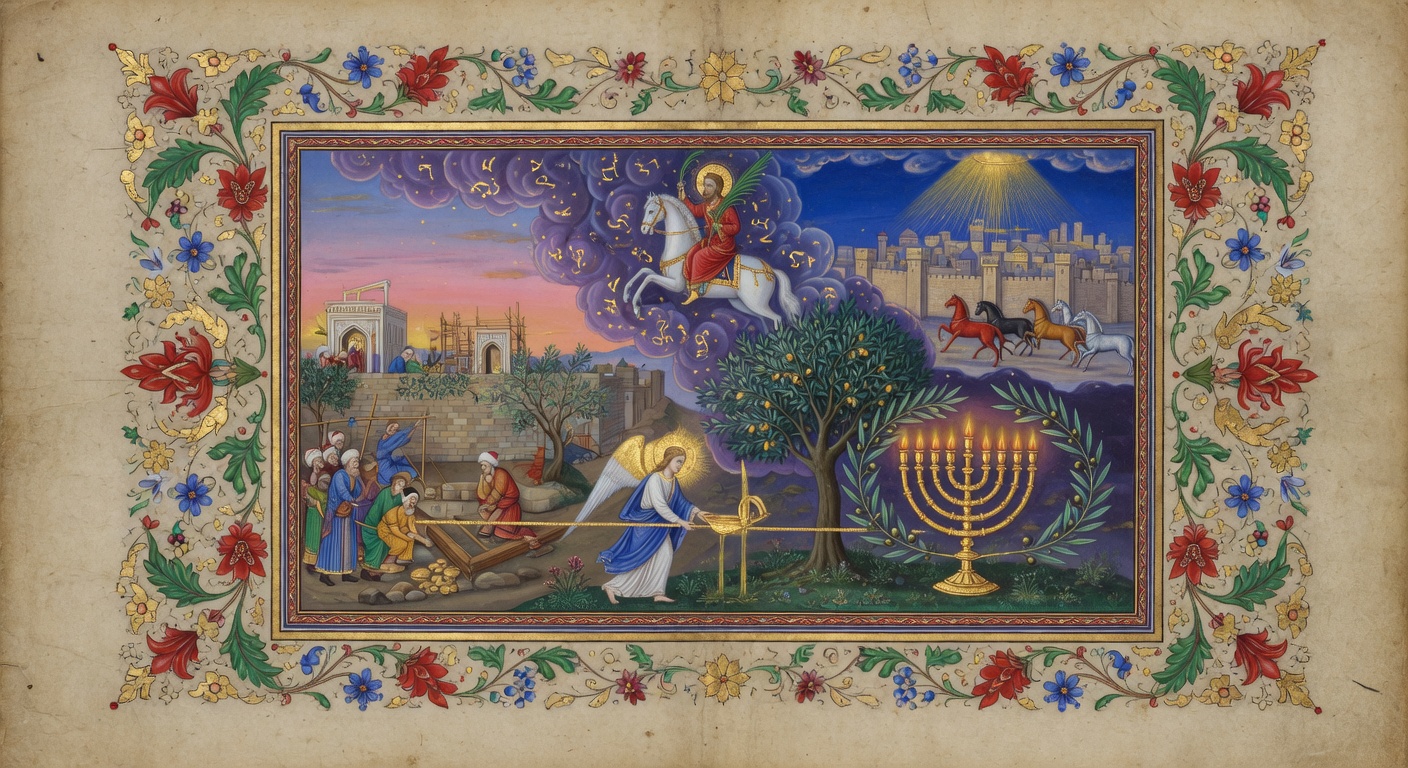
2 And said unto me, What seest thou? And I said, I have looked, and behold a candlestick all of gold, with a bowl upon the top of it, and his seven lamps thereon, and seven pipes to the seven lamps, which are upon the top thereof:
3 And two olive trees by it, one upon the right side of the bowl, and the other upon the left side thereof.
4 So I answered and spake to the angel that talked with me, saying, What are these, my lord?
5 Then the angel that talked with me answered and said unto me, Knowest thou not what these be? And I said, No, my lord.
6 Then he answered and spake unto me, saying, This is the word of the LORD unto Zerubbabel, saying, Not by might, nor by power, but by my spirit, saith the LORD of hosts.
7 Who art thou, O great mountain? before Zerubbabel thou shalt become a plain: and he shall bring forth the headstone thereof with shoutings, crying, Grace, grace unto it.
8 Moreover the word of the LORD came unto me, saying,
9 The hands of Zerubbabel have laid the foundation of this house; his hands shall also finish it; and thou shalt know that the LORD of hosts hath sent me unto you.
10 For who hath despised the day of small things? for they shall rejoice, and shall see the plummet in the hand of Zerubbabel with those seven; they are the eyes of the LORD, which run to and fro through the whole earth.
11 Then answered I, and said unto him, What are these two olive trees upon the right side of the candlestick and upon the left side thereof?
12 And I answered again, and said unto him, What be these two olive branches which through the two golden pipes empty the golden oil out of themselves?
13 And he answered me and said, Knowest thou not what these be? And I said, No, my lord.
14 Then said he, These are the two anointed ones, that stand by the LORD of the whole earth.
← → arrow keys to navigate chapters · spacebar to play/pause audio
Did You Know?
The vision's insistence that the temple will be finished 'not by might, nor by power, but by my spirit' reframes Zerubbabel's rebuilding project as a direct repudiation of Persian imperial ideology that equated temple construction with royal military strength.
By identifying the two olive trees as 'the two sons of oil' standing before the Lord, the chapter fuses royal and priestly anointing into a single vision, anticipating the diarchic leadership model later developed in the Dead Sea Scrolls' expectation of a messianic king and priest.
The seven lamps are explicitly called 'the eyes of the LORD, which run to and fro through the whole earth,' transforming the traditional menorah into a symbol of divine omniscience actively surveying and guaranteeing the temple's completion rather than merely illuminating sacred space.
Oil flows directly from the olive branches into the central bowl without human mediation or wick-trimming, a detail that quietly subverts the elaborate daily maintenance rituals prescribed for the tabernacle menorah in Exodus.
The chapter's closing identification of the two trees with Joshua and Zerubbabel creates an intertextual bridge to Haggai 2, where the same two leaders receive parallel oracles on the same day, suggesting the visions were originally paired to address a crisis of leadership legitimacy among the returnees.
As both prophet and priest, Zechariah's ministry overlapped with but extended years beyond Haggai's, continuing into the reign of Artaxerxes and addressing post-temple issues like ritual purity and Gentile inclusion in God's kingdom.
Though a Davidic heir and Persian-appointed governor, Zerubbabel vanishes from records after temple dedication around 516 BC, leading scholars to note his potential role in early messianic expectations without any recorded coronation.
Jesus had female disciples who traveled with and financially supported his ministry, an uncommon practice in first-century Judaism detailed in Luke 8:2-3 with specific names like Joanna and Susanna.
Jerusalem is mentioned over 800 times in the Bible. More than any other city.
Commentary & Study Notes Jamieson-Fausset-Brown (1871) · Public Domain waked me — The prophet was lying in a state of ecstatic slumber with astonishment at the previous vision. "Came again, and waked me," does not imply that the angel had departed and…
Classic verse-by-verse commentary on Zechariah 4 from Jamieson, Fausset & Brown (1871). Covers: Fifth vision. The golden candlestick and the two olive trees. The temple shall be completed by the aid of God's spirit.
- 1
- waked me — The prophet was lying in a state of ecstatic slumber with astonishment at the previous vision. "Came again, and waked me," does not imply that the angel had departed and now returned, but is an idiom for "waked me again."
- 2
- candlestick — symbolizing the Jewish theocracy; and ultimately, the Church of which the Jewish portion is to be the head: the light-bearer (so the original is of "lights," Mt 5:14, 16; Php 2:15) to the world. all... gold — all pure in doctrine and practice, precious and indestructible; such is the true ideal of the Church; such she shall be (Ps 45:13). bowl upon the top — In the candlestick of the tabernacle the plural is used, bowls (Ex 25:31). The Hebrew implies that it was the fountain of supply of oil to the lamps. Christ at the head ("on the top") of the Church is the true fountain, of whose fulness of the Spirit all we receive grace (Joh 1:16). his seven lamps — united in one stem; so in Ex 25:32. But in Re 1:12 the seven candlesticks are separate. The Gentile churches will not realize their unity till the Jewish Church as the stem unites all the lamps in one candlestick (Ro 11:16-24). The "seven lamps," in Re 4:5, are the "seven Spirits of God." seven pipes — feeding tubes, seven apiece from the "bowl" to each lamp (see Margin) [MAURER and CALVIN]; literally, "seven and seven": forty-nine in all. The greater the number of oil-feeding pipes, the brighter the light of the lamps. The explanation in Zec 4:6 is, that man's power by itself can neither retard nor advance God's work, that the real motive-power is God's Spirit. The seven times seven imply the manifold modes by which the Spirit's grace is imparted to the Church in her manifold work of enlightening the world.
Read all 13 notes on Zechariah 4 →