Binding of Isaac
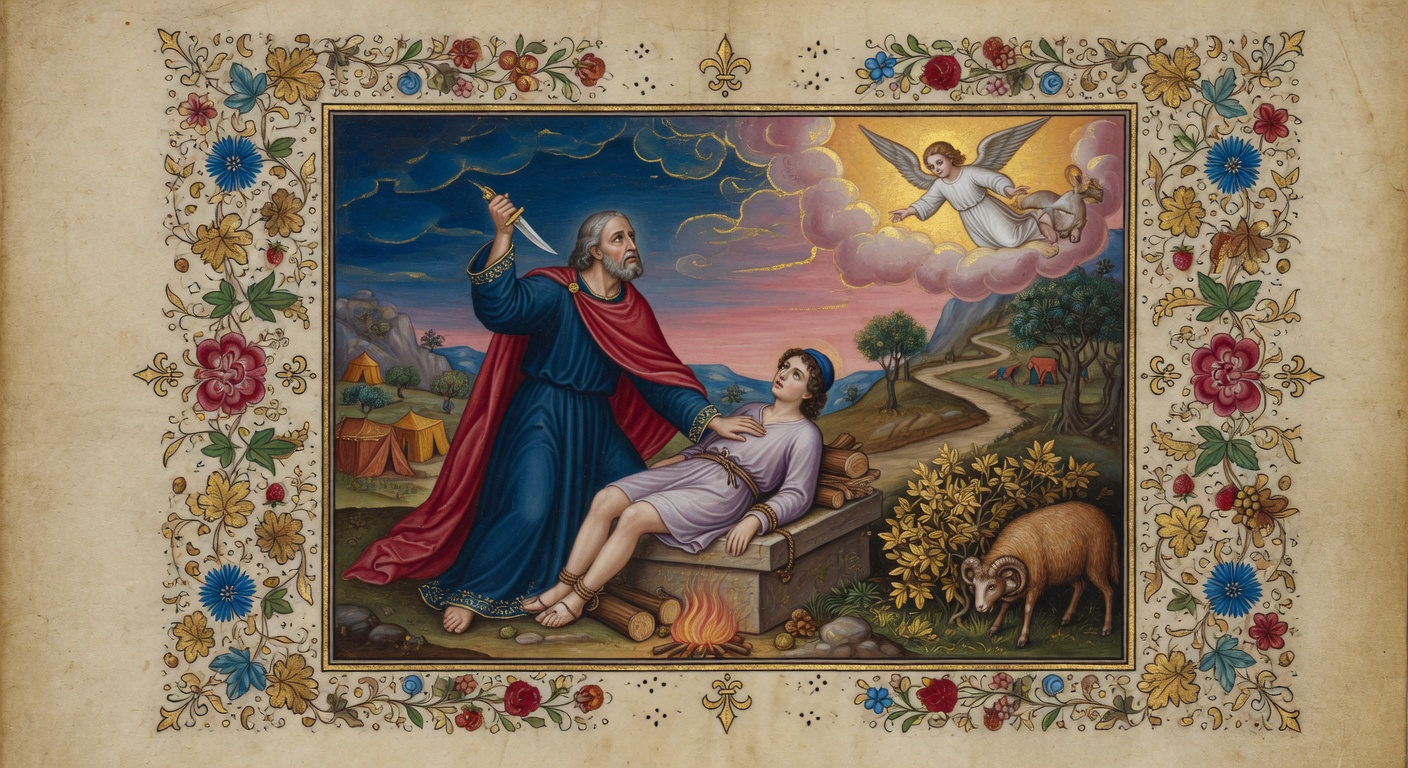
God asked a father to sacrifice his only son. What followed is one of the most agonizing tests of faith in all of Scripture.
In the biblical narrative from Genesis 22, God tests Abraham's faith by commanding him to sacrifice his son Isaac as a burnt offering on Mount Moriah. Abraham demonstrates complete obedience by journeying to the site, binding Isaac on the altar, and preparing to carry out the act until an angel of the Lord intervenes at the last moment, providing a ram caught in a thicket as a substitute. This event, known as the Akedah or Binding of Isaac, affirms the strength of the Abrahamic covenant through demonstrated trust in divine provision. Its significance in Scripture lies in establishing a model of faithful obedience while foreshadowing themes of substitutionary sacrifice that resonate throughout both the Hebrew Bible and New Testament interpretations.
Did You Know?
Abraham demonstrates complete obedience by journeying to the site, binding Isaac on the altar, and preparing to carry out the act until an angel of the Lord intervenes at the last moment, providing a ram caught in a thicket as a substitute.
This event, known as the Akedah or Binding of Isaac, affirms the strength of the Abrahamic covenant through demonstrated trust in divine provision.
This event is dated to approximately c. 2050 BC in biblical chronology.
This took place at or near Jerusalem.
Key Passage
Binding of Isaac
Genesis 22:1-19
 1nd it came to pass after these things, that God did tempt Abraham, and said unto him, Abraham: and he said, Behold, here I am.
Meanwhile in the World
Egypt's Old Kingdom builds the pyramids (c. 2600-2100 BC). Mesopotamia is dominated by Akkad and then Ur III. The Indus Valley civilization flourishes. Stonehenge is being constructed in Britain. This is the era of the great ziggurats and the first law codes (Ur-Nammu).