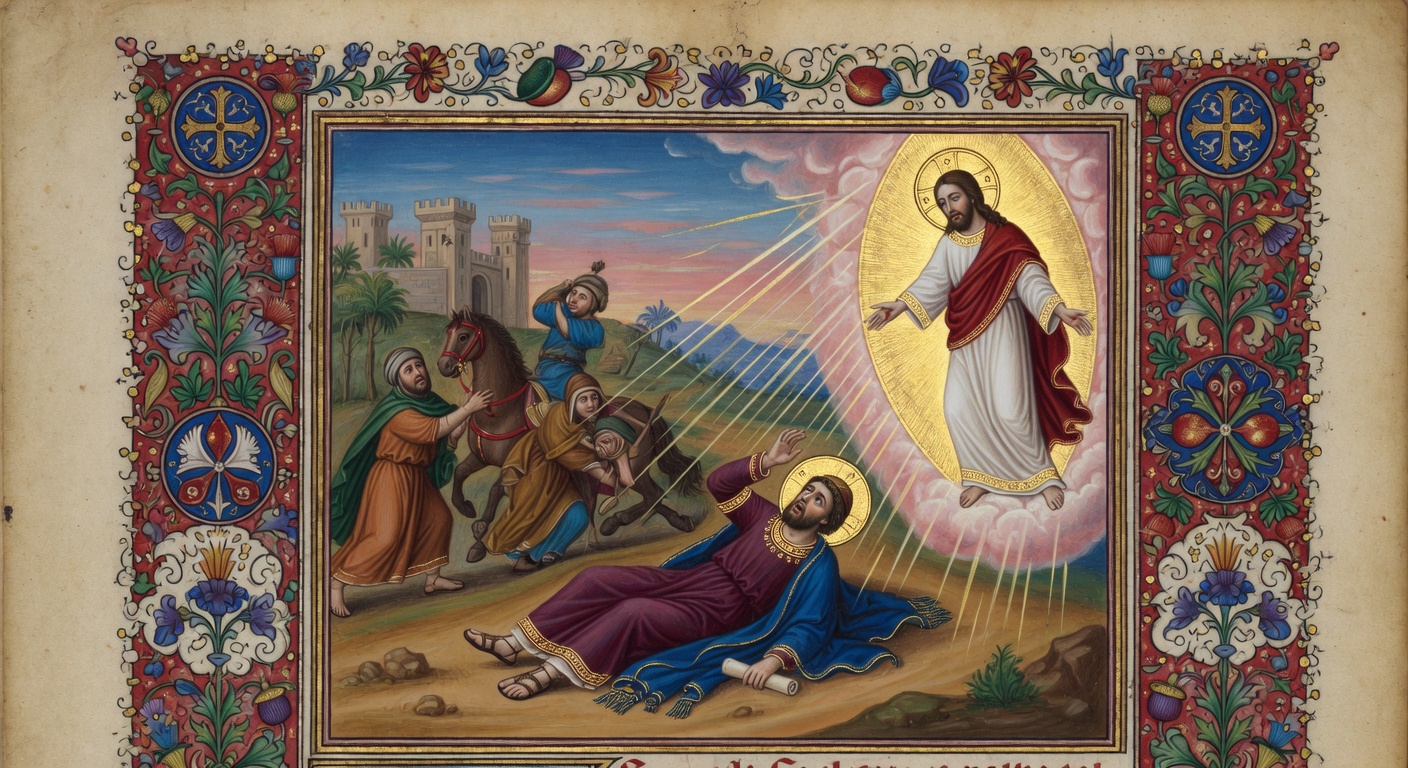
Conversion of Paul

Illustration of Conversion of Paul
Era
Early Church
Date
c. AD 33-36 โ‰ˆ Approximate
Reference
Acts 9:1-19
The church's greatest enemy became its greatest missionary - blinded by light on the road to Damascus.

Saul of Tarsus, a zealous Pharisee actively persecuting early Christians, was traveling to Damascus when he encountered the risen Christ in a blinding vision of light, during which Jesus confronted him about his actions and commissioned him for ministry. Temporarily blinded, Saul was led into the city where the disciple Ananias restored his sight and baptized him, marking his immediate transformation from opponent of the faith to devoted follower who soon began preaching that Jesus is the Son of God. This event, recorded in Acts 9 with additional details in Acts 22 and 26, holds major significance in Scripture as it illustrates divine grace powerfully redirecting a key adversary, resulting in Saul's adoption of the name Paul and his pivotal role as apostle to the Gentiles.

0:00

Did You Know?

1

This event is dated to approximately c. AD 33-36 in biblical chronology.

2

This took place at or near Damascus.

Key Passage

Conversion of Paul

Acts 9:1-19
A1nd Saul, yet breathing out threatenings and slaughter against the disciples of the Lord, went unto the high priest,

2 And desired of him letters to Damascus to the synagogues, that if he found any of this way, whether they were men or women, he might bring them bound unto Jerusalem. 3 And as he journeyed, he came near Damascus: and suddenly there shined round about him a light from heaven: 4 And he fell to the earth, and heard a voice saying unto him, Saul, Saul, why persecutest thou me? 5 And he said, Who art thou, Lord? And the Lord said, I am Jesus whom thou persecutest: it is hard for thee to kick against the pricks. 6 And he trembling and astonished said, Lord, what wilt thou have me to do? And the Lord said unto him, Arise, and go into the city, and it shall be told thee what thou must do. 7 And the men which journeyed with him stood speechless, hearing a voice, but seeing no man. 8 And Saul arose from the earth; and when his eyes were opened, he saw no man: but they led him by the hand, and brought him into Damascus. 9 And he was three days without sight, and neither did eat nor drink. 10 And there was a certain disciple at Damascus, named Ananias; and to him said the Lord in a vision, Ananias. And he said, Behold, I am here, Lord. 11 And the Lord said unto him, Arise, and go into the street which is called Straight, and enquire in the house of Judas for one called Saul, of Tarsus: for, behold, he prayeth, 12 And hath seen in a vision a man named Ananias coming in, and putting his hand on him, that he might receive his sight. 13 Then Ananias answered, Lord, I have heard by many of this man, how much evil he hath done to thy saints at Jerusalem: 14 And here he hath authority from the chief priests to bind all that call on thy name. 15 But the Lord said unto him, Go thy way: for he is a chosen vessel unto me, to bear my name before the Gentiles, and kings, and the children of Israel: 16 For I will shew him how great things he must suffer for my nameโ€™s sake. 17 And Ananias went his way, and entered into the house; and putting his hands on him said, Brother Saul, the Lord, even Jesus, that appeared unto thee in the way as thou camest, hath sent me, that thou mightest receive thy sight, and be filled with the Holy Ghost. 18 And immediately there fell from his eyes as it had been scales: and he received sight forthwith, and arose, and was baptized. 19 And when he had received meat, he was strengthened. Then was Saul certain days with the disciples which were at Damascus.

Read full chapter: Acts 9 โ†’

Meanwhile in the World

The Roman Empire under Nero, Vespasian, and Domitian. Nero persecutes Christians (AD 64). Jerusalem and its temple are destroyed by Rome (AD 70). Pompeii is buried by Vesuvius (AD 79). The Colosseum is built. This is the era of the Pax Romana's later years and increasing imperial cult pressure.

When: c. AD 30 - 100

Key Civilizations: Roman Empire (Flavian dynasty)

Biblical Parallels: Acts 1-28

Destruction of the Second Temple (70 AD), rise of rabbinic Judaism