
Council of Jerusalem
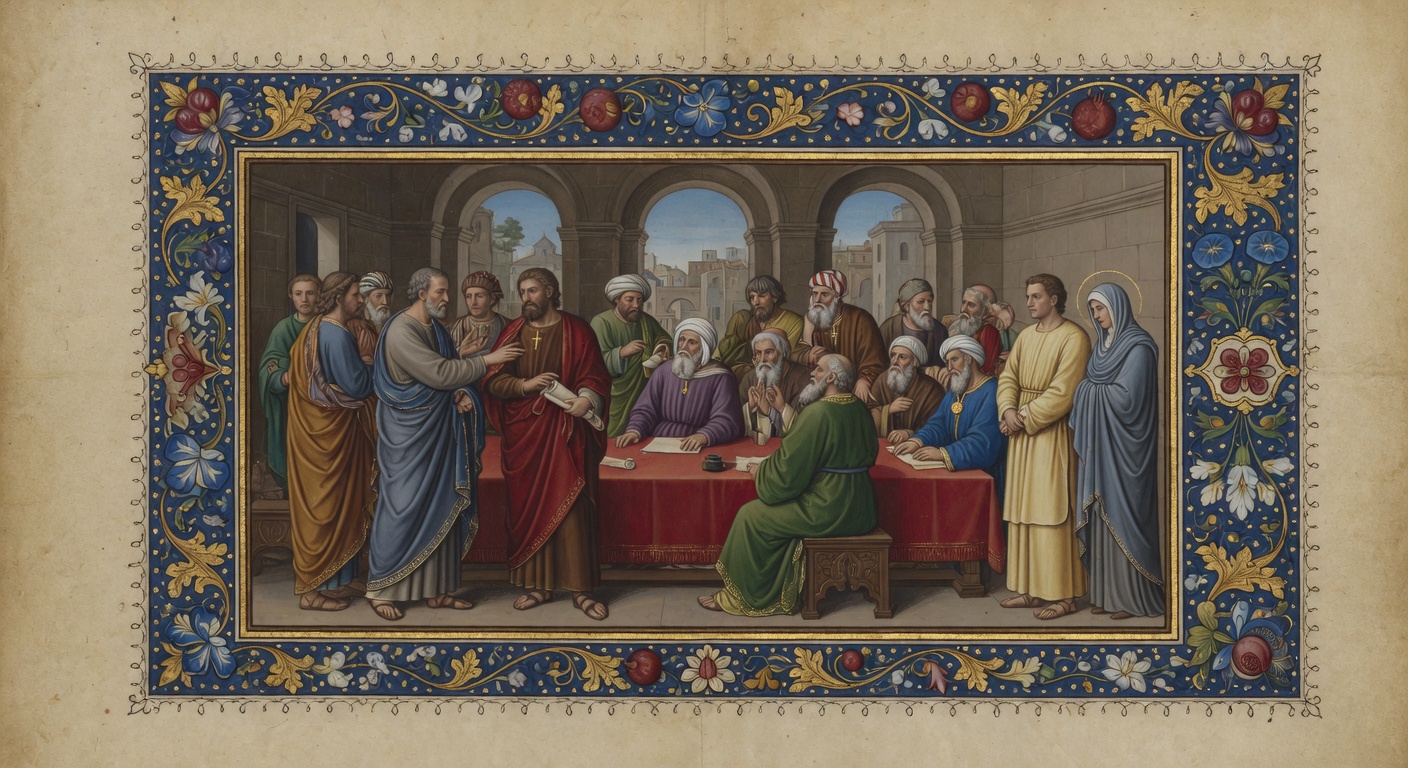
Illustration of Council of Jerusalem
Era
Early Church
Date
c. AD 49 โ‰ˆ Approximate
Reference
Acts 15:1-29

The Council of Jerusalem, described in Acts 15, was convened by the early church leaders around 50 AD to resolve a dispute over whether Gentile converts must undergo circumcision and fully observe the Mosaic Law to be saved. Jewish believers from Judea insisted on these requirements, but apostles including Peter, Paul, Barnabas, and James gathered to examine the matter through testimonies, the Holy Spirit's work among Gentiles, and scriptural interpretation. The council ultimately ruled that circumcision was unnecessary for salvation, issuing a letter directing Gentile believers only to avoid food sacrificed to idols, blood, strangled animals, and sexual immorality. This decision proved pivotal in Scripture by affirming salvation through grace alone, enabling the church's expansion beyond Jewish boundaries, and modeling Spirit-led resolution of doctrinal conflict for future generations.

0:00

Did You Know?

1

Jewish believers from Judea insisted on these requirements, but apostles including Peter, Paul, Barnabas, and James gathered to examine the matter through testimonies, the Holy Spirit's work among Gentiles, and scriptural interpretation.

2

The council ultimately ruled that circumcision was unnecessary for salvation, issuing a letter directing Gentile believers only to avoid food sacrificed to idols, blood, strangled animals, and sexual immorality.

3

This event is dated to approximately c. AD 49 in biblical chronology.

4

Key figures involved: Paul, Barnabas, Peter, James Brother Of Jesus.

5

This took place at or near Jerusalem and Antioch.

Key Passage

Council of Jerusalem

Acts 15:1-29
A1nd certain men which came down from Judaea taught the brethren, and said, Except ye be circumcised after the manner of Moses, ye cannot be saved.

2 When therefore Paul and Barnabas had no small dissension and disputation with them, they determined that Paul and Barnabas, and certain other of them, should go up to Jerusalem unto the apostles and elders about this question. 3 And being brought on their way by the church, they passed through Phenice and Samaria, declaring the conversion of the Gentiles: and they caused great joy unto all the brethren. 4 And when they were come to Jerusalem, they were received of the church, and of the apostles and elders, and they declared all things that God had done with them. 5 But there rose up certain of the sect of the Pharisees which believed, saying, That it was needful to circumcise them, and to command them to keep the law of Moses. 6 And the apostles and elders came together for to consider of this matter. 7 And when there had been much disputing, Peter rose up, and said unto them, Men and brethren, ye know how that a good while ago God made choice among us, that the Gentiles by my mouth should hear the word of the gospel, and believe. 8 And God, which knoweth the hearts, bare them witness, giving them the Holy Ghost, even as he did unto us; 9 And put no difference between us and them, purifying their hearts by faith. 10 Now therefore why tempt ye God, to put a yoke upon the neck of the disciples, which neither our fathers nor we were able to bear? 11 But we believe that through the grace of the LORD Jesus Christ we shall be saved, even as they. 12 Then all the multitude kept silence, and gave audience to Barnabas and Paul, declaring what miracles and wonders God had wrought among the Gentiles by them. 13 And after they had held their peace, James answered, saying, Men and brethren, hearken unto me: 14 Simeon hath declared how God at the first did visit the Gentiles, to take out of them a people for his name. 15 And to this agree the words of the prophets; as it is written, 16 After this I will return, and will build again the tabernacle of David, which is fallen down; and I will build again the ruins thereof, and I will set it up: 17 That the residue of men might seek after the Lord, and all the Gentiles, upon whom my name is called, saith the Lord, who doeth all these things. 18 Known unto God are all his works from the beginning of the world. 19 Wherefore my sentence is, that we trouble not them, which from among the Gentiles are turned to God: 20 But that we write unto them, that they abstain from pollutions of idols, and from fornication, and from things strangled, and from blood. 21 For Moses of old time hath in every city them that preach him, being read in the synagogues every sabbath day. 22 Then pleased it the apostles and elders, with the whole church, to send chosen men of their own company to Antioch with Paul and Barnabas; namely, Judas surnamed Barsabas, and Silas, chief men among the brethren: 23 And they wrote letters by them after this manner; The apostles and elders and brethren send greeting unto the brethren which are of the Gentiles in Antioch and Syria and Cilicia: 24 Forasmuch as we have heard, that certain which went out from us have troubled you with words, subverting your souls, saying, Ye must be circumcised, and keep the law: to whom we gave no such commandment: 25 It seemed good unto us, being assembled with one accord, to send chosen men unto you with our beloved Barnabas and Paul, 26 Men that have hazarded their lives for the name of our Lord Jesus Christ. 27 We have sent therefore Judas and Silas, who shall also tell you the same things by mouth. 28 For it seemed good to the Holy Ghost, and to us, to lay upon you no greater burden than these necessary things; 29 That ye abstain from meats offered to idols, and from blood, and from things strangled, and from fornication: from which if ye keep yourselves, ye shall do well. Fare ye well.

Read full chapter: Acts 15 โ†’

Meanwhile in the World

The Roman Empire under Nero, Vespasian, and Domitian. Nero persecutes Christians (AD 64). Jerusalem and its temple are destroyed by Rome (AD 70). Pompeii is buried by Vesuvius (AD 79). The Colosseum is built. This is the era of the Pax Romana's later years and increasing imperial cult pressure.

When: c. AD 30 - 100

Key Civilizations: Roman Empire (Flavian dynasty)

Biblical Parallels: Acts 1-28

Destruction of the Second Temple (70 AD), rise of rabbinic Judaism