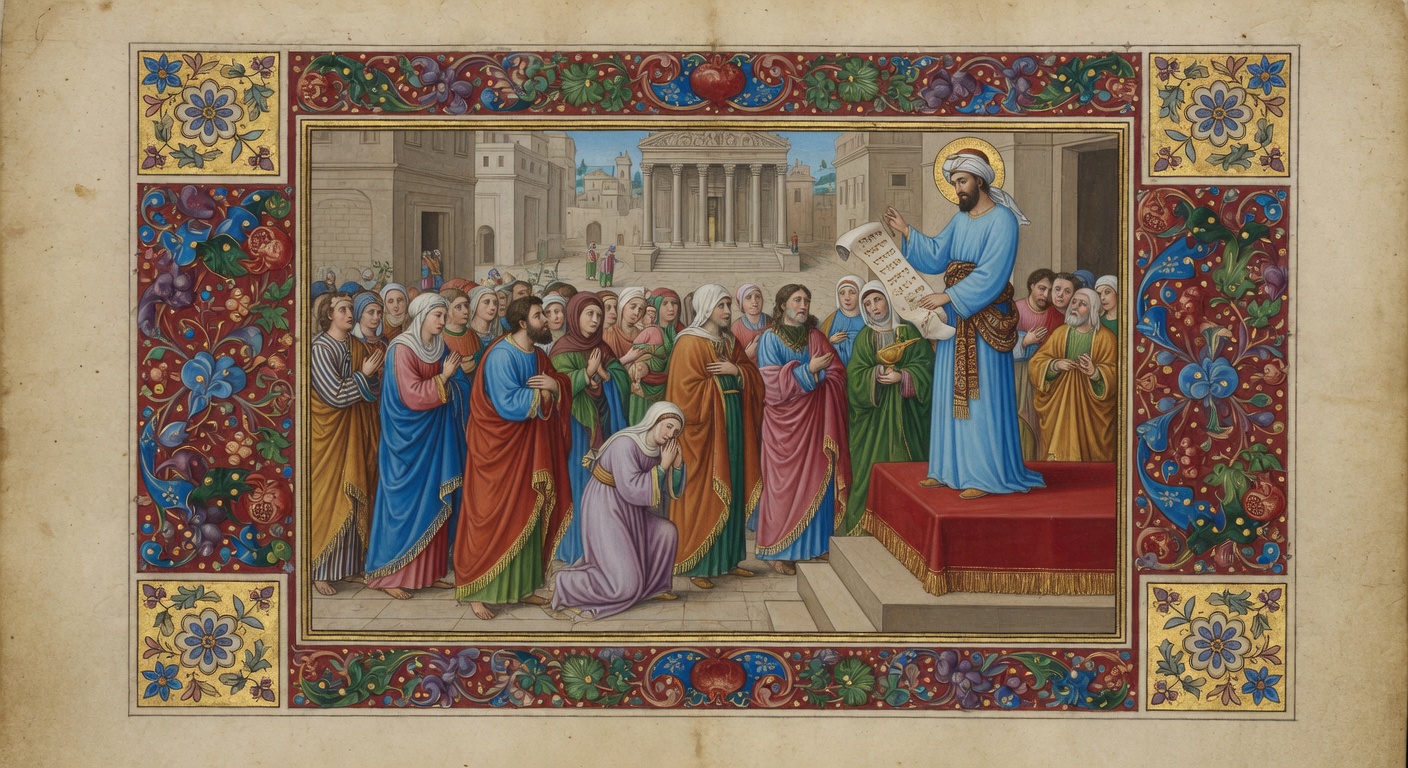
Ezra Reads the Law

Illustration of Ezra Reads the Law
Era
Exile & Return
Date
c. 444 BC โ‰ˆ Approximate
Reference
Nehemiah 8:1-12

Following the return from Babylonian exile and the rebuilding of Jerusalem's walls under Nehemiah, Ezra the priest and scribe assembled all the people (including men, women, and those old enough to understand) in the square before the Water Gate. From daybreak until noon he read aloud from the Book of the Law of Moses while Levites explained its meaning, prompting the crowd to weep in conviction, worship, and renewed obedience. The people then observed the Feast of Tabernacles with joy and later confessed their sins, leading to a covenant renewal ceremony. This public reading, recorded in Nehemiah 8, highlights Scripture's central role in restoring Israel's spiritual identity and covenant faithfulness after judgment and dispersion.

0:00

Did You Know?

1

From daybreak until noon he read aloud from the Book of the Law of Moses while Levites explained its meaning, prompting the crowd to weep in conviction, worship, and renewed obedience.

2

The people then observed the Feast of Tabernacles with joy and later confessed their sins, leading to a covenant renewal ceremony.

3

This event is dated to approximately c. 444 BC in biblical chronology.

4

This took place at or near Jerusalem.

5

The public reading in Nehemiah 8 signified a profound renewal of Israel's covenant relationship with God, reinforcing Scripture's central place in communal worship.

Key Passage

Ezra Reads the Law

Nehemiah 8:1-12
A1nd all the people gathered themselves together as one man into the street that was before the water gate; and they spake unto Ezra the scribe to bring the book of the law of Moses, which the LORD had commanded to Israel.

2 And Ezra the priest brought the law before the congregation both of men and women, and all that could hear with understanding, upon the first day of the seventh month. 3 And he read therein before the street that was before the water gate from the morning until midday, before the men and the women, and those that could understand; and the ears of all the people were attentive unto the book of the law. 4 And Ezra the scribe stood upon a pulpit of wood, which they had made for the purpose; and beside him stood Mattithiah, and Shema, and Anaiah, and Urijah, and Hilkiah, and Maaseiah, on his right hand; and on his left hand, Pedaiah, and Mishael, and Malchiah, and Hashum, and Hashbadana, Zechariah, and Meshullam. 5 And Ezra opened the book in the sight of all the people; (for he was above all the people;) and when he opened it, all the people stood up: 6 And Ezra blessed the LORD, the great God. And all the people answered, Amen, Amen, with lifting up their hands: and they bowed their heads, and worshipped the LORD with their faces to the ground. 7 Also Jeshua, and Bani, and Sherebiah, Jamin, Akkub, Shabbethai, Hodijah, Maaseiah, Kelita, Azariah, Jozabad, Hanan, Pelaiah, and the Levites, caused the people to understand the law: and the people stood in their place. 8 So they read in the book in the law of God distinctly, and gave the sense, and caused them to understand the reading. 9 And Nehemiah, which is the Tirshatha, and Ezra the priest the scribe, and the Levites that taught the people, said unto all the people, This day is holy unto the LORD your God; mourn not, nor weep. For all the people wept, when they heard the words of the law. 10 Then he said unto them, Go your way, eat the fat, and drink the sweet, and send portions unto them for whom nothing is prepared: for this day is holy unto our LORD: neither be ye sorry; for the joy of the LORD is your strength. 11 So the Levites stilled all the people, saying, Hold your peace, for the day is holy; neither be ye grieved. 12 And all the people went their way to eat, and to drink, and to send portions, and to make great mirth, because they had understood the words that were declared unto them.

Read full chapter: Nehemiah 8 โ†’

Meanwhile in the World

Babylon under Nebuchadnezzar conquers the known world, then falls to Persia under Cyrus the Great (539 BC). Greece enters its Classical period - Socrates, Plato, the Parthenon. Rome becomes a republic. The Persian Empire creates the Royal Road and standardized coinage.

When: 586 - 400 BC

Key Civilizations: Neo-Babylonian Empire, Achaemenid Persia, Classical Greece