1 Corinthians 3 KJV
The Church and Its Leaders
Echoes & Connections 1 connections
The Church and Its Leaders
Paul's transition from agricultural metaphors (planting and watering) to architectural ones (foundation-laying and combustible materials) mirrors ancient rhetorical handbooks on varied imagery to sustain audience attention while reinforcing that human leaders remain subordinate to God's singular role in both growth and eschatological testing.
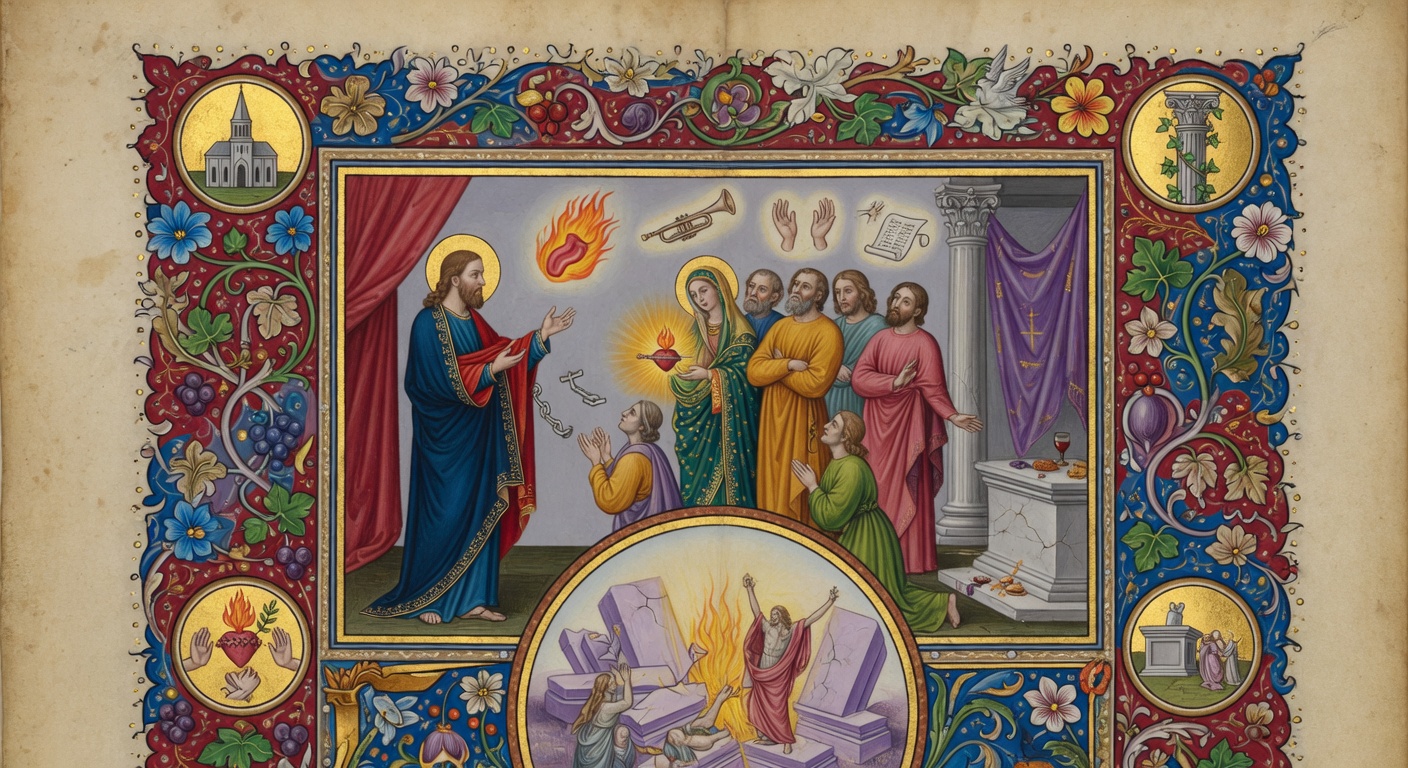
 1nd I, brethren, could not speak unto you as unto spiritual, but as unto carnal, even as unto babes in Christ.
2 I have fed you with milk, and not with meat: for hitherto ye were not able to bear it, neither yet now are ye able.
3 For ye are yet carnal: for whereas there is among you envying, and strife, and divisions, are ye not carnal, and walk as men?
4 For while one saith, I am of Paul; and another, I am of Apollos; are ye not carnal?
5 Who then is Paul, and who is Apollos, but ministers by whom ye believed, even as the Lord gave to every man?
6 I have planted, Apollos watered; but God gave the increase.
7 So then neither is he that planteth any thing, neither he that watereth; but God that giveth the increase.
8 Now he that planteth and he that watereth are one: and every man shall receive his own reward according to his own labour.
9 For we are labourers together with God: ye are God’s husbandry, ye are God’s building.
10 According to the grace of God which is given unto me, as a wise masterbuilder, I have laid the foundation, and another buildeth thereon. But let every man take heed how he buildeth thereupon.
11 For other foundation can no man lay than that is laid, which is Jesus Christ.
12 Now if any man build upon this foundation gold, silver, precious stones, wood, hay, stubble;
13 Every man’s work shall be made manifest: for the day shall declare it, because it shall be revealed by fire; and the fire shall try every man’s work of what sort it is.
14 If any man’s work abide which he hath built thereupon, he shall receive a reward.
15 If any man’s work shall be burned, he shall suffer loss: but he himself shall be saved; yet so as by fire.
16 Know ye not that ye are the temple of God, and that the Spirit of God dwelleth in you?cf.
17 If any man defile the temple of God, him shall God destroy; for the temple of God is holy, which temple ye are.cf.
18 Let no man deceive himself. If any man among you seemeth to be wise in this world, let him become a fool, that he may be wise.
19 For the wisdom of this world is foolishness with God. For it is written, He taketh the wise in their own craftiness.
20 And again, The Lord knoweth the thoughts of the wise, that they are vain.
21 Therefore let no man glory in men. For all things are yours;
22 Whether Paul, or Apollos, or Cephas, or the world, or life, or death, or things present, or things to come; all are yours;
23 And ye are Christ’s; and Christ is God’s.
← → arrow keys to navigate chapters · spacebar to play/pause audio
Did You Know?
Paul's transition from agricultural metaphors (planting and watering) to architectural ones (foundation-laying and combustible materials) mirrors ancient rhetorical handbooks on varied imagery to sustain audience attention while reinforcing that human leaders remain subordinate to God's singular role in both growth and eschatological testing.
The phrase 'ye are God's building' in verse 9 employs the rare compound term 'theou oikodome' that echoes Septuagint descriptions of the Jerusalem temple, transferring sacred-space language from a physical structure to the Corinthian congregation and implying that factionalism constitutes a form of temple desecration.
Verse 15's 'saved yet so as by fire' alludes to the ordeal-by-fire motif in Numbers 16 and Amos 4, where survival through divine fire signals both judgment on rebellion and unexpected preservation, repurposed here to describe believers who lose rewards but retain salvation.
By calling himself a 'wise masterbuilder' (architekton), Paul borrows technical terminology from Greco-Roman building contracts, where the architekton alone received payment for the entire project; this subtly asserts his foundational authority over later workers like Apollos without claiming ownership of the church.
The chapter's closing assertion that 'all things are yours' inverts the Roman patronage system dominant in Corinth, where clients accrued honor by attaching themselves to powerful patrons; Paul instead declares believers as heirs of the cosmos through union with Christ, rendering allegiance to human leaders unnecessary.
Apollos is the only New Testament figure explicitly said to have debated publicly and 'refuted' Jewish opponents in the synagogue using Scripture, demonstrating a level of formal debate skill rare among the apostles themselves.
In 2 Corinthians, Paul details surviving three shipwrecks, a night and day adrift at sea, and being stoned and left for dead at Lystra, hardships that underscore the physical dangers of his travels beyond the more commonly recounted imprisonments.
Corinth was so immoral that 'to Corinthianize' became a Greek verb meaning to be sexually immoral.
Commentary & Study Notes Jamieson-Fausset-Brown (1871) · Public Domain And I — that is, as the natural (animal) man cannot receive, so I also could not speak unto you the deep things of God, as I would to the spiritual; but I was compelled to speak to…
Classic verse-by-verse commentary on 1 Corinthians 3 from Jamieson, Fausset & Brown (1871). Covers: Paul could not speak to them of deep spiritual truths, as they were carnal, contending for their several teachers; These are nothing but workers for God, to whom they must give account in the day of fiery judgment. The hearers are God's temple, which they must not defile by contentions for teachers, who, as well as all things, are theirs, being Christ's.
- 1
- And I — that is, as the natural (animal) man cannot receive, so I also could not speak unto you the deep things of God, as I would to the spiritual; but I was compelled to speak to you as I would to MEN OF FLESH. The oldest manuscripts read this for "carnal." The former (literally, "fleshy") implies men wholly of flesh, or natural. Carnal, or fleshly, implies not they were wholly natural or unregenerate (1Co 2:14), but that they had much of a carnal tendency; for example their divisions. Paul had to speak to them as he would to men wholly natural, inasmuch as they are still carnal (1Co 3:3) in many respects, notwithstanding their conversion (1Co 1:4-9). babes — contrasted with the perfect (fully matured) in Christ (Col 1:28; compare Heb 5:13, 14). This implies they were not men wholly of flesh, though carnal in tendencies. They had life in Christ, but it was weak. He blames them for being still in a degree (not altogether, compare 1Co 1:5, 7; therefore he says as) babes in Christ, when by this time they ought to have "come unto a perfect man, unto the measure of the stature of the fulness of Christ" (Eph 4:13). In Ro 7:14, also the oldest manuscripts read, "I am a man of flesh."
- 2
- (Heb 5:12). milk — the elementary "principles of the doctrine of Christ."
Read all 23 notes on 1 Corinthians 3 →