1 Corinthians 5 KJV
Immorality in the Church
Echoes & Connections 1 connections
Immorality in the Church
Paul's identification of Christ as "our passover" in verse 7 draws on the Passover lamb's blood applied to doorposts in Exodus, positioning church purity as participation in Christ's atoning sacrifice rather than mere moral improvement.
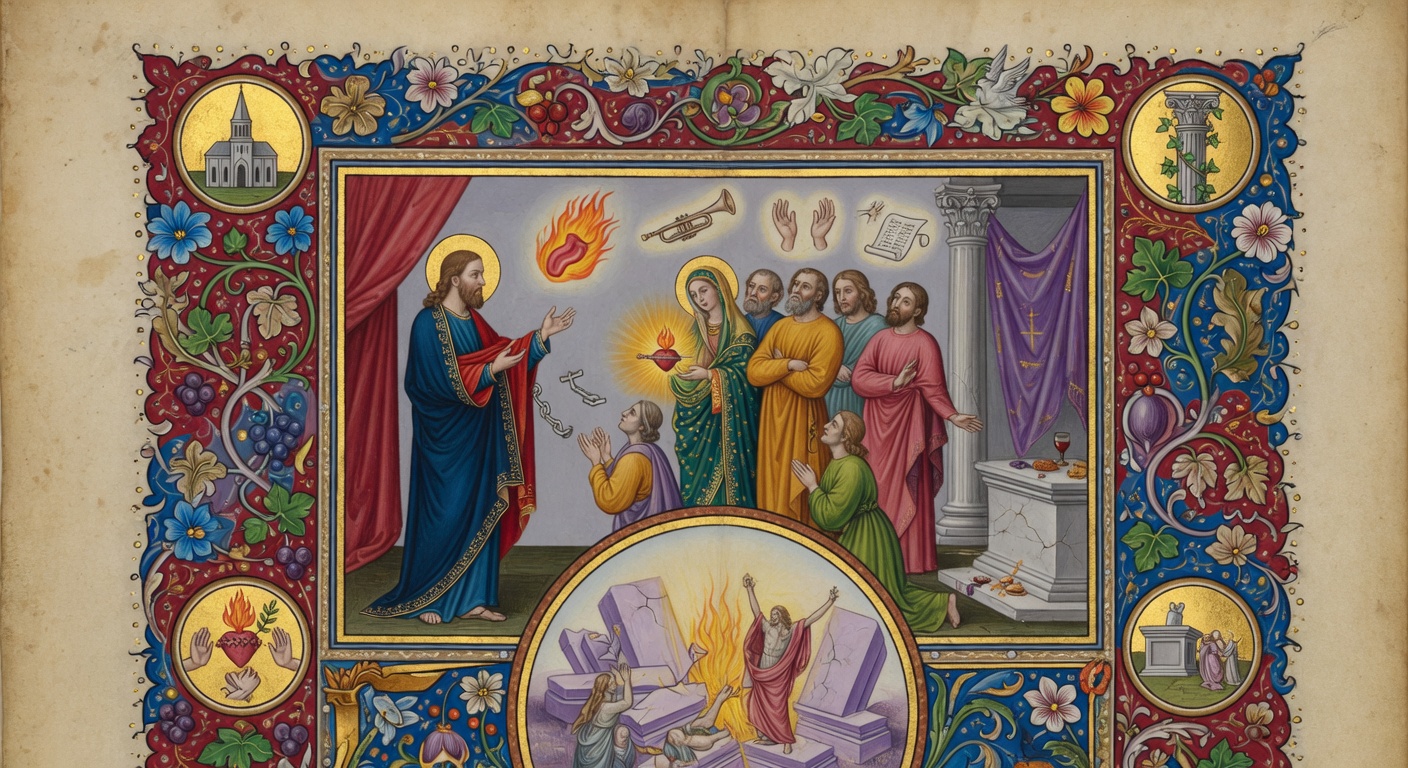
 1t is reported commonly that there is fornication among you, and such fornication as is not so much as named among the Gentiles, that one should have his father’s wife.
2 And ye are puffed up, and have not rather mourned, that he that hath done this deed might be taken away from among you.
3 For I verily, as absent in body, but present in spirit, have judged already, as though I were present, concerning him that hath so done this deed,
4 In the name of our Lord Jesus Christ, when ye are gathered together, and my spirit, with the power of our Lord Jesus Christ,
5 To deliver such an one unto Satan for the destruction of the flesh, that the spirit may be saved in the day of the Lord Jesus.
6 Your glorying is not good. Know ye not that a little leaven leaveneth the whole lump?
7 Purge out therefore the old leaven, that ye may be a new lump, as ye are unleavened. For even Christ our passover is sacrificed for us:cf.
8 Therefore let us keep the feast, not with old leaven, neither with the leaven of malice and wickedness; but with the unleavened bread of sincerity and truth.
9 I wrote unto you in an epistle not to company with fornicators:
10 Yet not altogether with the fornicators of this world, or with the covetous, or extortioners, or with idolaters; for then must ye needs go out of the world.
11 But now I have written unto you not to keep company, if any man that is called a brother be a fornicator, or covetous, or an idolater, or a railer, or a drunkard, or an extortioner; with such an one no not to eat.
12 For what have I to do to judge them also that are without? do not ye judge them that are within?
13 But them that are without God judgeth. Therefore put away from among yourselves that wicked person.
← → arrow keys to navigate chapters · spacebar to play/pause audio
Did You Know?
Paul's identification of Christ as "our passover" in verse 7 draws on the Passover lamb's blood applied to doorposts in Exodus, positioning church purity as participation in Christ's atoning sacrifice rather than mere moral improvement.
The command to deliver the offender "unto Satan for the destruction of the flesh" echoes Job's trials and 1 Timothy 1:20, suggesting a temporary physical affliction permitted by apostolic authority to prompt repentance and ultimate salvation.
By invoking the "leaven" metaphor from Exodus 12 and applying it to moral corruption, Paul reinterprets the Jewish Feast of Unleavened Bread as an ongoing ethical reality for Gentile believers, where even tolerated sin spreads like fermentation.
The distinction between refusing fellowship with immoral "brethren" inside the church versus associating with outsiders mirrors the boundary-keeping in Deuteronomy 23 yet permits pragmatic engagement with the pagan marketplace, shaping early Christian social ethics.
Paul's claim to judge the case "as though I were present" asserts apostolic authority exercised remotely through letter and Spirit, prefiguring later conciliar decisions and the concept of virtual ecclesiastical presence.
Paul's Roman citizenship, acquired through his birth in the prominent city of Tarsus, granted him the rare legal privilege to appeal directly to Caesar, which he exercised during his trial before Festus and ultimately led to his voyage to Rome.
Apollos originated from Alexandria, the intellectual center of the Hellenistic world where the Septuagint was translated, which likely equipped him with exceptional rhetorical training and mastery of the Greek Old Testament unmatched by most early preachers.
Paul worked as a tentmaker in Corinth to support himself while planting the church.
Commentary & Study Notes Jamieson-Fausset-Brown (1871) · Public Domain commonly — rather, "actually" [ALFORD]. Absolutely [BENGEL]. "It is reported," implies, that the Corinthians, though they "wrote" (1Co 7:1) to Paul on other points, gave him no inf…
Classic verse-by-verse commentary on 1 Corinthians 5 from Jamieson, Fausset & Brown (1871). Covers: The incestuous person at corinth: the corinthians reproved for connivance, and warned to purge out the bad leaven. Qualification of his former command as to association with sinners of the world.
- 1
- commonly — rather, "actually" [ALFORD]. Absolutely [BENGEL]. "It is reported," implies, that the Corinthians, though they "wrote" (1Co 7:1) to Paul on other points, gave him no information on those things which bore against themselves. These latter matters reached the apostle indirectly (1Co 1:11). so much as named — The oldest manuscripts and authorities omit "named": "Fornication of such a gross kind as (exists) not even among the heathen, so that one (of you) hath (in concubinage) his father's wife," that is, his stepmother, while his father is still alive (2Co 7:12; compare Le 18:8). She was perhaps a heathen, for which reason he does not direct his rebuke against her (compare 1Co 5:12, 13). ALFORD thinks "have" means have in marriage: but the connection is called "fornication," and neither Christian nor Gentile law would have sanctioned such a marriage, however Corinth's notorious profligacy might wink at the concubinage.
- 2
- puffed up — with your own wisdom and knowledge, and the eloquence of your favorite teachers: at a time when ye ought to be "mourning" at the scandal caused to religion by the incest. Paul mourned because they did not mourn (2Co 2:4). We ought to mourn over the transgressions of others, and repent of our own (2Co 12:21) [BENGEL]. that — ye have not felt such mourning as would lead to the result that, &c. taken away from among you — by excommunication. The incestuous person was hereby brought to bitter repentance, in the interval between the sending of the first and second Epistles (2Co 2:5-10). Excommunication in the Christian Church corresponded to that in the Jewish synagogue, in there being a lighter and heavier form: the latter an utter separation from church fellowship and the Lord's house, the former exclusion from the Lord's Supper only but not from the Church.
Read all 13 notes on 1 Corinthians 5 →