1 Corinthians 8 KJV
Food Offered to Idols
Food Offered to Idols
The chapter adapts the Shema of Deuteronomy 6:4 into an early binitarian confession (v. 6) by placing Jesus Christ as 'one Lord' in parallel with 'one God, the Father,' transforming Jewish monotheism within a pagan context.
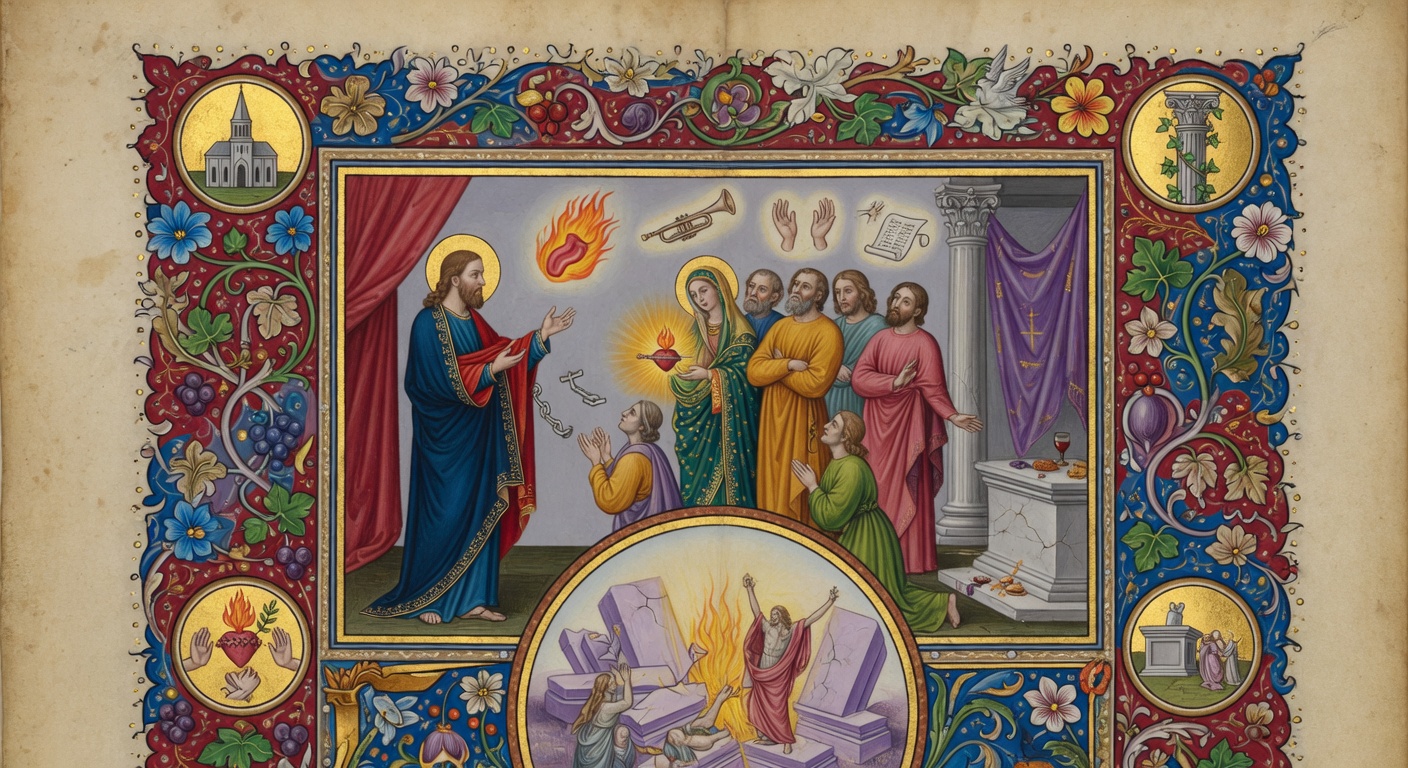
 1ow as touching things offered unto idols, we know that we all have knowledge. Knowledge puffeth up, but charity edifieth.
2 And if any man think that he knoweth any thing, he knoweth nothing yet as he ought to know.
3 But if any man love God, the same is known of him.
4 As concerning therefore the eating of those things that are offered in sacrifice unto idols, we know that an idol is nothing in the world, and that there is none other God but one.
5 For though there be that are called gods, whether in heaven or in earth, (as there be gods many, and lords many,)
6 But to us there is but one God, the Father, of whom are all things, and we in him; and one Lord Jesus Christ, by whom are all things, and we by him.
7 Howbeit there is not in every man that knowledge: for some with conscience of the idol unto this hour eat it as a thing offered unto an idol; and their conscience being weak is defiled.
8 But meat commendeth us not to God: for neither, if we eat, are we the better; neither, if we eat not, are we the worse.
9 But take heed lest by any means this liberty of yours become a stumblingblock to them that are weak.
10 For if any man see thee which hast knowledge sit at meat in the idol’s temple, shall not the conscience of him which is weak be emboldened to eat those things which are offered to idols;
11 And through thy knowledge shall the weak brother perish, for whom Christ died?
12 But when ye sin so against the brethren, and wound their weak conscience, ye sin against Christ.
13 Wherefore, if meat make my brother to offend, I will eat no flesh while the world standeth, lest I make my brother to offend.
← → arrow keys to navigate chapters · spacebar to play/pause audio
Did You Know?
The chapter adapts the Shema of Deuteronomy 6:4 into an early binitarian confession (v. 6) by placing Jesus Christ as 'one Lord' in parallel with 'one God, the Father,' transforming Jewish monotheism within a pagan context.
Paul distinguishes between the ontological non-existence of idols and the subjective reality of 'defiled' consciences, introducing an ethical framework where love limits the exercise of knowledge-based freedom.
The discussion reflects Corinth's economic realities, where temple-sourced meat was the primary supply for markets and banquets, disproportionately affecting wealthier believers who participated in civic and cultic meals.
Verse 13's hyperbolic vow not to eat meat 'while the world standeth' if it offends a brother anticipates the apostolic decree in Acts 15 yet shifts its basis from ritual purity to pastoral accommodation.
The chapter's contrast between 'puffing up' knowledge and 'edifying' love (v. 1) critiques Greco-Roman intellectual elitism while modeling the self-emptying pattern later developed in Philippians 2.
In 2 Corinthians, Paul details surviving three shipwrecks, a night and day adrift at sea, and being stoned and left for dead at Lystra, hardships that underscore the physical dangers of his travels beyond the more commonly recounted imprisonments.
Apollos is the only New Testament figure explicitly said to have debated publicly and 'refuted' Jewish opponents in the synagogue using Scripture, demonstrating a level of formal debate skill rare among the apostles themselves.
Paul worked as a tentmaker in Corinth to support himself while planting the church.
Commentary & Study Notes Jamieson-Fausset-Brown (1871) · Public Domain Though to those knowing that an idol has no existence, the question of eating meats offered to idols (referred to in the letter of the Corinthians, compare 1Co 7:1) might seem unim…
Classic verse-by-verse commentary on 1 Corinthians 8 from Jamieson, Fausset & Brown (1871). Covers: On partaking of meats offered to idols.
- 1
- Though to those knowing that an idol has no existence, the question of eating meats offered to idols (referred to in the letter of the Corinthians, compare 1Co 7:1) might seem unimportant, it is not so with some, and the infirmities of such should be respected. The portions of the victims not offered on the altars belonged partly to the priests, partly to the offerers; and were eaten at feasts in the temples and in private houses and were often sold in the markets; so that Christians were constantly exposed to the temptation of receiving them, which was forbidden (Nu 25:2; Ps 106:28). The apostles forbade it in their decree issued from Jerusalem (Ac 15:1-29; 21:25); but Paul does not allude here to that decree, as he rests his precepts rather on his own independent apostolic authority. we know that we all have knowledge — The Corinthians doubtless had referred to their "knowledge" (namely, of the indifference of meats, as in themselves having no sanctity or pollution). Paul replies, "We are aware that we all have [speaking generally, and so far as Christian theory goes; for in 1Co 8:7 he speaks of some who practically have not] this knowledge." Knowledge puffeth up — when without "love." Here a parenthesis begins; and the main subject is resumed in the same words, 1Co 8:4. "As concerning [touching] therefore the eating," &c. "Puffing up" is to please self. "Edifying" is to please one's neighbor; Knowledge only says, All things are lawful for me; Love adds, But all things do not edify [BENGEL], (1Co 10:23; Ro 14:15). edifieth — tends to build up the spiritual temple (1Co 3:9; 6:19).
- 2
- And — omitted in the oldest manuscripts The absence of the connecting particle gives an emphatical sententiousness to the style, suitable to the subject. The first step to knowledge is to know our own ignorance. Without love there is only the appearance of knowledge. knoweth — The oldest manuscripts read a Greek word implying personal experimental acquaintance, not merely knowledge of a fact, which the Greek of "we know" or are aware (1Co 8:1) means. as he ought to know — experimentally and in the way of "love."
Read all 13 notes on 1 Corinthians 8 →