2 Chronicles 12 KJV
Shishak Attacks Jerusalem
Shishak Attacks Jerusalem
Shishak's campaign, identified with Pharaoh Shoshenq I, receives independent corroboration from the Bubastite Portal at Karnak, whose toponym list includes Judahite sites and thus anchors the biblical account in 22nd-Dynasty Egyptian records.
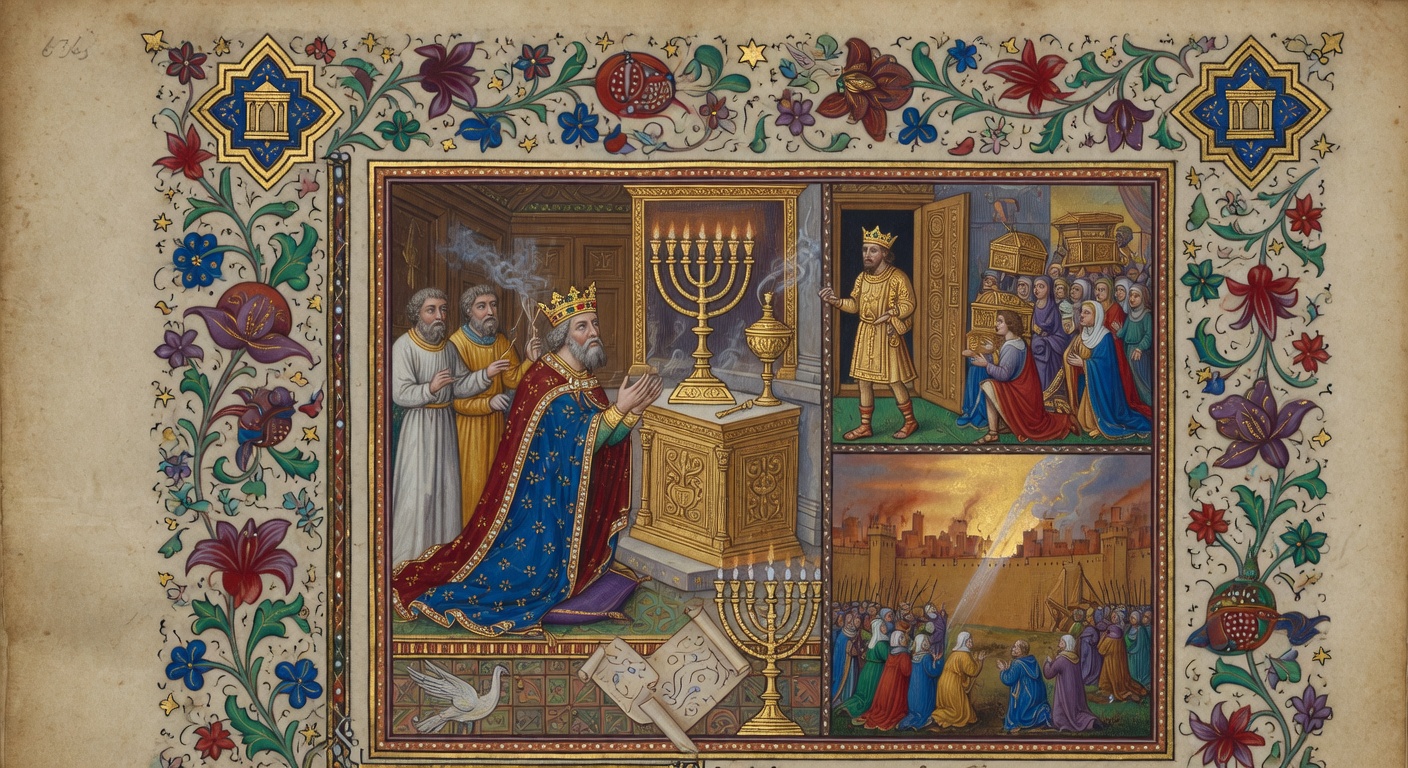
 1nd it came to pass, when Rehoboam had established the kingdom, and had strengthened himself, he forsook the law of the LORD, and all Israel with him.
2 And it came to pass, that in the fifth year of king Rehoboam Shishak king of Egypt came up against Jerusalem, because they had transgressed against the LORD,
3 With twelve hundred chariots, and threescore thousand horsemen: and the people were without number that came with him out of Egypt; the Lubims, the Sukkiims, and the Ethiopians.
4 And he took the fenced cities which pertained to Judah, and came to Jerusalem.
5 Then came Shemaiah the prophet to Rehoboam, and to the princes of Judah, that were gathered together to Jerusalem because of Shishak, and said unto them, Thus saith the LORD, Ye have forsaken me, and therefore have I also left you in the hand of Shishak.
6 Whereupon the princes of Israel and the king humbled themselves; and they said, The LORD is righteous.
7 And when the LORD saw that they humbled themselves, the word of the LORD came to Shemaiah, saying, They have humbled themselves; therefore I will not destroy them, but I will grant them some deliverance; and my wrath shall not be poured out upon Jerusalem by the hand of Shishak.
8 Nevertheless they shall be his servants; that they may know my service, and the service of the kingdoms of the countries.
9 So Shishak king of Egypt came up against Jerusalem, and took away the treasures of the house of the LORD, and the treasures of the king’s house; he took all: he carried away also the shields of gold which Solomon had made.
10 Instead of which king Rehoboam made shields of brass, and committed them to the hands of the chief of the guard, that kept the entrance of the king’s house.
11 And when the king entered into the house of the LORD, the guard came and fetched them, and brought them again into the guard chamber.
12 And when he humbled himself, the wrath of the LORD turned from him, that he would not destroy him altogether: and also in Judah things went well.
13 So king Rehoboam strengthened himself in Jerusalem, and reigned: for Rehoboam was one and forty years old when he began to reign, and he reigned seventeen years in Jerusalem, the city which the LORD had chosen out of all the tribes of Israel, to put his name there. And his mother’s name was Naamah an Ammonitess.
14 And he did evil, because he prepared not his heart to seek the LORD.
15 Now the acts of Rehoboam, first and last, are they not written in the book of Shemaiah the prophet, and of Iddo the seer concerning genealogies? And there were wars between Rehoboam and Jeroboam continually.
16 And Rehoboam slept with his fathers, and was buried in the city of David: and Abijah his son reigned in his stead.
← → arrow keys to navigate chapters · spacebar to play/pause audio
Did You Know?
Shishak's campaign, identified with Pharaoh Shoshenq I, receives independent corroboration from the Bubastite Portal at Karnak, whose toponym list includes Judahite sites and thus anchors the biblical account in 22nd-Dynasty Egyptian records.
The replacement of Solomon's gold shields with bronze ones functions as a deliberate literary symbol of dynastic decline, visually enacting the Chronicler's theology that covenant unfaithfulness erodes the material splendor promised to a faithful king.
Shemaiah's dual oracles frame the invasion as both threat and tempered mercy, illustrating Chronicles' distinctive emphasis on immediate, conditional retribution whereby collective humility alters but does not cancel the decreed penalty.
The chapter's closing reference to the 'book of Shemaiah the prophet and of Iddo the seer' points to otherwise lost prophetic sources that the Chronicler privileges over the Deuteronomistic History, revealing a deliberate historiographic strategy.
Rehoboam's Ammonite mother Naamah, mentioned only here, subtly evokes the foreign alliances of Solomon that the Chronicler views as the root of Judah's subsequent apostasy and vulnerability to Egyptian aggression.
Solomon's throne, overlaid with gold and ivory, featured six steps flanked by twelve lions symbolizing the tribes of Israel and incorporated a calf-shaped seat back, making it a unique artifact unmatched by any other royal throne of the era.
After being told by Isaiah that he would die from his illness, Hezekiah prayed and received both a fifteen-year extension of life and the miraculous reversal of the sun's shadow on Ahaz's stairway as a divine sign, details recorded in both 2 Kings 20 and Isaiah 38.
At age twenty-six Josiah funded an unprecedented national Passover from his own resources and those of his officials, an observance described as unequaled since the era of the judges and attended by participants from both Judah and the remnant of the northern tribes.
He established both local judges in Judah's fortified cities and a supreme tribunal in Jerusalem staffed by Levites, priests, and family heads to handle religious and civil cases, formalizing a two-tier legal system.
Jerusalem is mentioned over 800 times in the Bible. More than any other city.
This location became the focal point of national worship and divine promises, later extending symbolically to encompass the Temple Mount where Solomon built the house of the Lord.
The Hanging Gardens of Babylon were one of the Seven Wonders of the Ancient World.
Commentary & Study Notes Jamieson-Fausset-Brown (1871) · Public Domain when Rehoboam had established the kingdom, and had strengthened himself — (See on 2Ch 11:17). During the first three years of his reign his royal influence was exerted in the encou…
Classic verse-by-verse commentary on 2 Chronicles 12 from Jamieson, Fausset & Brown (1871). Covers: Rehoboam, forsaking God, is punished by shishak; His reign and death.
- 1
- when Rehoboam had established the kingdom, and had strengthened himself — (See on 2Ch 11:17). During the first three years of his reign his royal influence was exerted in the encouragement of the true religion. Security and ease led to religious decline, which, in the fourth year, ended in open apostasy. The example of the court was speedily followed by his subjects, for "all Israel was with him," that is, the people in his own kingdom. The very next year, the fifth of his reign, punishment was inflicted by the invasion of Shishak.
- 2
- Shishak king of Egypt came up against Jerusalem — He was the first king of the twenty-second or Bubastic Dynasty. What was the immediate cause of this invasion? Whether it was in resentment for some provocation from the king of Judah, or in pursuance of ambitious views of conquest, is not said. But the invading army was a vast horde, for Shishak brought along with his native Egyptians an immense number of foreign auxiliaries.
Read all 7 notes on 2 Chronicles 12 →