2 Corinthians 4 KJV
Treasure in Jars of Clay
Treasure in Jars of Clay
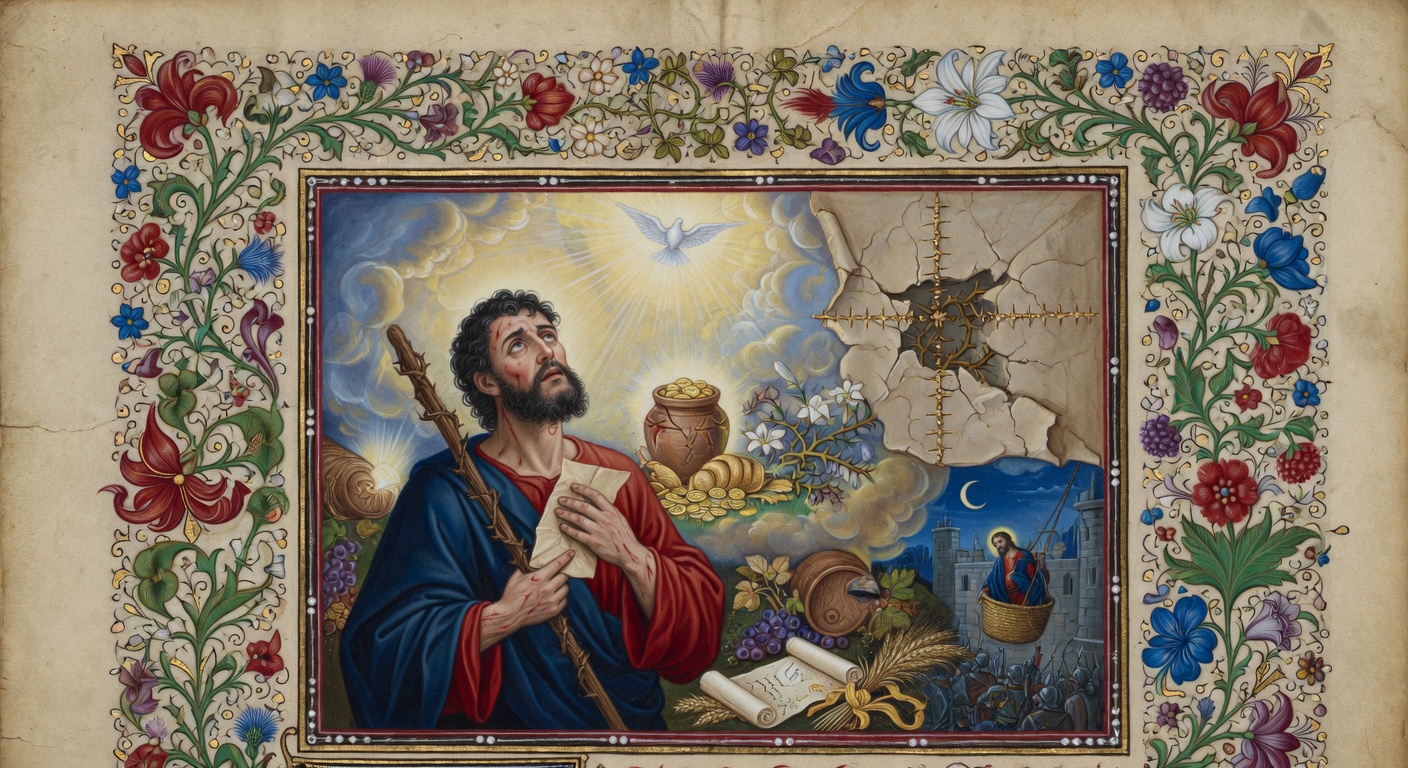
The 'earthen vessels' metaphor in verse 7 echoes not only Genesis pottery imagery but also the specific military tactic in Judges 7 where Gideon's torches hidden in clay jars reveal sudden divine light, framing apostolic suffering as a deliberate concealment that paradoxically manifests God's power. Themes: Suffering
 1herefore seeing we have this ministry, as we have received mercy, we faint not;
2 But have renounced the hidden things of dishonesty, not walking in craftiness, nor handling the word of God deceitfully; but by manifestation of the truth commending ourselves to every man’s conscience in the sight of God.
3 But if our gospel be hid, it is hid to them that are lost:
4 In whom the god of this world hath blinded the minds of them which believe not, lest the light of the glorious gospel of Christ, who is the image of God, should shine unto them.
5 For we preach not ourselves, but Christ Jesus the Lord; and ourselves your servants for Jesus’ sake.
6 For God, who commanded the light to shine out of darkness, hath shined in our hearts, to give the light of the knowledge of the glory of God in the face of Jesus Christ.
7 But we have this treasure in earthen vessels, that the excellency of the power may be of God, and not of us.
8 We are troubled on every side, yet not distressed; we are perplexed, but not in despair;
9 Persecuted, but not forsaken; cast down, but not destroyed;
10 Always bearing about in the body the dying of the Lord Jesus, that the life also of Jesus might be made manifest in our body.
11 For we which live are alway delivered unto death for Jesus’ sake, that the life also of Jesus might be made manifest in our mortal flesh.
12 So then death worketh in us, but life in you.
13 We having the same spirit of faith, according as it is written, I believed, and therefore have I spoken; we also believe, and therefore speak;
14 Knowing that he which raised up the Lord Jesus shall raise up us also by Jesus, and shall present us with you.
15 For all things are for your sakes, that the abundant grace might through the thanksgiving of many redound to the glory of God.
16 For which cause we faint not; but though our outward man perish, yet the inward man is renewed day by day.
17 For our light affliction, which is but for a moment, worketh for us a far more exceeding and eternal weight of glory;
18 While we look not at the things which are seen, but at the things which are not seen: for the things which are seen are temporal; but the things which are not seen are eternal.
← → arrow keys to navigate chapters · spacebar to play/pause audio
Did You Know?
The 'earthen vessels' metaphor in verse 7 echoes not only Genesis pottery imagery but also the specific military tactic in Judges 7 where Gideon's torches hidden in clay jars reveal sudden divine light, framing apostolic suffering as a deliberate concealment that paradoxically manifests God's power.
Verse 4's unique phrase 'god of this world' (distinct from 'ruler of this age' in 1 Corinthians) draws on Jewish two-age apocalyptic thought while subtly countering emerging Gnostic dualisms by affirming Satan's temporary dominion over the present cosmos rather than an eternal evil principle.
Paul's chain of four antitheses in verses 8-9 ('troubled yet not distressed,' etc.) mirrors the structure of Greco-Roman peristasis catalogues used by philosophers like Epictetus, yet subverts them by grounding endurance in resurrection hope rather than Stoic self-sufficiency.
The daily renewal of the 'inward man' in verse 16 adapts Hellenistic body-soul dualism (seen in Plato and Philo) into an eschatological framework where present affliction produces an eternal weight of glory, linking personal transformation to the unseen realities of verse 18.
Verse 6 fuses the Genesis creation command with Isaiah 42's servant-light motif and the Damascus-road experience, presenting the gospel as a new creative fiat that shines 'in our hearts' to reveal Christ's face, thereby equating conversion with participation in primordial light.
Paul's nephew, the son of his sister in Jerusalem, uncovered an assassination plot against him and alerted Roman authorities, an intervention recorded in Acts that facilitated Paul's transfer to Caesarea under heavy guard.
Near the end of Paul's life, Titus was dispatched to Dalmatia, indicating his ministry extended from Crete into the western Balkans rather than remaining confined to the eastern Mediterranean (2 Timothy 4:10).
As a young pastor in Ephesus, Timothy was tasked with confronting false teachers and establishing church order, a role Paul emphasized despite cultural norms that often dismissed youthful leadership.
The city had two harbors, making it one of the wealthiest trade centers in the ancient world.
An earthquake miraculously opened the prison doors, leading to the jailer’s conversion and the church’s growth amid persecution.
Jerusalem is mentioned over 800 times in the Bible. More than any other city.
Commentary & Study Notes Jamieson-Fausset-Brown (1871) · Public Domain Therefore — Greek, "For this cause": Because we have the liberty-giving Spirit of the Lord, and with unveiled face behold His glory (2Co 3:17, 18). seeing we have this ministry — "…
Classic verse-by-verse commentary on 2 Corinthians 4 from Jamieson, Fausset & Brown (1871). Covers: His preaching is open and sincere, though to many the gospel is hidden.
- 1
- Therefore — Greek, "For this cause": Because we have the liberty-giving Spirit of the Lord, and with unveiled face behold His glory (2Co 3:17, 18). seeing we have this ministry — "The ministration of the Spirit" (2Co 3:8, 9): the ministry of such a spiritual, liberty-giving Gospel: resuming 2Co 3:6,
- 8
- received mercy — from God, in having had this ministry conferred on us (2Co 3:5). The sense of "mercy" received from God, makes men active for God (1Ti 1:11-13). we faint not — in boldness of speech and action, and patience in suffering (2Co 4:2, 8-16, &c.).
Read all 19 notes on 2 Corinthians 4 →