Amos 6 KJV
Woe to the Complacent
Woe to the Complacent
The opening woe addresses both Zion and Samaria in parallel, underscoring that Amos’s oracle of judgment targets the complacent elites of both the southern and northern kingdoms rather than Israel alone.
 1oe to them that are at ease in Zion, and trust in the mountain of Samaria, which are named chief of the nations, to whom the house of Israel came!
2 Pass ye unto Calneh, and see; and from thence go ye to Hamath the great: then go down to Gath of the Philistines: be they better than these kingdoms? or their border greater than your border?
3 Ye that put far away the evil day, and cause the seat of violence to come near;
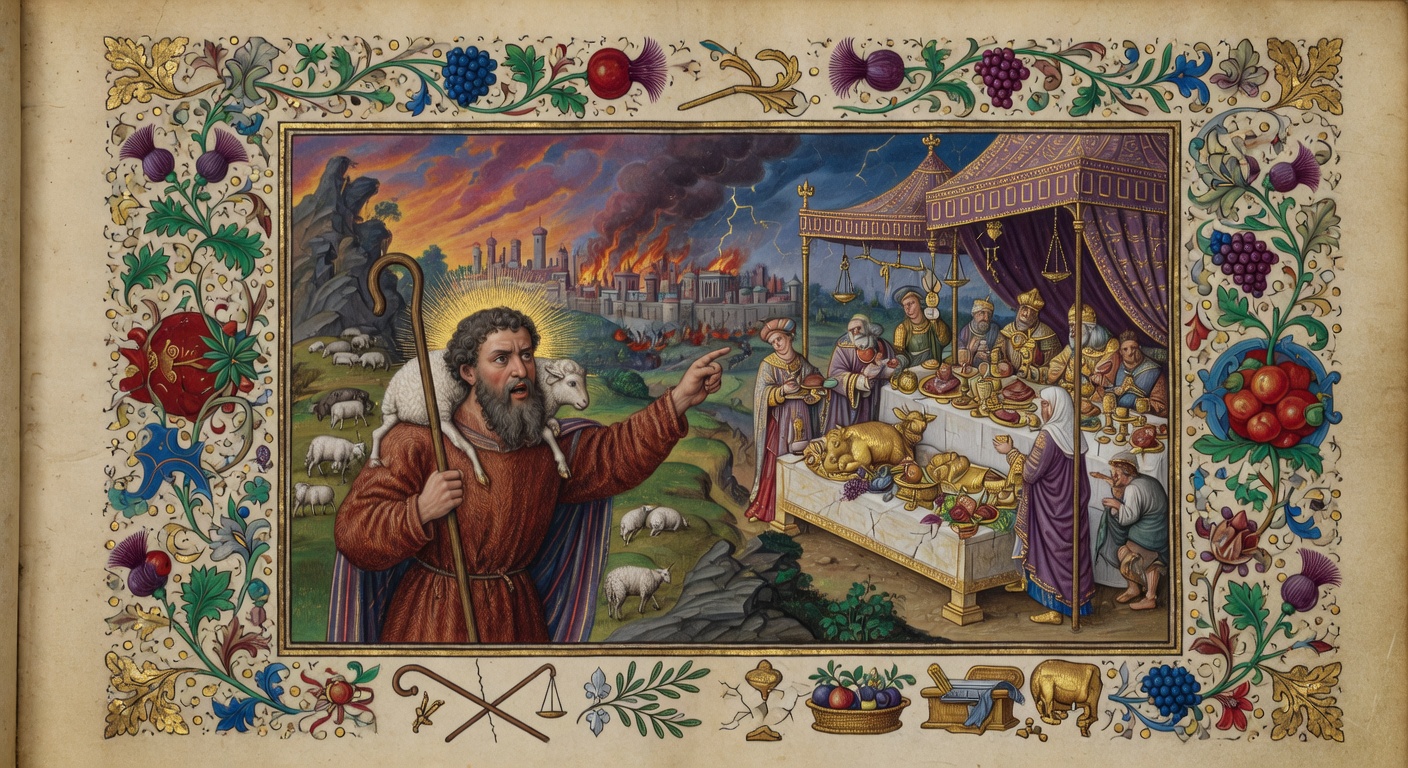
4 That lie upon beds of ivory, and stretch themselves upon their couches, and eat the lambs out of the flock, and the calves out of the midst of the stall;
5 That chant to the sound of the viol, and invent to themselves instruments of musick, like David;
6 That drink wine in bowls, and anoint themselves with the chief ointments: but they are not grieved for the affliction of Joseph.
7 Therefore now shall they go captive with the first that go captive, and the banquet of them that stretched themselves shall be removed.
8 The Lord GOD hath sworn by himself, saith the LORD the God of hosts, I abhor the excellency of Jacob, and hate his palaces: therefore will I deliver up the city with all that is therein.
9 And it shall come to pass, if there remain ten men in one house, that they shall die.
10 And a man’s uncle shall take him up, and he that burneth him, to bring out the bones out of the house, and shall say unto him that is by the sides of the house, Is there yet any with thee? and he shall say, No. Then shall he say, Hold thy tongue: for we may not make mention of the name of the LORD.
11 For, behold, the LORD commandeth, and he will smite the great house with breaches, and the little house with clefts.
12 Shall horses run upon the rock? will one plow there with oxen? for ye have turned judgment into gall, and the fruit of righteousness into hemlock:
13 Ye which rejoice in a thing of nought, which say, Have we not taken to us horns by our own strength?
14 But, behold, I will raise up against you a nation, O house of Israel, saith the LORD the God of hosts; and they shall afflict you from the entering in of Hemath unto the river of the wilderness.
← → arrow keys to navigate chapters · spacebar to play/pause audio
Did You Know?
The opening woe addresses both Zion and Samaria in parallel, underscoring that Amos’s oracle of judgment targets the complacent elites of both the southern and northern kingdoms rather than Israel alone.
References to Calneh, Hamath the great, and Gath function as recent exemplars of Assyrian expansion under Tiglath-Pileser III, turning contemporary geopolitical events into prophetic proof that no fortified city is immune to divine reversal.
The phrase 'drink wine in bowls' alludes to the misuse of large temple libation vessels (mizraqim) for secular revelry, implying not merely excess but the profanation of cultic objects reserved for sacrificial blood.
The ironic comparison 'like David' highlights that the same instruments once employed for sacred worship are now deployed for private entertainment, exposing a counterfeit imitation of Israel’s royal and liturgical heritage.
The closing declaration that God will 'raise up a nation' against Israel deliberately echoes the covenantal language of Deuteronomy 28, framing the coming Assyrian invasion as the outworking of ancient curse sanctions rather than an arbitrary political event.
His opening oracles begin not with Israel but with a ring of surrounding nations, using the repeated formula "For three transgressions and for four" to lull Israelite listeners before pivoting the same judgment formula onto them for selling the poor "for a pair of sandals."
This location became a significant center for worship and a symbol of God's covenant promises to the patriarchs.
Longstanding ethnic and religious tensions led Jews to avoid travel through Samaria and to view its inhabitants with hostility and suspicion.
Jerusalem sits at about 2,500 feet elevation. Higher than most surrounding areas.
Commentary & Study Notes Jamieson-Fausset-Brown (1871) · Public Domain named chief of the nations — that is, you nobles, so eminent in influence, that your names are celebrated among the chief nations [LUDOVICUS DE DIEU]. Hebrew, "Men designated by na…
Classic verse-by-verse commentary on Amos 6 from Jamieson, Fausset & Brown (1871). Covers: Denunciation of both the sister nations (especially their nobles) for wanton security--Zion, as well as samaria: threat of the exile: ruin of their palaces and slaughter of the people: their perverse injustice.
- 1
- named chief of the nations — that is, you nobles, so eminent in influence, that your names are celebrated among the chief nations [LUDOVICUS DE DIEU]. Hebrew, "Men designated by name among the first-fruits of the nations," that is, men of note in Israel, the people chosen by God as first of the nations (Ex 19:5; compare Nu 24:20) [PISCATOR]. to whom... Israel came — that is, the princes to whom the Israelites used to repair for the decision of controversies, recognizing their authority [MAURER]. I prefer to refer "which" to the antecedent "Zion" and "Samaria"; these were esteemed "chief" strongholds among the heathen nations "to whom... Israel came" when it entered Canaan; Am 6:2 accords with this.
- 2
- Calneh — on the east bank of the Tigris. Once powerful, but recently subjugated by Assyria (Isa 10:9; about 794 B.C.). Hameth — subjugated by Jeroboam II (2Ki 14:25). Also by Assyria subsequently (2Ki 18:34). Compare Am 6:14. Gath — subjugated by Uzziah (2Ch 26:6). be they better — no. Their so recent subjugation renders it needless for Me to tell you they are not. And yet they once were; still they could not defend themselves against the enemy. How vain, then, your secure confidence in the strength of Mounts Zion and Samaria! He takes cities respectively east, north, south, and west of Israel (compare Na 3:8).
Read all 14 notes on Amos 6 →