Ecclesiastes 7 KJV
Wisdom and Folly
Wisdom and Folly
The chapter's opening proverb on a good name surpassing ointment exploits a Hebrew wordplay between 'shem' and 'shemen' that underscores reputation's enduring value over fleeting luxury, a motif echoing ancient Near Eastern royal inscriptions.
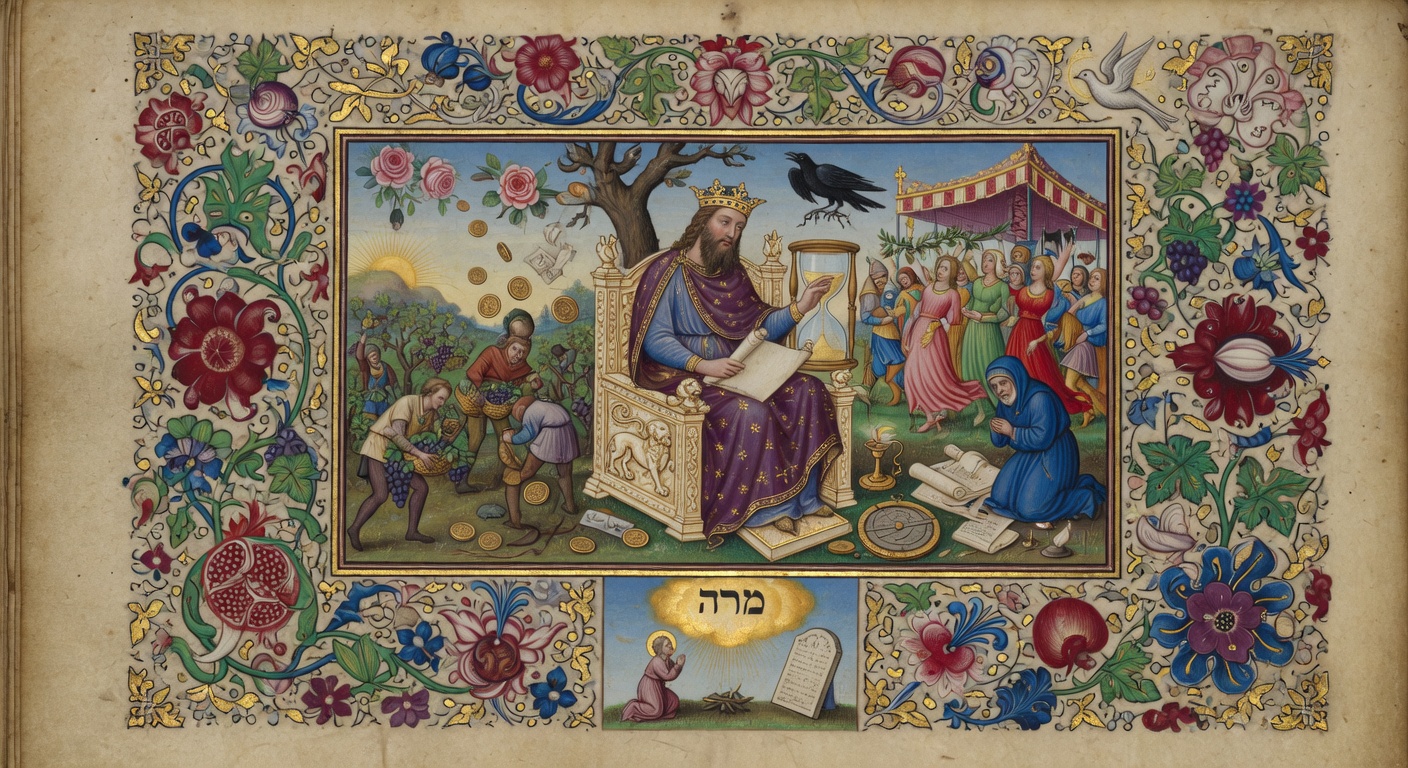
 1 good name is better than precious ointment; and the day of death than the day of one’s birth.
2 It is better to go to the house of mourning, than to go to the house of feasting: for that is the end of all men; and the living will lay it to his heart.
3 Sorrow is better than laughter: for by the sadness of the countenance the heart is made better.
4 The heart of the wise is in the house of mourning; but the heart of fools is in the house of mirth.
5 It is better to hear the rebuke of the wise, than for a man to hear the song of fools.
6 For as the crackling of thorns under a pot, so is the laughter of the fool: this also is vanity.
7 Surely oppression maketh a wise man mad; and a gift destroyeth the heart.
8 Better is the end of a thing than the beginning thereof: and the patient in spirit is better than the proud in spirit.
9 Be not hasty in thy spirit to be angry: for anger resteth in the bosom of fools.
10 Say not thou, What is the cause that the former days were better than these? for thou dost not enquire wisely concerning this.
11 Wisdom is good with an inheritance: and by it there is profit to them that see the sun.
12 For wisdom is a defence, and money is a defence: but the excellency of knowledge is, that wisdom giveth life to them that have it.
13 Consider the work of God: for who can make that straight, which he hath made crooked?
14 In the day of prosperity be joyful, but in the day of adversity consider: God also hath set the one over against the other, to the end that man should find nothing after him.
15 All things have I seen in the days of my vanity: there is a just man that perisheth in his righteousness, and there is a wicked man that prolongeth his life in his wickedness.
16 Be not righteous over much; neither make thyself over wise: why shouldest thou destroy thyself ?
17 Be not over much wicked, neither be thou foolish: why shouldest thou die before thy time?
18 It is good that thou shouldest take hold of this; yea, also from this withdraw not thine hand: for he that feareth God shall come forth of them all.
19 Wisdom strengtheneth the wise more than ten mighty men which are in the city.
20 For there is not a just man upon earth, that doeth good, and sinneth not.
21 Also take no heed unto all words that are spoken; lest thou hear thy servant curse thee:
22 For oftentimes also thine own heart knoweth that thou thyself likewise hast cursed others.
23 All this have I proved by wisdom: I said, I will be wise; but it was far from me.
24 That which is far off, and exceeding deep, who can find it out?
25 I applied mine heart to know, and to search, and to seek out wisdom, and the reason of things, and to know the wickedness of folly, even of foolishness and madness:
26 And I find more bitter than death the woman, whose heart is snares and nets, and her hands as bands: whoso pleaseth God shall escape from her; but the sinner shall be taken by her.
27 Behold, this have I found, saith the preacher, counting one by one, to find out the account:
28 Which yet my soul seeketh, but I find not: one man among a thousand have I found; but a woman among all those have I not found.
29 Lo, this only have I found, that God hath made man upright; but they have sought out many inventions.
← → arrow keys to navigate chapters · spacebar to play/pause audio
Did You Know?
The chapter's opening proverb on a good name surpassing ointment exploits a Hebrew wordplay between 'shem' and 'shemen' that underscores reputation's enduring value over fleeting luxury, a motif echoing ancient Near Eastern royal inscriptions.
Verse 16's warning against excessive righteousness critiques overzealous application of Torah piety, possibly reflecting Qoheleth's observation of emerging Hellenistic tensions between Jewish legalism and pragmatic survival under foreign rule.
The numerical proverb in verse 28 about rarity among a thousand draws on ancient Semitic hyperbolic counting formulas found in Ugaritic and Akkadian wisdom texts, framing human fidelity as statistically elusive under divine mystery.
By bookending its maxims with reflections on death in verses 1-2 and 26, the chapter structurally subordinates all human wisdom-seeking to mortality, inverting traditional wisdom literature's optimism about teachable virtue.
The portrayal of woman as a snare in verses 26-28 reworks Proverbs' Lady Wisdom versus Strange Woman binary into a pessimistic key, suggesting even relational wisdom remains inaccessible amid Qoheleth's empirical disillusionment.
Solomon's throne, overlaid with gold and ivory, featured six steps flanked by twelve lions symbolizing the tribes of Israel and incorporated a calf-shaped seat back, making it a unique artifact unmatched by any other royal throne of the era.
Jonathan sealed his covenant with David by giving him his royal robe, armor, sword, bow, and belt, ritually transferring symbols of kingship despite being Saul's heir.
Three major world religions consider Jerusalem a holy city.