Ezekiel 15 KJV
Jerusalem the Useless Vine
Jerusalem the Useless Vine
The chapter's vine metaphor uniquely emphasizes that unlike fruit-bearing vines in Isaiah 5 or Psalm 80, this wood has no utilitarian value even for pegs or vessels, underscoring Israel's election as purely relational rather than intrinsic.
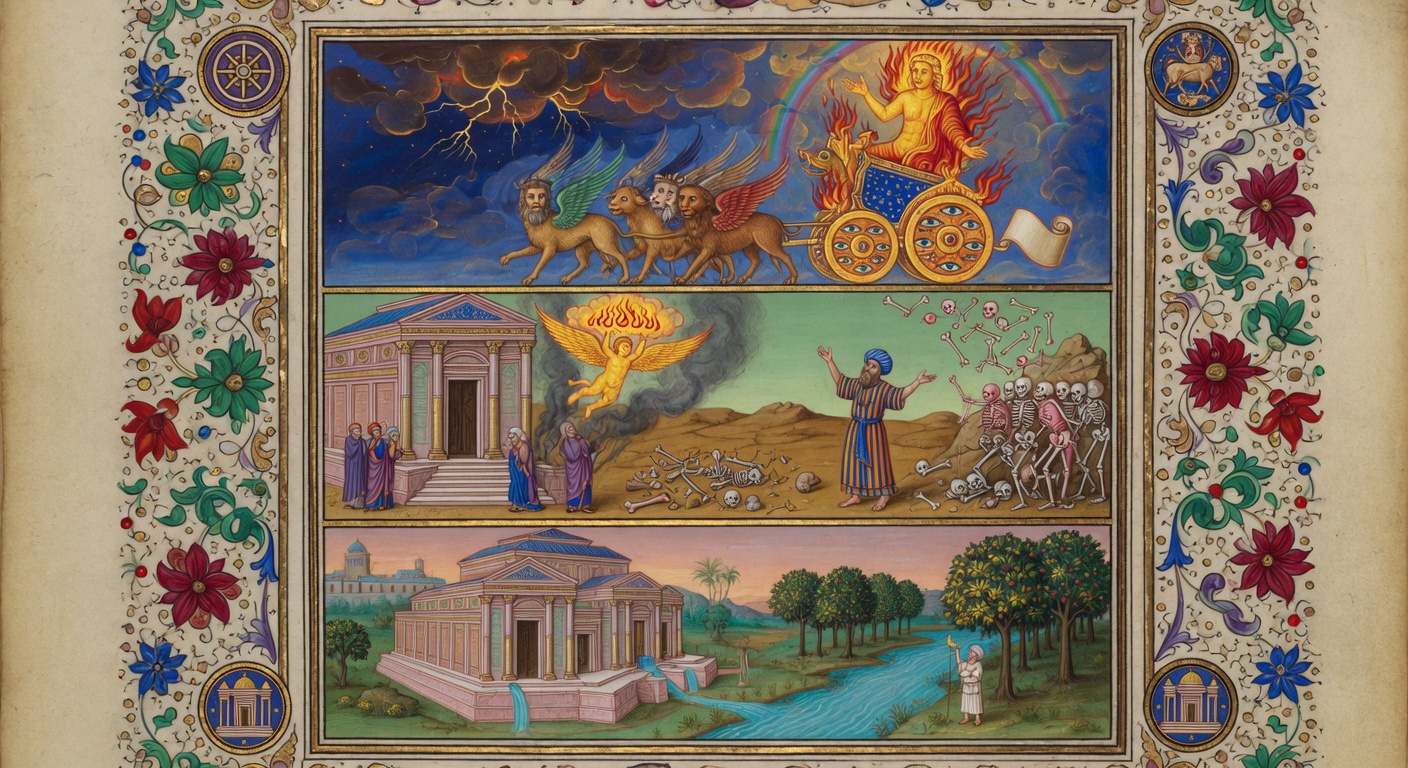
 1nd the word of the LORD came unto me, saying,
2 Son of man, What is the vine tree more than any tree, or than a branch which is among the trees of the forest?
3 Shall wood be taken thereof to do any work? or will men take a pin of it to hang any vessel thereon?
4 Behold, it is cast into the fire for fuel; the fire devoureth both the ends of it, and the midst of it is burned. Is it meet for any work?
5 Behold, when it was whole, it was meet for no work: how much less shall it be meet yet for any work, when the fire hath devoured it, and it is burned?
6 Therefore thus saith the Lord GOD; As the vine tree among the trees of the forest, which I have given to the fire for fuel, so will I give the inhabitants of Jerusalem.
7 And I will set my face against them; they shall go out from one fire, and another fire shall devour them; and ye shall know that I am the LORD, when I set my face against them.
8 And I will make the land desolate, because they have committed a trespass, saith the Lord GOD.
← → arrow keys to navigate chapters · spacebar to play/pause audio
Did You Know?
The chapter's vine metaphor uniquely emphasizes that unlike fruit-bearing vines in Isaiah 5 or Psalm 80, this wood has no utilitarian value even for pegs or vessels, underscoring Israel's election as purely relational rather than intrinsic.
The cryptic reference to fire consuming 'both the ends' and 'the midst' alludes to the 597 BCE deportation of Jehoiachin alongside the earlier 605 BCE tribute and the looming 586 BCE destruction, framing three successive waves of judgment within one image.
Ezekiel 15 functions as a prophetic lawsuit (rib) pattern drawn from ancient Near Eastern treaty curses, where the vine's worthlessness serves as evidence of covenant breach rather than a simple agricultural illustration.
The absence of any summons to repentance or future hope distinguishes this oracle from most surrounding chapters in Ezekiel, presenting total consumption as the sole remaining outcome of Jerusalem's history.
Its placement immediately before the extended marriage allegory of chapter 16 creates a deliberate literary progression from inanimate object to intimate relational betrayal, intensifying the emotional force of the judgment sequence.
Ezekiel was commanded to lie on his left side for 390 days and his right side for 40 days while bound with ropes, symbolically bearing the iniquity of Israel and Judah respectively during the Babylonian exile period.
The Hanging Gardens of Babylon were one of the Seven Wonders of the Ancient World.
Three major world religions consider Jerusalem a holy city.
Commentary & Study Notes Jamieson-Fausset-Brown (1871) · Public Domain What has the vine-wood to make it pre-eminent above other forest-wood? Nothing. Nay, the reverse. Other trees yield useful timber, but vine-wood is soft, brittle, crooked, and seld…
Classic verse-by-verse commentary on Ezekiel 15 from Jamieson, Fausset & Brown (1871). Covers: The worthlessness of the vine as wood especially when burnt, is the image of the worthlessness and guilt of the jews, who shall pass from one fire to another.
- 2,3
- What has the vine-wood to make it pre-eminent above other forest-wood? Nothing. Nay, the reverse. Other trees yield useful timber, but vine-wood is soft, brittle, crooked, and seldom large; not so much as a "pin" (the large wooden peg used inside houses in the East to hang household articles on, Isa 22:23-25) can be made of it. Its sole excellency is that it should bear fruit; when it does not bear fruit, it is not only not better, but inferior to other trees: so if God's people lose their distinctive excellency by not bearing fruits of righteousness, they are more unprofitable than the worldly (De 32:32), for they are the vine; the sole end of their being is to bear fruit to His glory (Ps 80:8, 9; Isa 5:1, &c.; Jer 2:21; Ho 10:1; Mt 21:33). In all respects, except in their being planted by God, the Jews were inferior to other nations, as Egypt, Babylon, &c., for example, in antiquity, extent of territory, resources, military power, attainments in arts and sciences. or than a branch — rather, in apposition with "the vine tree." Omit "or than." What superiority has the vine if it be but a branch among the trees of the forest, that is, if, as having no fruit, it lies cut down among other woods of trees?
- 4
- cast into... fire — (Joh 15:6). both the ends — the north kingdom having been already overturned by Assyria under Tiglath-pileser; the south being pressed on by Egypt (2Ki 23:29-35). midst of it is burned — rather, "is on flame"; namely, Jerusalem, which had now caught the flame by the attack of Nebuchadnezzar. Is it meet for any work — "it," that is, the scorched part still remaining.
Read all 6 notes on Ezekiel 15 →