Ezekiel 9 KJV
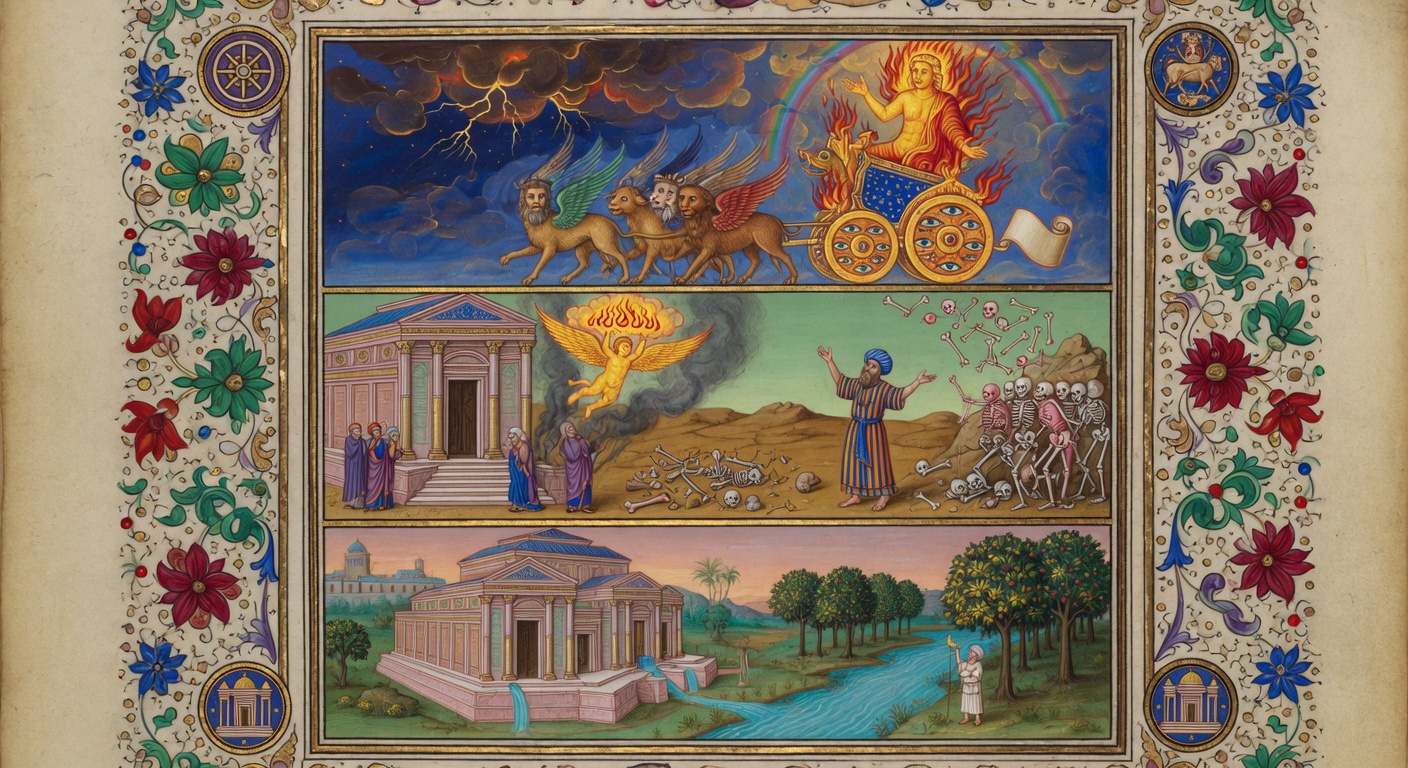
The Slaughter of the Wicked
The Slaughter of the Wicked
The Hebrew term for the protective "mark" on the foreheads is tav, the alphabet's final letter, whose archaic form resembled an X or cross, anticipating later Christian identification of the cross as the seal of the redeemed.
 1e cried also in mine ears with a loud voice, saying, Cause them that have charge over the city to draw near, even every man with his destroying weapon in his hand.
2 And, behold, six men came from the way of the higher gate, which lieth toward the north, and every man a slaughter weapon in his hand; and one man among them was clothed with linen, with a writer’s inkhorn by his side: and they went in, and stood beside the brasen altar.
3 And the glory of the God of Israel was gone up from the cherub, whereupon he was, to the threshold of the house. And he called to the man clothed with linen, which had the writer’s inkhorn by his side;
4 And the LORD said unto him, Go through the midst of the city, through the midst of Jerusalem, and set a mark upon the foreheads of the men that sigh and that cry for all the abominations that be done in the midst thereof.
5 And to the others he said in mine hearing, Go ye after him through the city, and smite: let not your eye spare, neither have ye pity:
6 Slay utterly old and young, both maids, and little children, and women: but come not near any man upon whom is the mark; and begin at my sanctuary. Then they began at the ancient men which were before the house.
7 And he said unto them, Defile the house, and fill the courts with the slain: go ye forth. And they went forth, and slew in the city.
8 And it came to pass, while they were slaying them, and I was left, that I fell upon my face, and cried, and said, Ah Lord GOD! wilt thou destroy all the residue of Israel in thy pouring out of thy fury upon Jerusalem?
9 Then said he unto me, The iniquity of the house of Israel and Judah is exceeding great, and the land is full of blood, and the city full of perverseness: for they say, The LORD hath forsaken the earth, and the LORD seeth not.
10 And as for me also, mine eye shall not spare, neither will I have pity, but I will recompense their way upon their head.
11 And, behold, the man clothed with linen, which had the inkhorn by his side, reported the matter, saying, I have done as thou hast commanded me.
← → arrow keys to navigate chapters · spacebar to play/pause audio
Did You Know?
The Hebrew term for the protective "mark" on the foreheads is tav, the alphabet's final letter, whose archaic form resembled an X or cross, anticipating later Christian identification of the cross as the seal of the redeemed.
Judgment is executed first upon the twenty-five elders "before the house" who had been offering incense to idols, establishing that divine wrath targets corrupt religious leadership before reaching the broader city.
The single linen-clad scribe with the inkhorn is paired with six armed destroyers, forming a heptad that evokes the completeness of heavenly justice and parallels the seven angels of judgment in Revelation.
This scene inverts the Exodus Passover: instead of blood on doorposts sparing Israelites from an angel of death, an ink mark on foreheads spares the grieving remnant from six human executioners sent by God.
The vision immediately follows the tour of secret temple abominations in Ezekiel 8, demonstrating that the detailed inventory of idolatry is not descriptive flourish but the legal warrant authorizing the slaughter that ensues.
Ezekiel's wife died suddenly as a divine sign, yet he was forbidden to mourn or perform customary funeral rites, serving as a living parable for the exiles' stunned response to the temple's destruction.
The Hanging Gardens of Babylon were one of the Seven Wonders of the Ancient World.
The city has been destroyed at least twice, besieged 23 times, and captured 44 times.
Commentary & Study Notes Jamieson-Fausset-Brown (1871) · Public Domain cried — contrasted with their "cry" for mercy (Eze 8:18) is the "cry" here for vengeance, showing how vain was the former. them that have charge — literally, officers; so "officers…
Classic verse-by-verse commentary on Ezekiel 9 from Jamieson, Fausset & Brown (1871). Covers: Continuation of the preceding vision: the sealing of the faithful.
- 1
- cried — contrasted with their "cry" for mercy (Eze 8:18) is the "cry" here for vengeance, showing how vain was the former. them that have charge — literally, officers; so "officers" (Isa 60:17), having the city in charge, not to guard, but to punish it. The angels who as "watchers" fulfil God's judgments (Da 4:13, 17, 23; 10:20, 21); the "princes" (Jer 39:3) of Nebuchadnezzar's army were under their guidance. draw near — in the Hebrew intensive, "to draw near quickly."
- 2
- clothed with linen — (Da 10:5; 12:6, 7). His clothing marked his office as distinct from that of the six officers of vengeance; "linen" characterized the high priest (Le 16:4); emblematic of purity. The same garment is assigned to the angel of the Lord (for whom Michael is but another name) by the contemporary prophet Daniel (Da 10:5; 12:6, 7). Therefore the intercessory High Priest in heaven must be meant (Zec 1:12). The six with Him are His subordinates; therefore He is said to be "among them," literally, "in the midst of them," as their recognized Lord (Heb 1:6). He appears as a "man," implying His incarnation; as "one" (compare 1Ti 2:5). Salvation is peculiarly assigned to Him, and so He bears the "inkhorn" in order to "mark" His elect (Eze 9:4; compare Ex 12:7; Re 7:3; 9:4; 13:16, 17; 20:4), and to write their names in His book of life (Re 13:8). As Oriental scribes suspend their inkhorn at their side in the present day, and as a "scribe of the host is found in Assyrian inscriptions accompanying the host" to number the heads of the slain, so He stands ready for the work before Him. "The higher gate" was probably where now the gate of Damascus is. The six with Him make up the sacred and perfect number, seven (Zec 3:9; Re 5:6). The executors of judgment on the wicked, in Scripture teaching, are good, not bad, angels; the bad have permitted to them the trial of the pious (Job 1:12; 2Co 12:7). The judgment is executed by Him (Eze 10:2, 7; Joh 5:22, 27) through the six (Mt 13:41; 25:31); so beautifully does the Old Testament harmonize with the New Testament. The seven come "from the way of the north"; for it was there the idolatries were seen, and from the same quarter must proceed the judgment (Babylon lying northeast of Judea). So Mt 24:28. stood — the attitude of waiting reverently for Jehovah's commands. brazen altar — the altar of burnt offerings, not the altar of incense, which was of gold. They "stood" there to imply reverent obedience; for there God gave His answers to prayer [CALVIN]; also as being about to slay victims to God's justice, they stand where sacrifices are usually slain [GROTIUS], (Eze 39:17; Isa 34:6; Jer 12:3; 46:10).
Read all 10 notes on Ezekiel 9 →