Ezra 3 KJV
Rebuilding the Altar
Rebuilding the Altar
The altar's reconstruction precedes any temple work and occurs amid surrounding hostility, establishing sacrifice as the essential precondition for communal identity rather than a secondary cultic accessory.
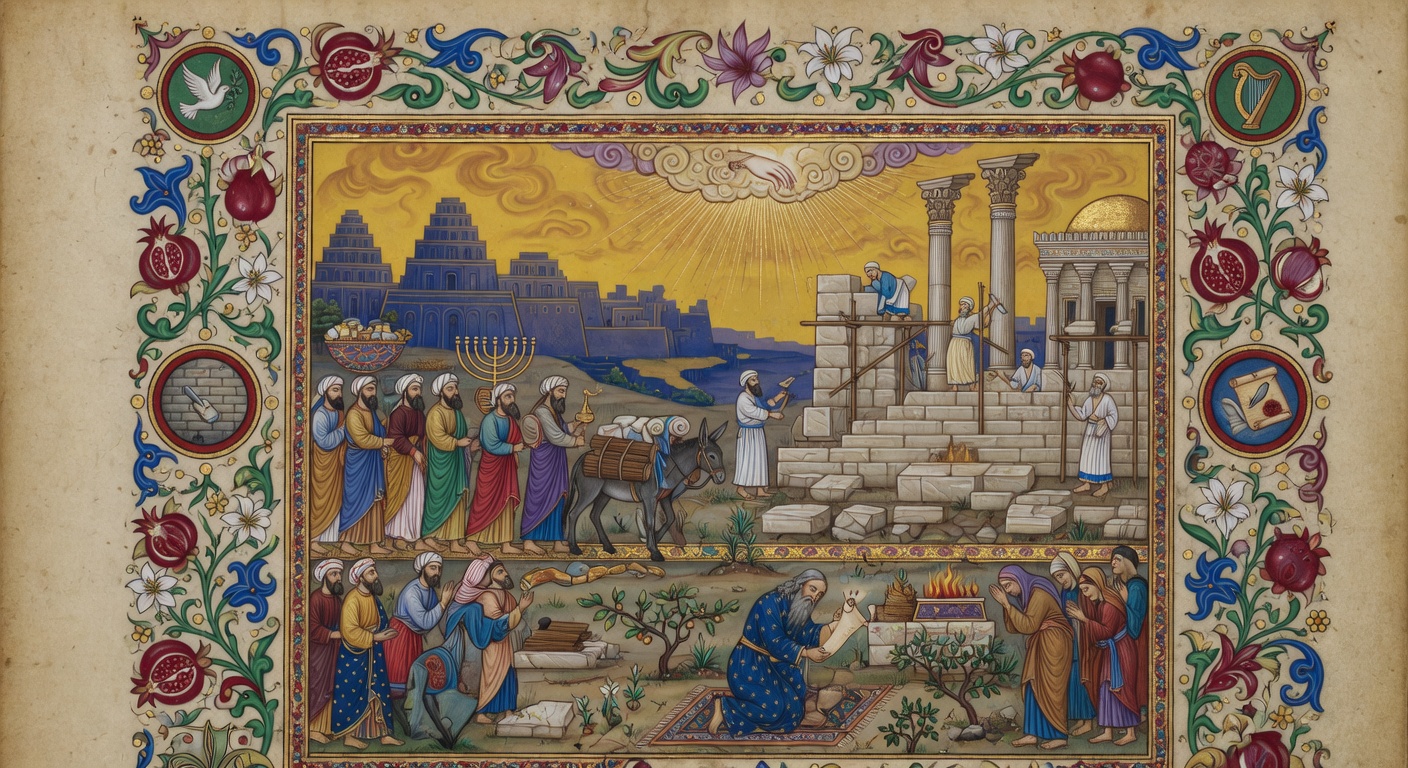
 1nd when the seventh month was come, and the children of Israel were in the cities, the people gathered themselves together as one man to Jerusalem.
2 Then stood up Jeshua the son of Jozadak, and his brethren the priests, and Zerubbabel the son of Shealtiel, and his brethren, and builded the altar of the God of Israel, to offer burnt offerings thereon, as it is written in the law of Moses the man of God.
3 And they set the altar upon his bases; for fear was upon them because of the people of those countries: and they offered burnt offerings thereon unto the LORD, even burnt offerings morning and evening.
4 They kept also the feast of tabernacles, as it is written, and offered the daily burnt offerings by number, according to the custom, as the duty of every day required;
5 And afterward offered the continual burnt offering, both of the new moons, and of all the set feasts of the LORD that were consecrated, and of every one that willingly offered a freewill offering unto the LORD.
6 From the first day of the seventh month began they to offer burnt offerings unto the LORD. But the foundation of the temple of the LORD was not yet laid.
7 They gave money also unto the masons, and to the carpenters; and meat, and drink, and oil, unto them of Zidon, and to them of Tyre, to bring cedar trees from Lebanon to the sea of Joppa, according to the grant that they had of Cyrus king of Persia.
8 Now in the second year of their coming unto the house of God at Jerusalem, in the second month, began Zerubbabel the son of Shealtiel, and Jeshua the son of Jozadak, and the remnant of their brethren the priests and the Levites, and all they that were come out of the captivity unto Jerusalem; and appointed the Levites, from twenty years old and upward, to set forward the work of the house of the LORD.
9 Then stood Jeshua with his sons and his brethren, Kadmiel and his sons, the sons of Judah, together, to set forward the workmen in the house of God: the sons of Henadad, with their sons and their brethren the Levites.
10 And when the builders laid the foundation of the temple of the LORD, they set the priests in their apparel with trumpets, and the Levites the sons of Asaph with cymbals, to praise the LORD, after the ordinance of David king of Israel.
11 And they sang together by course in praising and giving thanks unto the LORD; because he is good, for his mercy endureth for ever toward Israel. And all the people shouted with a great shout, when they praised the LORD, because the foundation of the house of the LORD was laid.
12 But many of the priests and Levites and chief of the fathers, who were ancient men, that had seen the first house, when the foundation of this house was laid before their eyes, wept with a loud voice; and many shouted aloud for joy:
13 So that the people could not discern the noise of the shout of joy from the noise of the weeping of the people: for the people shouted with a loud shout, and the noise was heard afar off.
← → arrow keys to navigate chapters · spacebar to play/pause audio
Did You Know?
The altar's reconstruction precedes any temple work and occurs amid surrounding hostility, establishing sacrifice as the essential precondition for communal identity rather than a secondary cultic accessory.
By resuming offerings 'as it is written in the law of Moses' on the first day of the seventh month, the returnees synchronize their restoration with the pre-exilic calendar yet adapt Levitical service ages downward to twenty, revealing pragmatic halakhic flexibility absent in Numbers 4.
The antiphonal singing that mixes 'trumpets' and 'cymbals after the ordinance of David' deliberately revives Solomonic temple liturgy (1 Chr 25) while the foundation is still unlaid, asserting continuity with the Davidic covenant despite the absence of monarchy or completed sanctuary.
The simultaneous weeping of elderly eyewitnesses and shouts of younger participants at the foundation ceremony encodes a theological tension later echoed in Haggai 2:3-9: the second temple's lesser visible glory is already acknowledged at its inception.
Hiring Sidonian and Tyrian timber merchants for the project replicates Solomon's international arrangements (1 Kgs 5) but under Persian imperial oversight, illustrating how post-exilic Judah re-employs pre-exilic diplomatic patterns now refracted through foreign suzerainty.
Ezra 2 lists Zerubbabel returning with nearly 50,000 people including temple servants and livestock, yet the group faced severe economic hardship and identity conflicts with local populations claiming shared heritage.
Zechariah's vision of Joshua is one of the clearest Old Testament pictures of justification: filthy garments removed and clean robes given, entirely at God's initiative.
Ezra's marathon public reading of the Torah over seven days in Jerusalem prompted the people to celebrate the Feast of Tabernacles with unprecedented joy, unmatched since the time of Joshua.
Josephus records that Cyrus was shown Isaiah's prophecies concerning himself, prompting his edict for the Jews' return, an extra-biblical tradition that aligns with the Persian king's documented tolerance of local cults across his empire.
Three major world religions consider Jerusalem a holy city.
The Hanging Gardens of Babylon were one of the Seven Wonders of the Ancient World.
Through these accounts Persia reveals how the Lord sovereignly directs even mighty Gentile kingdoms to preserve his people and advance the promises of restoration.
Commentary & Study Notes Jamieson-Fausset-Brown (1871) · Public Domain when the seventh month was come — The departure of the returning exiles from Babylon took place in the spring. For some time after their arrival they were occupied in the necessary…
Classic verse-by-verse commentary on Ezra 3 from Jamieson, Fausset & Brown (1871). Covers: The altar set up; Offerings renewed; The foundation of the temple laid.
- 1
- when the seventh month was come — The departure of the returning exiles from Babylon took place in the spring. For some time after their arrival they were occupied in the necessary work of rearing habitations to themselves amid the ruins of Jerusalem and its neighborhood. This preliminary work being completed, they addressed themselves to rebuild the altar of burnt offering. As the seventh month of the sacred year was at hand — corresponding to the latter end of our September — when the feast of tabernacles (Le 23:34) fell to be observed, they resolved to celebrate that religious festival, just as if the temple had been fully restored.
- 2
- Jeshua — the grandson of Seraiah, the high priest, put to death by Nebuchadnezzar at Riblah (2Ki 25:18-21). His father, Josedech, had been carried captive to Babylon, and died there, some time before this. Zerubbabel — was, according to the order of nature, son of Pedaiah (1Ch 3:17-19); but having been brought up by Salathiel, he was called his son. builded the altar of the God of Israel, to offer burnt offerings thereon — This was of urgent and immediate necessity, in order, first, to make atonement for their sins; secondly, to obtain the divine blessing on their preparations for the temple, as well as animate their feelings of piety and patriotism for the prosecution of that national work.
Read all 9 notes on Ezra 3 →