Ezra 5 KJV
Rebuilding Resumes
Rebuilding Resumes
The chapter explicitly credits the prophetic words of Haggai and Zechariah with spurring Zerubbabel and Jeshua to resume construction, embodying the principle that divine initiative through prophecy precedes and empowers human action in restoration.
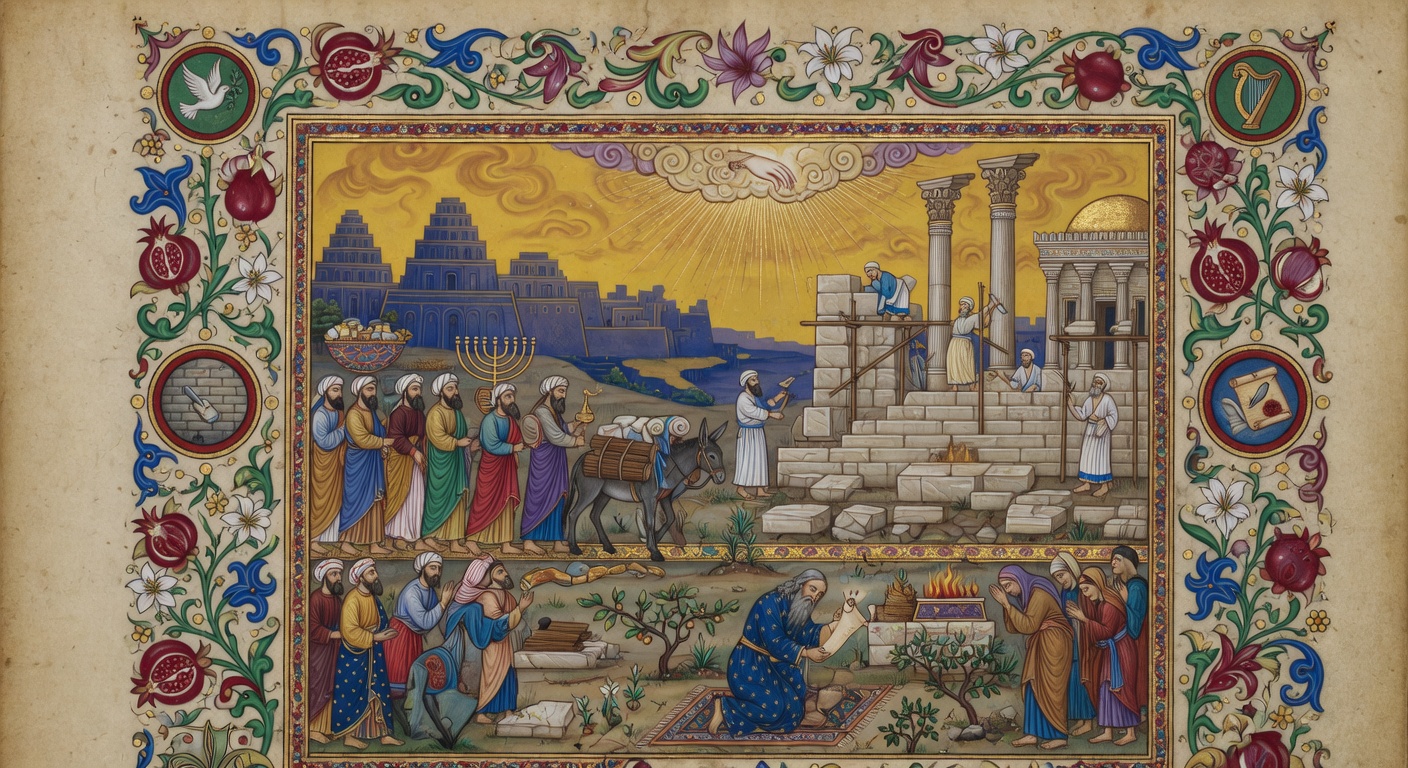
 1hen the prophets, Haggai the prophet, and Zechariah the son of Iddo, prophesied unto the Jews that were in Judah and Jerusalem in the name of the God of Israel, even unto them.
2 Then rose up Zerubbabel the son of Shealtiel, and Jeshua the son of Jozadak, and began to build the house of God which is at Jerusalem: and with them were the prophets of God helping them.
3 At the same time came to them Tatnai, governor on this side the river, and Shetharboznai, and their companions, and said thus unto them, Who hath commanded you to build this house, and to make up this wall?
4 Then said we unto them after this manner, What are the names of the men that make this building?
5 But the eye of their God was upon the elders of the Jews, that they could not cause them to cease, till the matter came to Darius: and then they returned answer by letter concerning this matter.
6 The copy of the letter that Tatnai, governor on this side the river, and Shetharboznai, and his companions the Apharsachites, which were on this side the river, sent unto Darius the king:
7 They sent a letter unto him, wherein was written thus; Unto Darius the king, all peace.
8 Be it known unto the king, that we went into the province of Judea, to the house of the great God, which is builded with great stones, and timber is laid in the walls, and this work goeth fast on, and prospereth in their hands.
9 Then asked we those elders, and said unto them thus, Who commanded you to build this house, and to make up these walls?
10 We asked their names also, to certify thee, that we might write the names of the men that were the chief of them.
11 And thus they returned us answer, saying, We are the servants of the God of heaven and earth, and build the house that was builded these many years ago, which a great king of Israel builded and set up.
12 But after that our fathers had provoked the God of heaven unto wrath, he gave them into the hand of Nebuchadnezzar the king of Babylon, the Chaldean, who destroyed this house, and carried the people away into Babylon.
13 But in the first year of Cyrus the king of Babylon the same king Cyrus made a decree to build this house of God.
14 And the vessels also of gold and silver of the house of God, which Nebuchadnezzar took out of the temple that was in Jerusalem, and brought them into the temple of Babylon, those did Cyrus the king take out of the temple of Babylon, and they were delivered unto one, whose name was Sheshbazzar, whom he had made governor;
15 And said unto him, Take these vessels, go, carry them into the temple that is in Jerusalem, and let the house of God be builded in his place.
16 Then came the same Sheshbazzar, and laid the foundation of the house of God which is in Jerusalem: and since that time even until now hath it been in building, and yet it is not finished.
17 Now therefore, if it seem good to the king, let there be search made in the king’s treasure house, which is there at Babylon, whether it be so, that a decree was made of Cyrus the king to build this house of God at Jerusalem, and let the king send his pleasure to us concerning this matter.
← → arrow keys to navigate chapters · spacebar to play/pause audio
Did You Know?
The chapter explicitly credits the prophetic words of Haggai and Zechariah with spurring Zerubbabel and Jeshua to resume construction, embodying the principle that divine initiative through prophecy precedes and empowers human action in restoration.
Jewish leaders respond to Tattenai not by asserting fresh divine command but by invoking Cyrus's archived decree, revealing how Persian bureaucratic records functioned as instruments of God's providential continuity across reigns.
The Aramaic phrase noting that 'the eye of their God was upon the elders' conveys more than general favor, implying active divine scrutiny and safeguarding precisely during the official inquiry that could have halted the work.
Tattenai's questioning occurs after the temple foundation had lain exposed for years, underscoring a narrative pattern where prophetic encouragement revives projects stalled by earlier opposition recorded in Ezra 4.
The detailed recap of Nebuchadnezzar's destruction and Cyrus's counter-decree within the elders' defense creates an internal literary echo of the exile's reversal, framing the rebuilding as the deliberate undoing of Babylonian judgment through Persian agency.
Ezra traced his priestly ancestry directly back to Aaron through sixteen generations listed in Ezra 7:1-5, a detail underscoring his unique authority to reform worship practices among the returned exiles.
In Isaiah 45:1, God uniquely calls the pagan ruler Cyrus His "anointed" (mashiach), a title otherwise reserved for Israelite kings, priests, and the future Messiah, underscoring divine sovereignty over foreign empires.
Zerubbabel's name, derived from Akkadian meaning 'seed of Babylon,' indicates he was likely born in captivity, underscoring how Persian policy allowed exiled royalty to retain leadership roles upon return.
The city has been destroyed at least twice, besieged 23 times, and captured 44 times.
The city fell to Persia in 539 BC exactly as Daniel prophesied. Conquered without a battle.
Through these accounts Persia reveals how the Lord sovereignly directs even mighty Gentile kingdoms to preserve his people and advance the promises of restoration.
Commentary & Study Notes Jamieson-Fausset-Brown (1871) · Public Domain Then the prophets... prophesied... in the name of the God of Israel — From the recorded writings of Haggai and Zechariah, it appears that the difficulties experienced and the many…
Classic verse-by-verse commentary on Ezra 5 from Jamieson, Fausset & Brown (1871). Covers: Zerubbabel and jeshua set forward the building of the temple in the reign of darius.
- 1
- Then the prophets... prophesied... in the name of the God of Israel — From the recorded writings of Haggai and Zechariah, it appears that the difficulties experienced and the many obstacles thrown in the way had first cooled the zeal of the Jews in the building of the temple, and then led to an abandonment of the work, under a pretended belief that the time for rebuilding it had not yet come (Hag 1:2-11). For fifteen years the work was completely suspended. These two prophets upbraided them with severe reproaches for their sloth, negligence, and worldly selfishness (Hag 1:4), threatened them with severe judgments if they continued backward, and promised that they would be blessed with great national prosperity if they resumed and prosecuted the work with alacrity and vigor. Zechariah the son of Iddo — that is, grandson (Zec 1:1).
- 2
- Then rose up Zerubbabel... and Jeshua... began to build the house of God — The strong appeals and animating exhortations of these prophets gave a new impulse to the building of the temple. It was in the second year of the reign of Darius Hystaspes that the work, after a long interruption, was resumed.
Read all 7 notes on Ezra 5 →