Nahum 2 KJV
The Fall of Nineveh
The Fall of Nineveh
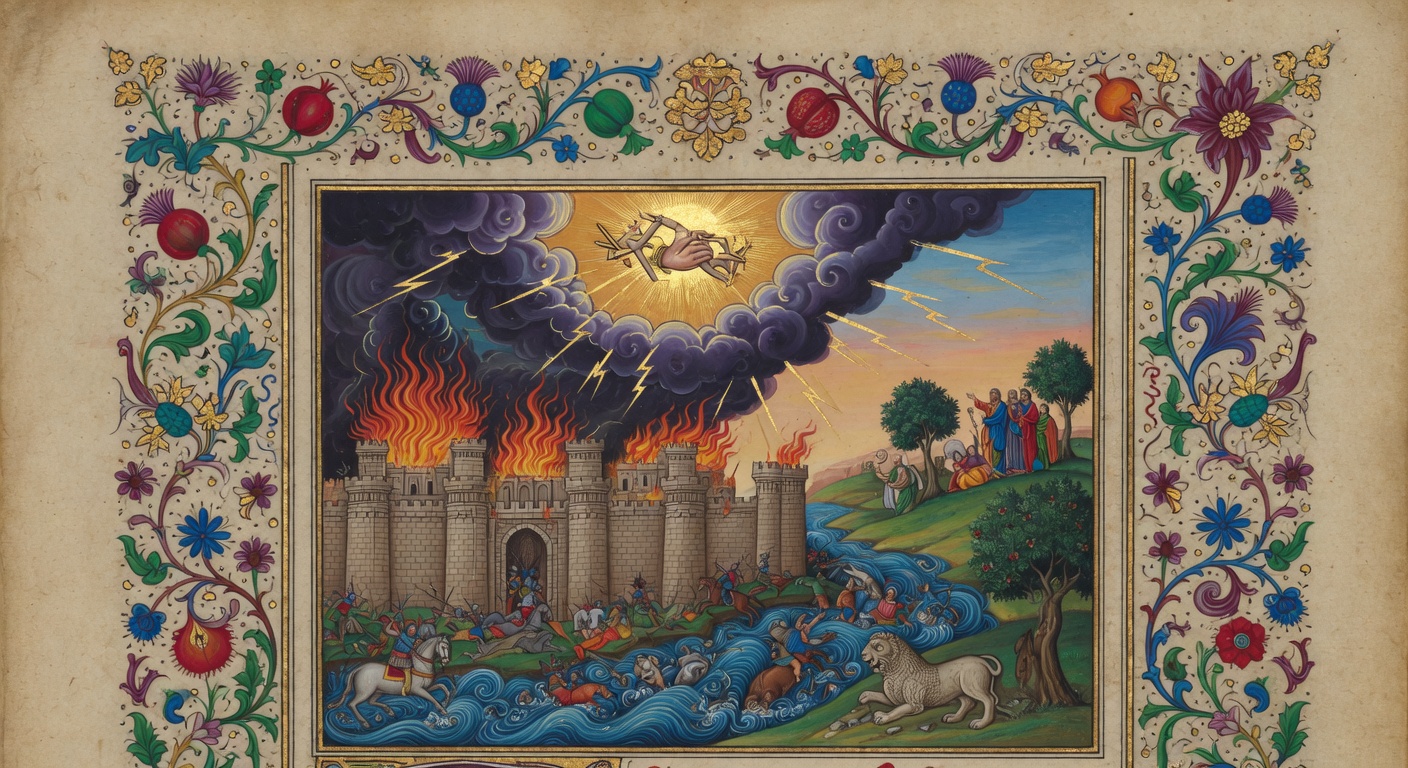
Nahum 2:6's reference to river gates opening and the palace dissolving matches archaeological and cuneiform evidence of the Khosr River flooding during Nineveh's 612 BC siege, literally undermining the city's fortifications.
 1e that dasheth in pieces is come up before thy face: keep the munition, watch the way, make thy loins strong, fortify thy power mightily.
2 For the LORD hath turned away the excellency of Jacob, as the excellency of Israel: for the emptiers have emptied them out, and marred their vine branches.
3 The shield of his mighty men is made red, the valiant men are in scarlet: the chariots shall be with flaming torches in the day of his preparation, and the fir trees shall be terribly shaken.
4 The chariots shall rage in the streets, they shall justle one against another in the broad ways: they shall seem like torches, they shall run like the lightnings.
5 He shall recount his worthies: they shall stumble in their walk; they shall make haste to the wall thereof, and the defence shall be prepared.
6 The gates of the rivers shall be opened, and the palace shall be dissolved.
7 And Huzzab shall be led away captive, she shall be brought up, and her maids shall lead her as with the voice of doves, tabering upon their breasts.
8 But Nineveh is of old like a pool of water: yet they shall flee away. Stand, stand, shall they cry; but none shall look back.
9 Take ye the spoil of silver, take the spoil of gold: for there is none end of the store and glory out of all the pleasant furniture.
10 She is empty, and void, and waste: and the heart melteth, and the knees smite together, and much pain is in all loins, and the faces of them all gather blackness.
11 Where is the dwelling of the lions, and the feedingplace of the young lions, where the lion, even the old lion, walked, and the lion’s whelp, and none made them afraid?
12 The lion did tear in pieces enough for his whelps, and strangled for his lionesses, and filled his holes with prey, and his dens with ravin.
13 Behold, I am against thee, saith the LORD of hosts, and I will burn her chariots in the smoke, and the sword shall devour thy young lions: and I will cut off thy prey from the earth, and the voice of thy messengers shall no more be heard.
← → arrow keys to navigate chapters · spacebar to play/pause audio
Did You Know?
Nahum 2:6's reference to river gates opening and the palace dissolving matches archaeological and cuneiform evidence of the Khosr River flooding during Nineveh's 612 BC siege, literally undermining the city's fortifications.
The lion-den imagery in verses 11-12 deliberately inverts Assyrian royal inscriptions and palace reliefs that portrayed kings as majestic lions, transforming their symbol of power into one of desolation and divine mockery.
Huzzab in verse 7, whose name may derive from a verb meaning 'to stand firm' or refer to Ishtar as city goddess, is depicted being led captive with mourning doves, symbolizing the humiliating deportation of Nineveh's protective deity or queen.
The chariots described as 'flaming torches' and 'lightning' in verse 4 evoke not only speed but the actual iron fittings and scythes of Neo-Assyrian war chariots, whose polished metal would flash dramatically in sunlight during battle.
Verse 13's declaration that God will 'burn her chariots in the smoke' and silence messengers reverses the Assyrian practice of sending taunting letters (as in 2 Kings 18-19), showing Yahweh silencing the empire that once terrorized Judah through propaganda.
Nahum's terse three-chapter book is written entirely as poetry with no narrative prose or calls for repentance, unlike most other prophetic texts.
Jonah's reluctance makes more sense knowing Assyria was Israel's most brutal enemy.
In this way, Assyria plays a pivotal role in the unfolding redemptive narrative, illustrating both the severity of divine judgment and the breadth of divine compassion.
Commentary & Study Notes Jamieson-Fausset-Brown (1871) · Public Domain He that dasheth in pieces — God's "battle axe," wherewith He "breaks in pieces" His enemies. Jer 51:20 applies the same Hebrew term to Nebuchadnezzar (compare Pr 25:18; Jer 50:23,…
Classic verse-by-verse commentary on Nahum 2 from Jamieson, Fausset & Brown (1871). Covers: The advance of the destroying forces against nineveh, after it was used as God's rod for a time to chastise his people: the capture of that lion's dwelling, according to the sure word of Jehovah.
- 1
- He that dasheth in pieces — God's "battle axe," wherewith He "breaks in pieces" His enemies. Jer 51:20 applies the same Hebrew term to Nebuchadnezzar (compare Pr 25:18; Jer 50:23, "the hammer of the whole earth"). Here the Medo-Babylonian army under Cyaxares and Nabopolassar, that destroyed Nineveh, is prophetically meant. before thy face — before Nineveh. Openly, so that the work of God may be manifest. watch the way — by which the foe will attack, so as to be ready to meet him. Ironical advice; equivalent to a prophecy, Thou shalt have need to use all possible means of defense; but use what thou wilt, all will be in vain. make thy loins strong — The loins are the seat of strength; to gird them up is to prepare all one's strength for conflict (Job 40:7). Also gird on thy sword (2Sa 20:8; 2Ki 4:29).
- 2
- For the Lord hath turned away the excellency of Jacob — that is, the time for Nineveh's overthrow is ripe, because Jacob (Judah) and Israel (the ten tribes) have been sufficiently chastised. The Assyrian rod of chastisement, having done its work, is to be thrown into the fire. If God chastised Jacob and Israel with all their "excellency" (Jerusalem and the temple, which was their pre-eminent excellency above all nations in God's eyes, Ps 47:4; 87:2; Eze 24:21; see on Am 6:8), how much more will He punish fatally Nineveh, an alien to Him, and idolatrous? MAURER, not so well, translates, "restores," or "will restore the excellency of Jacob." emptiers — the Assyrian spoilers. have emptied them out — have spoiled the Israelites and Jews (Ho 10:1). Compare Ps 80:8-16, on "vine branches," as applied to Israel.
Read all 13 notes on Nahum 2 →