Nehemiah 11 KJV
Residents of Jerusalem
Residents of Jerusalem
The chapter frames Jerusalem's repopulation as a renewed land allotment by casting lots, directly echoing Joshua's distribution of Canaan and portraying the return from exile as a second conquest under divine sovereignty.
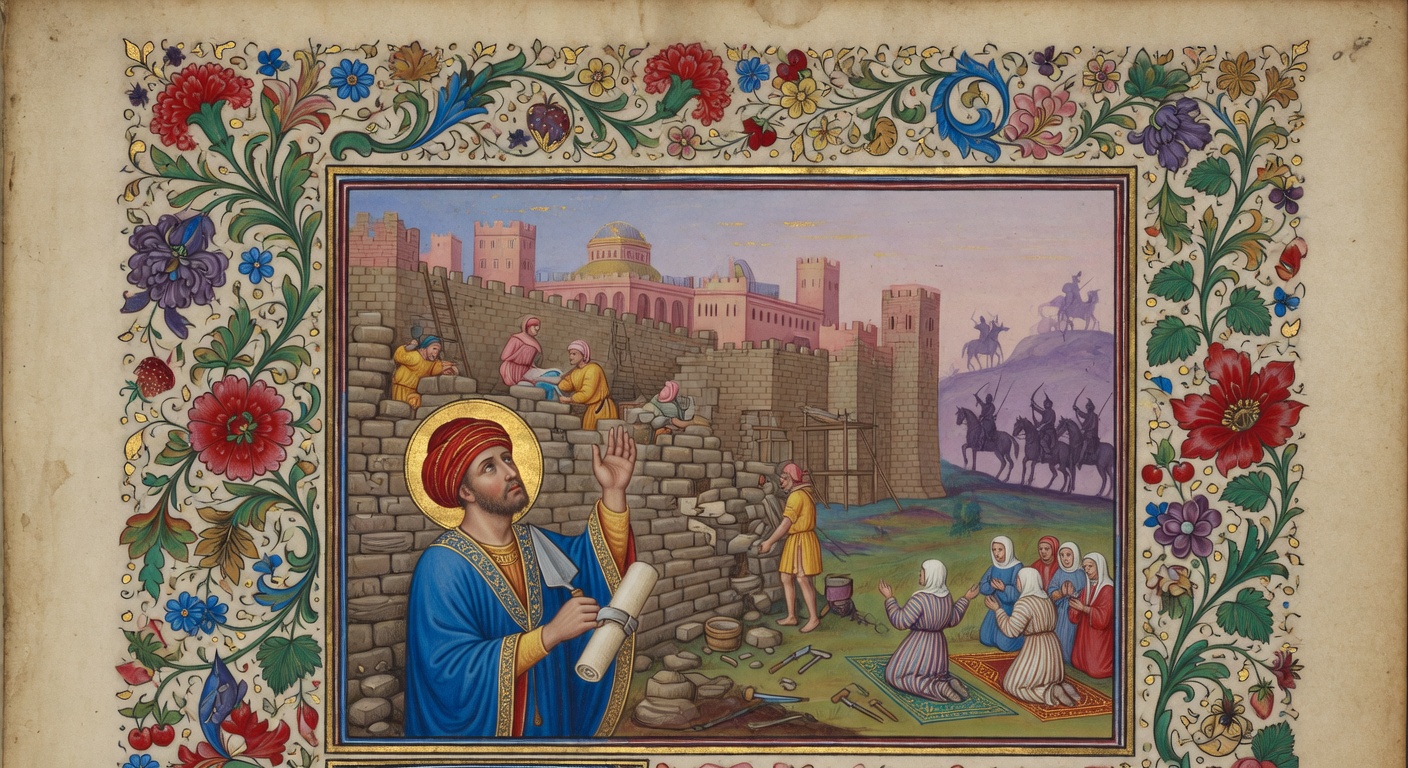
 1nd the rulers of the people dwelt at Jerusalem: the rest of the people also cast lots, to bring one of ten to dwell in Jerusalem the holy city, and nine parts to dwell in other cities.
2 And the people blessed all the men, that willingly offered themselves to dwell at Jerusalem.
3 Now these are the chief of the province that dwelt in Jerusalem: but in the cities of Judah dwelt every one in his possession in their cities, to wit, Israel, the priests, and the Levites, and the Nethinims, and the children of Solomon’s servants.
4 And at Jerusalem dwelt certain of the children of Judah, and of the children of Benjamin. Of the children of Judah; Athaiah the son of Uzziah, the son of Zechariah, the son of Amariah, the son of Shephatiah, the son of Mahalaleel, of the children of Perez;
5 And Maaseiah the son of Baruch, the son of Colhozeh, the son of Hazaiah, the son of Adaiah, the son of Joiarib, the son of Zechariah, the son of Shiloni.
6 All the sons of Perez that dwelt at Jerusalem were four hundred threescore and eight valiant men.
7 And these are the sons of Benjamin; Sallu the son of Meshullam, the son of Joed, the son of Pedaiah, the son of Kolaiah, the son of Maaseiah, the son of Ithiel, the son of Jesaiah.
8 And after him Gabbai, Sallai, nine hundred twenty and eight.
9 And Joel the son of Zichri was their overseer: and Judah the son of Senuah was second over the city.
10 Of the priests: Jedaiah the son of Joiarib, Jachin.
11 Seraiah the son of Hilkiah, the son of Meshullam, the son of Zadok, the son of Meraioth, the son of Ahitub, was the ruler of the house of God.
12 And their brethren that did the work of the house were eight hundred twenty and two: and Adaiah the son of Jeroham, the son of Pelaliah, the son of Amzi, the son of Zechariah, the son of Pashur, the son of Malchiah,
13 And his brethren, chief of the fathers, two hundred forty and two: and Amashai the son of Azareel, the son of Ahasai, the son of Meshillemoth, the son of Immer,
14 And their brethren, mighty men of valour, an hundred twenty and eight: and their overseer was Zabdiel, the son of one of the great men.
15 Also of the Levites: Shemaiah the son of Hashub, the son of Azrikam, the son of Hashabiah, the son of Bunni;
16 And Shabbethai and Jozabad, of the chief of the Levites, had the oversight of the outward business of the house of God.
17 And Mattaniah the son of Micha, the son of Zabdi, the son of Asaph, was the principal to begin the thanksgiving in prayer: and Bakbukiah the second among his brethren, and Abda the son of Shammua, the son of Galal, the son of Jeduthun.
18 All the Levites in the holy city were two hundred fourscore and four.
19 Moreover the porters, Akkub, Talmon, and their brethren that kept the gates, were an hundred seventy and two.
20 And the residue of Israel, of the priests, and the Levites, were in all the cities of Judah, every one in his inheritance.
21 But the Nethinims dwelt in Ophel: and Ziha and Gispa were over the Nethinims.
22 The overseer also of the Levites at Jerusalem was Uzzi the son of Bani, the son of Hashabiah, the son of Mattaniah, the son of Micha. Of the sons of Asaph, the singers were over the business of the house of God.
23 For it was the king’s commandment concerning them, that a certain portion should be for the singers, due for every day.
24 And Pethahiah the son of Meshezabeel, of the children of Zerah the son of Judah, was at the king’s hand in all matters concerning the people.
25 And for the villages, with their fields, some of the children of Judah dwelt at Kirjatharba, and in the villages thereof, and at Dibon, and in the villages thereof, and at Jekabzeel, and in the villages thereof,
26 And at Jeshua, and at Moladah, and at Bethphelet,
27 And at Hazarshual, and at Beersheba, and in the villages thereof,
28 And at Ziklag, and at Mekonah, and in the villages thereof,
29 And at Enrimmon, and at Zareah, and at Jarmuth,
30 Zanoah, Adullam, and in their villages, at Lachish, and the fields thereof, at Azekah, and in the villages thereof. And they dwelt from Beersheba unto the valley of Hinnom.
31 The children also of Benjamin from Geba dwelt at Michmash, and Aija, and Bethel, and in their villages,
32 And at Anathoth, Nob, Ananiah,
33 Hazor, Ramah, Gittaim,
34 Hadid, Zeboim, Neballat,
35 Lod, and Ono, the valley of craftsmen.
36 And of the Levites were divisions in Judah, and in Benjamin.
← → arrow keys to navigate chapters · spacebar to play/pause audio
Did You Know?
The chapter frames Jerusalem's repopulation as a renewed land allotment by casting lots, directly echoing Joshua's distribution of Canaan and portraying the return from exile as a second conquest under divine sovereignty.
Volunteers who freely chose to dwell in the vulnerable 'holy city' receive a public blessing from the people, elevating personal sacrifice above the compulsory one-in-ten selection and underscoring themes of willing devotion in post-exilic theology.
Genealogical notices trace certain Jerusalem leaders back to Perez, the Judahite ancestor of David, subtly affirming the persistence of the messianic line even as tribal identities are renegotiated after the exile.
The parallel lists with 1 Chronicles 9 indicate that both texts draw from a common archival source, revealing the Chronicler's broader agenda of presenting temple personnel and tribal unity as continuous from pre-exilic times into the restoration era.
Placement of Nethinims and temple servants among the first enumerated residents signals that cultic infrastructure took precedence over general population needs, ensuring the rebuilt city's identity remained centered on worship rather than mere security or economics.
Before approaching the king, Nehemiah spent four months in mourning, fasting, and prayer, timing his request to coincide with the queen's presence to increase his chances of success.
Before departing Babylon, Ezra refused a military escort from King Artaxerxes and instead proclaimed a fast beside the Ahava River, relying solely on divine protection for the caravan of nearly 5,000 people carrying temple treasures.
Extra-biblical Elephantine papyri from 407 BC identify Sanballat's sons Delaiah and Shelemiah as influential figures who advocated for the reconstruction of a Jewish temple in Egypt, revealing unexpected diplomatic ties between Samaritan leadership and diaspora communities.
Nehemiah records that Tobiah sent a series of intimidating letters to Jewish aristocrats who had sworn loyalty oaths to him, revealing an extensive espionage network that reached inside Nehemiah’s own administration.
Three major world religions consider Jerusalem a holy city.
Through these accounts Persia reveals how the Lord sovereignly directs even mighty Gentile kingdoms to preserve his people and advance the promises of restoration.
Commentary & Study Notes Jamieson-Fausset-Brown (1871) · Public Domain 1. the rulers... dwelt at Jerusalem — That city being the metropolis of the country, it was right and proper that the seat of government should be there. But the exigency of the ti…
Classic verse-by-verse commentary on Nehemiah 11 from Jamieson, Fausset & Brown (1871). Covers: The rulers, voluntary men, and every tenth man chosen by lot, dwell at Jerusalem; Their names.
- 3
- the chief of the province — that is, Judea. Nehemiah speaks of it, as it then was, a small appendix of the Persian empire. in the cities of Judah dwelt every one in his possession in their cities — The returned exiles, who had come from Babylon, repaired generally, and by a natural impulse, to the lands and cities throughout the country which had been anciently assigned them. Israel — This general name, which designated the descendants of Jacob before the unhappy division of the two kingdoms under Rehoboam, was restored after the captivity, the Israelites being then united with the Jews, and all traces of their former separation being obliterated. Although the majority of the returned exiles belonged to the tribes of Judah and Benjamin, they are here called Israel because a large number out of all the tribes were now intermingled, and these were principally the occupiers of the rural villages, while none but those of Judah and Benjamin resided in Jerusalem. the Levites — These took possession of the cities allotted to them according as they had opportunity. the Nethinims — A certain order of men, either Gibeonites or persons joined with them, who were devoted to the service of God.
- 4
- at Jerusalem dwelt certain of the children of Judah — The discrepancy that is apparent between this [Ne 11:4-36] and the list formerly given in 1Ch 9:1-9, arose not only from the Jewish and Oriental practice of changing or modifying the names of persons from a change of circumstances, but from the alterations that must have been produced in the course of time. The catalogue in Chronicles contains those who came with the first detachment of returned exiles, while the list in this passage probably included also those who returned with Ezra and Nehemiah; or it was most probably made out afterwards, when several had died, or some, who had been inserted as going on the journey, remained, and others came in their stead.
Read all 11 notes on Nehemiah 11 →