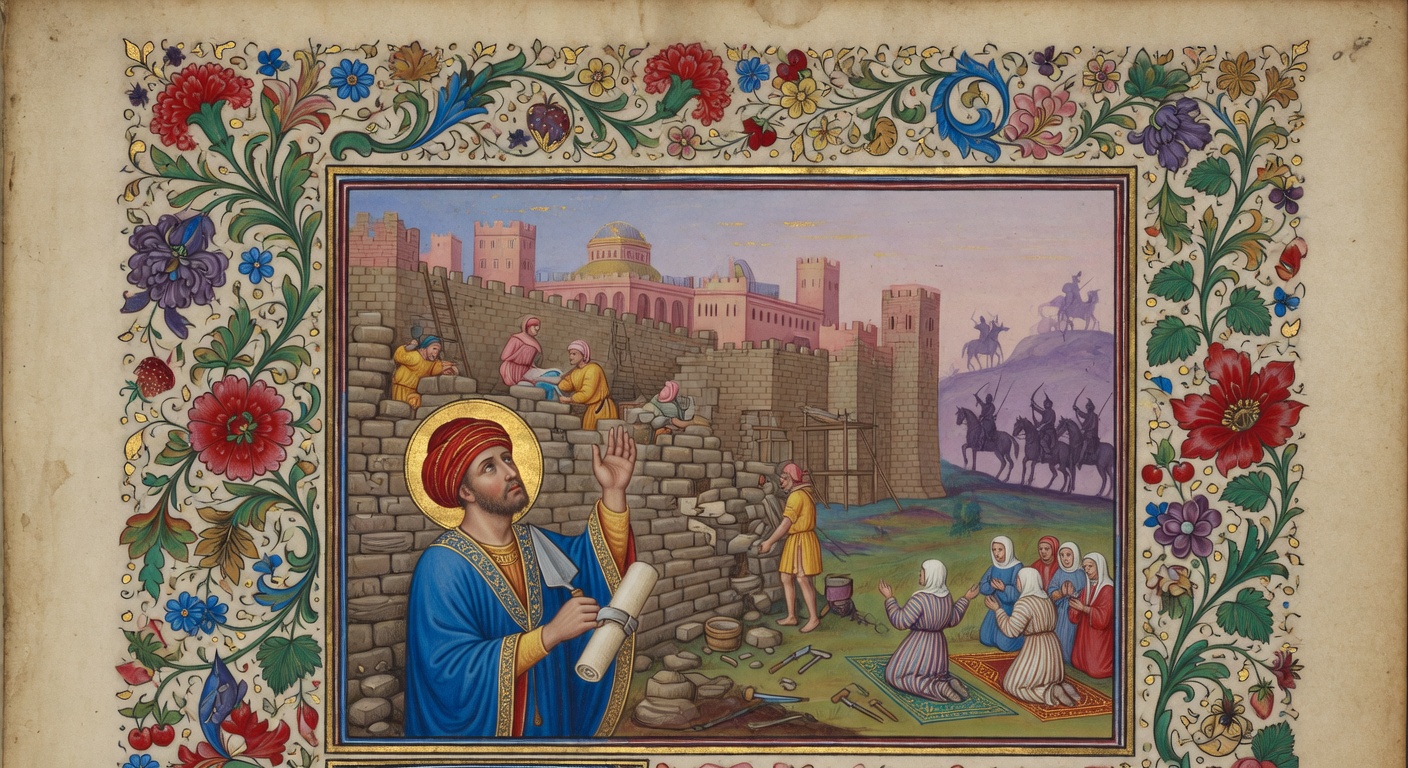
Nehemiah 1 KJV
Nehemiah's Prayer
Nehemiah's Prayer
Nehemiah's opening address to God as 'great and terrible' who 'keepest covenant' directly echoes the covenantal language of Deuteronomy 7:21 and 9:19, framing his intercession as a legal appeal to Yahweh's sworn faithfulness rather than mere emotional plea.
 1he words of Nehemiah the son of Hachaliah. And it came to pass in the month Chisleu, in the twentieth year, as I was in Shushan the palace,
2 That Hanani, one of my brethren, came, he and certain men of Judah; and I asked them concerning the Jews that had escaped, which were left of the captivity, and concerning Jerusalem.
3 And they said unto me, The remnant that are left of the captivity there in the province are in great affliction and reproach: the wall of Jerusalem also is broken down, and the gates thereof are burned with fire.
4 And it came to pass, when I heard these words, that I sat down and wept, and mourned certain days, and fasted, and prayed before the God of heaven,
5 And said, I beseech thee, O LORD God of heaven, the great and terrible God, that keepeth covenant and mercy for them that love him and observe his commandments:
6 Let thine ear now be attentive, and thine eyes open, that thou mayest hear the prayer of thy servant, which I pray before thee now, day and night, for the children of Israel thy servants, and confess the sins of the children of Israel, which we have sinned against thee: both I and my father’s house have sinned.
7 We have dealt very corruptly against thee, and have not kept the commandments, nor the statutes, nor the judgments, which thou commandedst thy servant Moses.
8 Remember, I beseech thee, the word that thou commandedst thy servant Moses, saying, If ye transgress, I will scatter you abroad among the nations:
9 But if ye turn unto me, and keep my commandments, and do them; though there were of you cast out unto the uttermost part of the heaven, yet will I gather them from thence, and will bring them unto the place that I have chosen to set my name there.
10 Now these are thy servants and thy people, whom thou hast redeemed by thy great power, and by thy strong hand.
11 O LORD, I beseech thee, let now thine ear be attentive to the prayer of thy servant, and to the prayer of thy servants, who desire to fear thy name: and prosper, I pray thee, thy servant this day, and grant him mercy in the sight of this man. For I was the king’s cupbearer.
← → arrow keys to navigate chapters · spacebar to play/pause audio
Did You Know?
Nehemiah's opening address to God as 'great and terrible' who 'keepest covenant' directly echoes the covenantal language of Deuteronomy 7:21 and 9:19, framing his intercession as a legal appeal to Yahweh's sworn faithfulness rather than mere emotional plea.
By referring to himself as 'thy servant' four times in the prayer, Nehemiah adopts Persian courtly self-designation while simultaneously claiming the distinctively Israelite servant identity of Moses and the prophets, creating a bilingual theological identity.
The report arrives via 'Hanani, one of my brethren,' indicating that the intelligence network sustaining Jerusalem's remnant operated through kinship ties within the Persian bureaucracy itself, not through official channels.
Nehemiah's confession moves from 'I and my father's house' to 'both I and my father's house have sinned' in a single verse, enacting the Deuteronomic principle of corporate personality in which an individual's prayer can vicariously represent the entire nation.
The prayer's closing request that God 'give him mercy in the sight of this man' deliberately avoids naming Artaxerxes, preserving a studied ambiguity that treats the Persian emperor as merely an instrument whose favor is secondary to divine sovereignty.
Before approaching the king, Nehemiah spent four months in mourning, fasting, and prayer, timing his request to coincide with the queen's presence to increase his chances of success.
Before departing Babylon, Ezra refused a military escort from King Artaxerxes and instead proclaimed a fast beside the Ahava River, relying solely on divine protection for the caravan of nearly 5,000 people carrying temple treasures.
Extra-biblical Elephantine papyri from 407 BC identify Sanballat's sons Delaiah and Shelemiah as influential figures who advocated for the reconstruction of a Jewish temple in Egypt, revealing unexpected diplomatic ties between Samaritan leadership and diaspora communities.
Nehemiah records that Tobiah sent a series of intimidating letters to Jewish aristocrats who had sworn loyalty oaths to him, revealing an extensive espionage network that reached inside Nehemiah’s own administration.
The famous law code of Hammurabi was discovered at Susa, where an Elamite king had carried it off as war booty centuries before Esther.
The city has been destroyed at least twice, besieged 23 times, and captured 44 times.
Through these accounts Persia reveals how the Lord sovereignly directs even mighty Gentile kingdoms to preserve his people and advance the promises of restoration.
Commentary & Study Notes Jamieson-Fausset-Brown (1871) · Public Domain Nehemiah the son of Hachaliah — This eminently pious and patriotic Jew is to be carefully distinguished from two other persons of the same name — one of whom is mentioned as helpin…
Classic verse-by-verse commentary on Nehemiah 1 from Jamieson, Fausset & Brown (1871). Covers: Nehemiah, understanding by hanani the afflicted state of Jerusalem, mourns, fasts, and prays; His prayer.
- 1
- Nehemiah the son of Hachaliah — This eminently pious and patriotic Jew is to be carefully distinguished from two other persons of the same name — one of whom is mentioned as helping to rebuild the walls of Jerusalem (Ne 3:16), and the other is noticed in the list of those who accompanied Zerubbabel in the first detachment of returning exiles (Ezr 2:2; Ne 7:7). Though little is known of his genealogy, it is highly probable that he was a descendant of the tribe of Judah and the royal family of David. in the month Chisleu — answering to the close of November and the larger part of December. Shushan the palace — the capital of ancient Susiana, east of the Tigris, a province of Persia. From the time of Cyrus it was the favorite winter residence of the Persian kings.
- 2,3
- Hanani, one of my brethren, came, he and certain men of Judah — Hanani is called his brother (Ne 7:2). But as that term was used loosely by Jews as well as other Orientals, it is probable that no more is meant than that he was of the same family. According to JOSEPHUS, Nehemiah, while walking around the palace walls, overheard some persons conversing in the Hebrew language. Having ascertained that they had lately returned from Judea, he was informed by them, in answer to his eager enquiries, of the unfinished and desolate condition of Jerusalem, as well as the defenseless state of the returned exiles. The commissions previously given to Zerubbabel and Ezra extending only to the repair of the temple and private dwellings, the walls and gates of the city had been allowed to remain a mass of shattered ruins, as they had been laid by the Chaldean siege.
Read all 4 notes on Nehemiah 1 →