Nehemiah 4 KJV
Opposition to the Work
Opposition to the Work
Sanballat's taunt invoking a fox leaping on the wall subtly mocks the Judahites by alluding to the rival Samaritan sanctuary on Mount Gerizim, where foxes featured in local folklore, framing the conflict as a contest between rival cultic centers rather than mere construction rivalry.
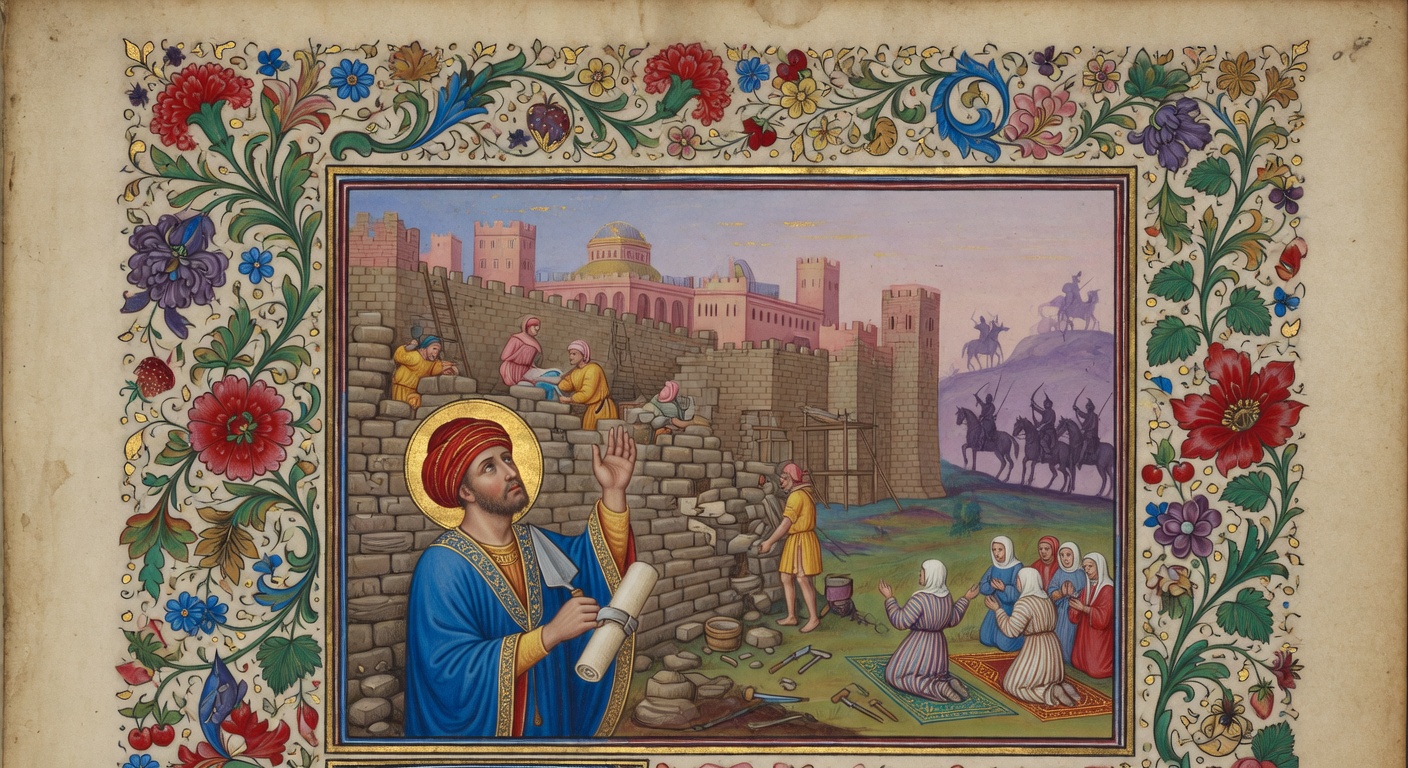
 1ut it came to pass, that when Sanballat heard that we builded the wall, he was wroth, and took great indignation, and mocked the Jews.
2 And he spake before his brethren and the army of Samaria, and said, What do these feeble Jews? will they fortify themselves? will they sacrifice? will they make an end in a day? will they revive the stones out of the heaps of the rubbish which are burned?
3 Now Tobiah the Ammonite was by him, and he said, Even that which they build, if a fox go up, he shall even break down their stone wall.
4 Hear, O our God; for we are despised: and turn their reproach upon their own head, and give them for a prey in the land of captivity:
5 And cover not their iniquity, and let not their sin be blotted out from before thee: for they have provoked thee to anger before the builders.
6 So built we the wall; and all the wall was joined together unto the half thereof: for the people had a mind to work.
7 But it came to pass, that when Sanballat, and Tobiah, and the Arabians, and the Ammonites, and the Ashdodites, heard that the walls of Jerusalem were made up, and that the breaches began to be stopped, then they were very wroth,
8 And conspired all of them together to come and to fight against Jerusalem, and to hinder it.
9 Nevertheless we made our prayer unto our God, and set a watch against them day and night, because of them.
10 And Judah said, The strength of the bearers of burdens is decayed, and there is much rubbish; so that we are not able to build the wall.
11 And our adversaries said, They shall not know, neither see, till we come in the midst among them, and slay them, and cause the work to cease.
12 And it came to pass, that when the Jews which dwelt by them came, they said unto us ten times, From all places whence ye shall return unto us they will be upon you.
13 Therefore set I in the lower places behind the wall, and on the higher places, I even set the people after their families with their swords, their spears, and their bows.
14 And I looked, and rose up, and said unto the nobles, and to the rulers, and to the rest of the people, Be not ye afraid of them: remember the LORD, which is great and terrible, and fight for your brethren, your sons, and your daughters, your wives, and your houses.
15 And it came to pass, when our enemies heard that it was known unto us, and God had brought their counsel to nought, that we returned all of us to the wall, every one unto his work.
16 And it came to pass from that time forth, that the half of my servants wrought in the work, and the other half of them held both the spears, the shields, and the bows, and the habergeons; and the rulers were behind all the house of Judah.
17 They which builded on the wall, and they that bare burdens, with those that laded, every one with one of his hands wrought in the work, and with the other hand held a weapon.
18 For the builders, every one had his sword girded by his side, and so builded. And he that sounded the trumpet was by me.
19 And I said unto the nobles, and to the rulers, and to the rest of the people, The work is great and large, and we are separated upon the wall, one far from another.
20 In what place therefore ye hear the sound of the trumpet, resort ye thither unto us: our God shall fight for us.
21 So we laboured in the work: and half of them held the spears from the rising of the morning till the stars appeared.
22 Likewise at the same time said I unto the people, Let every one with his servant lodge within Jerusalem, that in the night they may be a guard to us, and labour on the day.
23 So neither I, nor my brethren, nor my servants, nor the men of the guard which followed me, none of us put off our clothes, saving that every one put them off for washing.
← → arrow keys to navigate chapters · spacebar to play/pause audio
Did You Know?
Sanballat's taunt invoking a fox leaping on the wall subtly mocks the Judahites by alluding to the rival Samaritan sanctuary on Mount Gerizim, where foxes featured in local folklore, framing the conflict as a contest between rival cultic centers rather than mere construction rivalry.
The imprecatory prayer in verses 4-5, calling for the enemies' sins to remain unforgiven, echoes the covenant curses of Deuteronomy 28 while adapting them to post-exilic conditions, revealing how returned exiles repurposed Mosaic imprecations against new foreign adversaries.
Nehemiah's deployment of families grouped by kinship to guard specific wall sections revives the ancient Israelite militia system from the book of Judges, transforming tribal levies into a defensive workforce that preserves clan identity amid imperial threat.
The detail that builders labored with a weapon strapped to their side while carrying loads on their backs mirrors Assyrian palace reliefs of captive laborers under armed supervision, indicating Nehemiah deliberately adopted Persian administrative and military practices to counter Persian-appointed officials like Sanballat.
The trumpet signal for rallying at any breach point establishes an acoustic warning network across Jerusalem's perimeter, a practical adaptation of Levitical trumpet protocols from Numbers 10 that converts cultic signaling into a real-time communal defense mechanism.
Sanballat and his allies proposed a summit in the plain of Ono, a site roughly 30 miles northwest of Jerusalem, specifically chosen to draw Nehemiah away from the city's defenses for an assassination attempt disguised as negotiation.
Persian-period Aramaic documents from the Transjordan mention a Tobiad family estate near modern Amman, suggesting the biblical Tobiah belonged to a hereditary Ammonite aristocracy that continued to wield regional power for centuries.
As governor Nehemiah served without pay for twelve years and publicly confronted nobles for charging interest on loans to the poor, forcing restitution and covenant renewal to restore economic justice.
Jewish tradition credits Ezra with helping form the Great Assembly, standardizing the Hebrew canon, and shifting the sacred script from paleo-Hebrew to the square Aramaic letters still used today.
Jerusalem is mentioned over 800 times in the Bible. More than any other city.
In the unfolding of God's redemptive purposes, Persia rose as the empire that subdued Babylon and issued the decree enabling the Jewish exiles to return and rebuild the temple in Jerusalem.
Commentary & Study Notes Jamieson-Fausset-Brown (1871) · Public Domain when Sanballat heard that we builded the wall, he was wroth — The Samaritan faction showed their bitter animosity to the Jews on discovering the systematic design of refortifying J…
Classic verse-by-verse commentary on Nehemiah 4 from Jamieson, Fausset & Brown (1871). Covers: While the enemies scoff, nehemiah prays to God, and continues the work; He sets a watch.
- 1
- when Sanballat heard that we builded the wall, he was wroth — The Samaritan faction showed their bitter animosity to the Jews on discovering the systematic design of refortifying Jerusalem. Their opposition was confined at first to scoffs and insults, in heaping which the governors made themselves conspicuous, and circulated all sorts of disparaging reflections that might increase the feelings of hatred and contempt for them in their own party. The weakness of the Jews in respect of wealth and numbers, the absurdity of their purpose apparently to reconstruct the walls and celebrate the feast of dedication in one day, the idea of raising the walls on their old foundations, as well as using the charred and mouldering debris of the ruins as the materials for the restored buildings, and the hope of such a parapet as they could raise being capable of serving as a fortress of defense — these all afforded fertile subjects of hostile ridicule.
- 3
- if a fox go up — The foxes were mentioned because they were known to infest in great numbers the ruined and desolate places in the mount and city of Zion (La 5:18).
Read all 4 notes on Nehemiah 4 →