Nehemiah 5 KJV
Nehemiah Helps the Poor
Nehemiah Helps the Poor
Nehemiah's rebuke of the nobles frames internal Jewish debt slavery as a reversal of the Exodus narrative, where the people cry out against their own rather than foreign oppressors, underscoring that covenant unfaithfulness now originates from within the community.
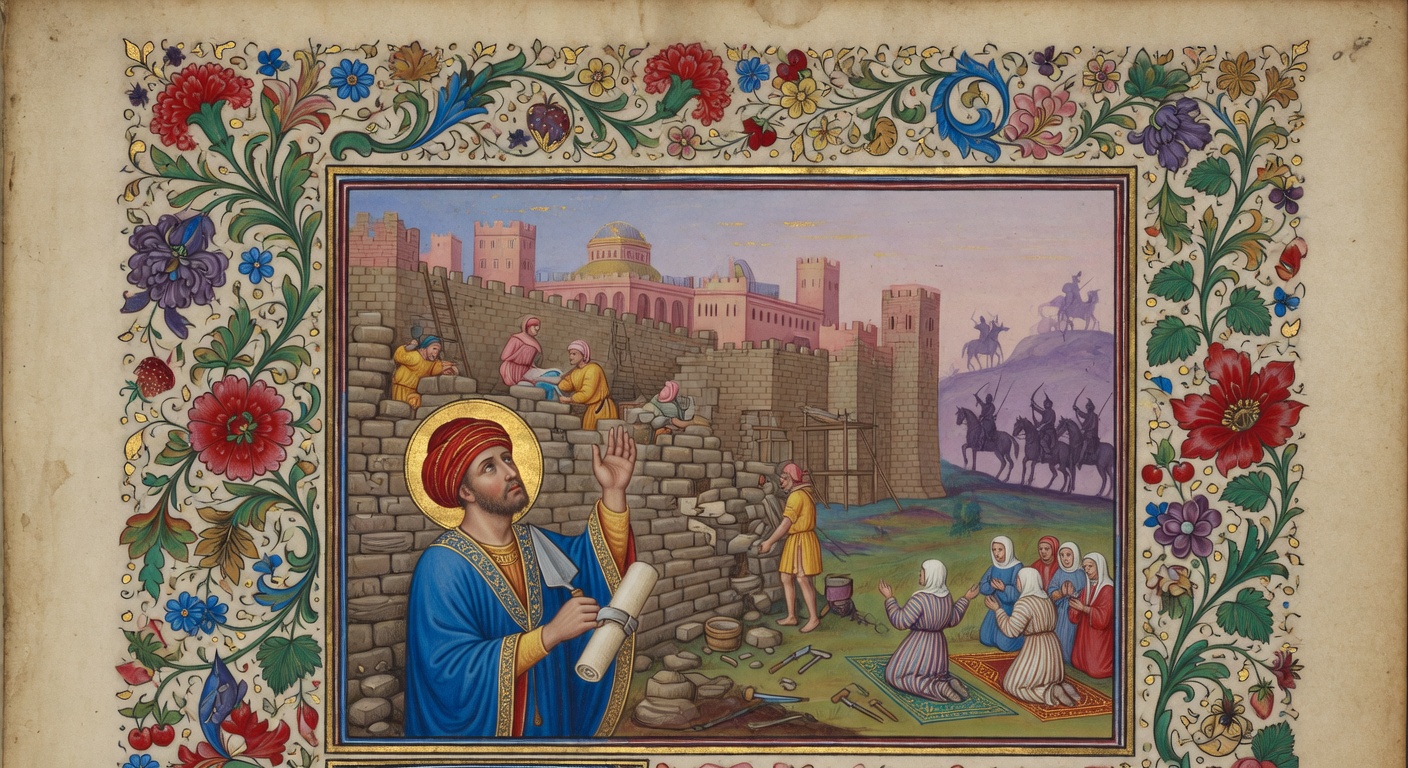
 1nd there was a great cry of the people and of their wives against their brethren the Jews.
2 For there were that said, We, our sons, and our daughters, are many: therefore we take up corn for them, that we may eat, and live.
3 Some also there were that said, We have mortgaged our lands, vineyards, and houses, that we might buy corn, because of the dearth.
4 There were also that said, We have borrowed money for the king’s tribute, and that upon our lands and vineyards.
5 Yet now our flesh is as the flesh of our brethren, our children as their children: and, lo, we bring into bondage our sons and our daughters to be servants, and some of our daughters are brought unto bondage already: neither is it in our power to redeem them; for other men have our lands and vineyards.
6 And I was very angry when I heard their cry and these words.
7 Then I consulted with myself, and I rebuked the nobles, and the rulers, and said unto them, Ye exact usury, every one of his brother. And I set a great assembly against them.
8 And I said unto them, We after our ability have redeemed our brethren the Jews, which were sold unto the heathen; and will ye even sell your brethren? or shall they be sold unto us? Then held they their peace, and found nothing to answer.
9 Also I said, It is not good that ye do: ought ye not to walk in the fear of our God because of the reproach of the heathen our enemies?
10 I likewise, and my brethren, and my servants, might exact of them money and corn: I pray you, let us leave off this usury.
11 Restore, I pray you, to them, even this day, their lands, their vineyards, their oliveyards, and their houses, also the hundredth part of the money, and of the corn, the wine, and the oil, that ye exact of them.
12 Then said they, We will restore them, and will require nothing of them; so will we do as thou sayest. Then I called the priests, and took an oath of them, that they should do according to this promise.
13 Also I shook my lap, and said, So God shake out every man from his house, and from his labour, that performeth not this promise, even thus be he shaken out, and emptied. And all the congregation said, Amen, and praised the LORD. And the people did according to this promise.
14 Moreover from the time that I was appointed to be their governor in the land of Judah, from the twentieth year even unto the two and thirtieth year of Artaxerxes the king, that is, twelve years, I and my brethren have not eaten the bread of the governor.
15 But the former governors that had been before me were chargeable unto the people, and had taken of them bread and wine, beside forty shekels of silver; yea, even their servants bare rule over the people: but so did not I, because of the fear of God.
16 Yea, also I continued in the work of this wall, neither bought we any land: and all my servants were gathered thither unto the work.
17 Moreover there were at my table an hundred and fifty of the Jews and rulers, beside those that came unto us from among the heathen that are about us.
18 Now that which was prepared for me daily was one ox and six choice sheep; also fowls were prepared for me, and once in ten days store of all sorts of wine: yet for all this required not I the bread of the governor, because the bondage was heavy upon this people.
19 Think upon me, my God, for good, according to all that I have done for this people.
← → arrow keys to navigate chapters · spacebar to play/pause audio
Did You Know?
Nehemiah's rebuke of the nobles frames internal Jewish debt slavery as a reversal of the Exodus narrative, where the people cry out against their own rather than foreign oppressors, underscoring that covenant unfaithfulness now originates from within the community.
The assembly Nehemiah summons functions as a post-exilic covenant renewal rite, complete with oath and priestly witnesses, paralleling earlier ceremonies under Joshua and Ezra but applied specifically to economic ethics rather than idolatry.
By refusing the governor's customary provisions and hosting 150 at his table daily without acquiring land, Nehemiah models a leadership ethic that inverts Persian satrap practices and anticipates New Testament servant-leadership themes.
The symbolic act of shaking out his garment invokes a curse formula akin to those in ancient Near Eastern treaties, binding the nobles not merely by Persian law but by divine sanction under the Mosaic prohibition of usury among Israelites.
Chapter 5 interrupts the wall-building narrative to argue that physical security of Jerusalem remains incomplete without rectification of social injustice, a literary device that links material restoration with the ethical demands of the Torah.
Nehemiah held the trusted role of cupbearer to Artaxerxes I, granting him intimate access to the Persian court where he likely tasted royal wine daily to guard against poisoning.
Ezra traced his priestly ancestry directly back to Aaron through sixteen generations listed in Ezra 7:1-5, a detail underscoring his unique authority to reform worship practices among the returned exiles.
Sanballat's name derives from the Akkadian Sin-uballit, meaning 'Sin has given life,' reflecting veneration of the Mesopotamian moon god and indicating his likely non-Israelite heritage despite ruling Samaria under Persian authority.
Despite the Mosaic law barring Ammonites from the assembly of God even to the tenth generation, Tobiah leveraged his marriage tie to the influential Shecaniah son of Arah to install a personal storeroom inside the Jerusalem temple precincts.
The city has been destroyed at least twice, besieged 23 times, and captured 44 times.
Through these accounts Persia reveals how the Lord sovereignly directs even mighty Gentile kingdoms to preserve his people and advance the promises of restoration.
Commentary & Study Notes Jamieson-Fausset-Brown (1871) · Public Domain 1-5. there was a great cry of the people... against their brethren — Such a crisis in the condition of the Jews in Jerusalem — fatigued with hard labor and harassed by the machinat…
Classic verse-by-verse commentary on Nehemiah 5 from Jamieson, Fausset & Brown (1871). Covers: The people complain of their debt, mortgage, and bondage; The usurers rebuked.
- 6-12
- I was very angry when I heard their cry and these words — When such disorders came to the knowledge of the governor, his honest indignation was roused against the perpetrators of the evil. Having summoned a public assembly, he denounced their conduct in terms of just severity. He contrasted it with his own in redeeming with his money some of the Jewish exiles who, through debt or otherwise, had lost their personal liberty in Babylon. He urged the rich creditors not only to abandon their illegal and oppressive system of usury, but to restore the fields and vineyards of the poor, so that a remedy might be put to an evil the introduction of which had led to much actual disorder, and the continuance of which would inevitably prove ruinous to the newly restored colony, by violating the fundamental principles of the Hebrew constitution. The remonstrance was effectual. The conscience of the usurious oppressors could not resist the touching and powerful appeal. With mingled emotions of shame, contrition, and fear, they with one voice expressed their readiness to comply with the governor's recommendation. The proceedings were closed by the parties binding themselves by a solemn oath, administered by the priests, that they would redeem their pledge, as well as by the governor invoking, by the solemn and significant gesture of shaking a corner of his garment, a malediction on those who should violate it. The historian has taken care to record that the people did according to this promise.
- 14
- Moreover from the time that I was appointed... I and my brethren have not eaten the bread of the governor — We have a remarkable proof both of the opulence and the disinterestedness of Nehemiah. As he declined, on conscientious grounds, to accept the lawful emoluments attached to his government, and yet maintained a style of princely hospitality for twelve years out of his own resources, it is evident that his office of cup-bearer at the court of Shushan must have been very lucrative.
Read all 4 notes on Nehemiah 5 →