Psalms 101 KJV
A Pledge of Integrity
About This Psalm
David's personal code of conduct as king. I will walk with integrity in my house. Leadership starts at home.
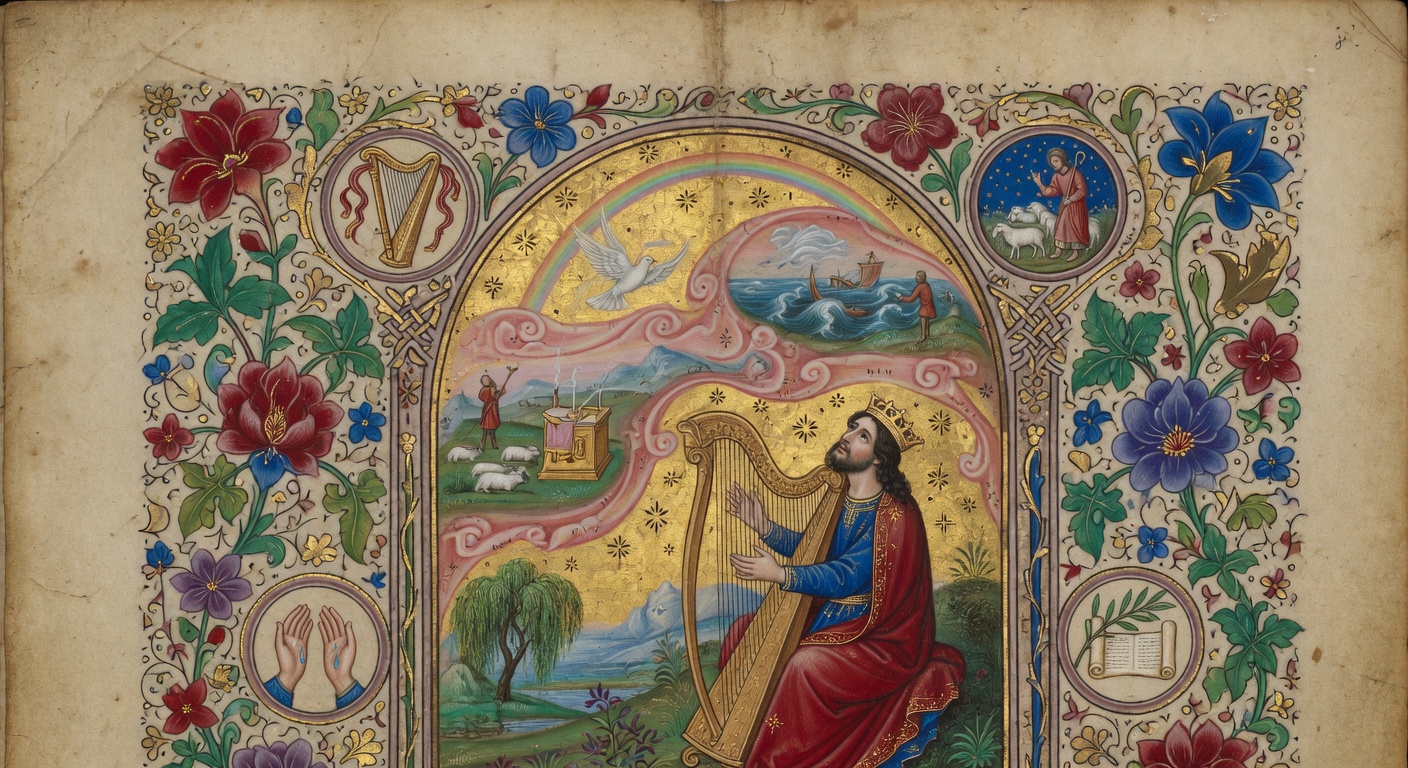
 1 will sing of mercy and judgment: unto thee, O LORD, will I sing.
2 I will behave myself wisely in a perfect way. O when wilt thou come unto me? I will walk within my house with a perfect heart.
3 I will set no wicked thing before mine eyes: I hate the work of them that turn aside; it shall not cleave to me.
4 A froward heart shall depart from me: I will not know a wicked person.
5 Whoso privily slandereth his neighbour, him will I cut off: him that hath an high look and a proud heart will not I suffer.
6 Mine eyes shall be upon the faithful of the land, that they may dwell with me: he that walketh in a perfect way, he shall serve me.
7 He that worketh deceit shall not dwell within my house: he that telleth lies shall not tarry in my sight.
8 I will early destroy all the wicked of the land; that I may cut off all wicked doers from the city of the LORD.
← → arrow keys to navigate chapters · spacebar to play/pause audio
Did You Know?
Psalm 101 articulates a theology of righteous kingship that integrates personal holiness with judicial equity, presenting the Davidic ruler as accountable to Yahweh rather than claiming divine status like surrounding ancient Near Eastern monarchs.
The repeated first-person vows create a performative oath structure that functions as self-imprecation, invoking divine judgment on the speaker if the commitments to purge evil from court and land are not fulfilled.
Its focus on purging the wicked 'morning by morning' (v. 8) draws on ancient Near Eastern royal rituals of daily justice renewal but reframes them as covenant obedience to Yahweh, linking creation order with moral governance.
The psalm uniquely pairs domestic integrity ('walk within my house with a perfect heart,' v. 2) with public policy, establishing the private sphere as the proving ground for royal fitness in a way echoed later in biblical elder qualifications.
Positioned before Psalm 102 in the Psalter, it forms a deliberate literary movement from royal ethical resolve to communal lament, suggesting an editorial shaping that portrays Davidic ideals as prelude to messianic hope amid affliction.
David purchased Araunah the Jebusite's threshing floor for fifty shekels of silver after the plague halted, establishing the exact site that later became the Temple Mount under Solomon.
Biblical tradition attributes 3,000 proverbs and 1,005 songs to Solomon, along with expertise in botany and zoology covering everything from cedar trees to hyssop and from livestock to birds, fish, and reptiles, yet only fragments survive in Proverbs, Ecclesiastes, and Song of Songs.
The New Testament further develops this imagery to portray the heavenly Jerusalem where believers gather to the living God.
The city has been destroyed at least twice, besieged 23 times, and captured 44 times.
Commentary & Study Notes Jamieson-Fausset-Brown (1871) · Public Domain He avows his sincere purpose, by God's aid, to act uprightly (Ge 17:1; Ps 18:30).
Classic verse-by-verse commentary on Psalms 101 from Jamieson, Fausset & Brown (1871). Covers: In this psalm the profession of the principles of his domestic and political government testifies, as well as actions in accordance with it, David's appreciation of God's mercy to him, and his judgment on his enemies: and thus he sings or celebrates God's dealings.
- 2
- He avows his sincere purpose, by God's aid, to act uprightly (Ge 17:1; Ps 18:30).
- 3
- set... eyes — as an example to be approved and followed. no wicked thing — literally, "word," plan or purpose of Belial (Ps 41:8). work of... aside — apostates. not cleave to me — I will not be implicated in it (compare Ps 1:1-3).
Read all 7 notes on Psalms 101 →