Psalms 111 KJV
Praise for God's Works
About This Psalm
An acrostic praising God's works. Great are the works of the LORD. The fear of the LORD is the beginning of wisdom.
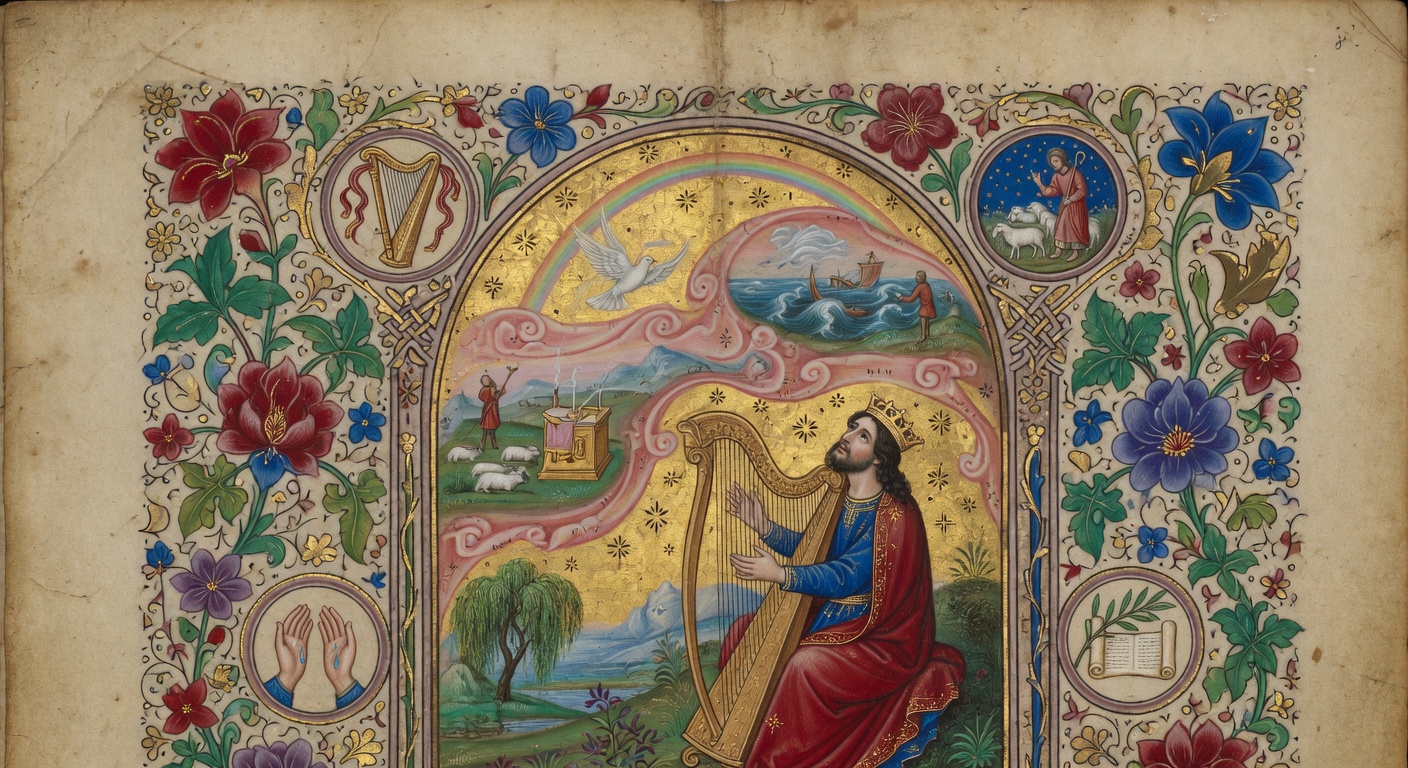
 1raise ye the LORD. I will praise the LORD with my whole heart, in the assembly of the upright, and in the congregation.
2 The works of the LORD are great, sought out of all them that have pleasure therein.
3 His work is honourable and glorious: and his righteousness endureth for ever.
4 He hath made his wonderful works to be remembered: the LORD is gracious and full of compassion.
5 He hath given meat unto them that fear him: he will ever be mindful of his covenant.
6 He hath shewed his people the power of his works, that he may give them the heritage of the heathen.
7 The works of his hands are verity and judgment; all his commandments are sure.
8 They stand fast for ever and ever, and are done in truth and uprightness.
9 He sent redemption unto his people: he hath commanded his covenant for ever: holy and reverend is his name.
10 The fear of the LORD is the beginning of wisdom: a good understanding have all they that do his commandments: his praise endureth for ever.
← → arrow keys to navigate chapters · spacebar to play/pause audio
Did You Know?
The acrostic structure of Psalm 111, advancing letter by letter through the Hebrew alphabet, enacts a theological claim that God's covenant acts encompass every dimension of reality from Aleph to Tav.
Paired deliberately with Psalm 112, the psalm forms a diptych in which divine attributes (righteousness, compassion, faithfulness) are presented as the pattern the righteous human is called to embody, modeling imitatio Dei.
Verse 6's reference to giving "the heritage of the heathen" subtly recasts the conquest traditions of Joshua as an act of divine power rather than Israelite military achievement, aligning with Deuteronomic theology.
By ending on the wisdom saying "the fear of the LORD is the beginning of wisdom," the psalm fuses hymnic praise with sapiential tradition, implying that meditation on redemptive history produces ethical discernment.
The phrase "his works to be remembered" (verse 4) echoes the language of cultic memorial in Exodus, suggesting the psalm itself functions as a liturgical counterpart to Passover or covenant-renewal ceremonies that keep God's deeds alive in Israel's memory.
David purchased Araunah the Jebusite's threshing floor for fifty shekels of silver after the plague halted, establishing the exact site that later became the Temple Mount under Solomon.
Biblical tradition attributes 3,000 proverbs and 1,005 songs to Solomon, along with expertise in botany and zoology covering everything from cedar trees to hyssop and from livestock to birds, fish, and reptiles, yet only fragments survive in Proverbs, Ecclesiastes, and Song of Songs.
This location became the focal point of national worship and divine promises, later extending symbolically to encompass the Temple Mount where Solomon built the house of the Lord.
Three major world religions consider Jerusalem a holy city.
Commentary & Study Notes Jamieson-Fausset-Brown (1871) · Public Domain Praise ye the Lord — or, Hallelujah (Ps 104:35). This seems to serve as a title to those of the later Psalms, which, like this, set forth God's gracious government and its blessed…
Classic verse-by-verse commentary on Psalms 111 from Jamieson, Fausset & Brown (1871). Covers: The psalmist celebrates God's gracious dealings with his people, of which a summary statement is given.
- 1
- Praise ye the Lord — or, Hallelujah (Ps 104:35). This seems to serve as a title to those of the later Psalms, which, like this, set forth God's gracious government and its blessed fruits. This praise claims the whole heart — (Ps 86:12), and is rendered publicly. upright — a title of the true Israel (Ps 32:11).
- 2
- His works, that is, of providence and grace are sought — or, carefully studied, by all desiring to know them.
Read all 6 notes on Psalms 111 →