Psalms 114 KJV
God's Wonders at the Exodus
About This Psalm
The Exodus in miniature - the sea fled, the mountains skipped. Poetic retelling of God's power in deliverance.
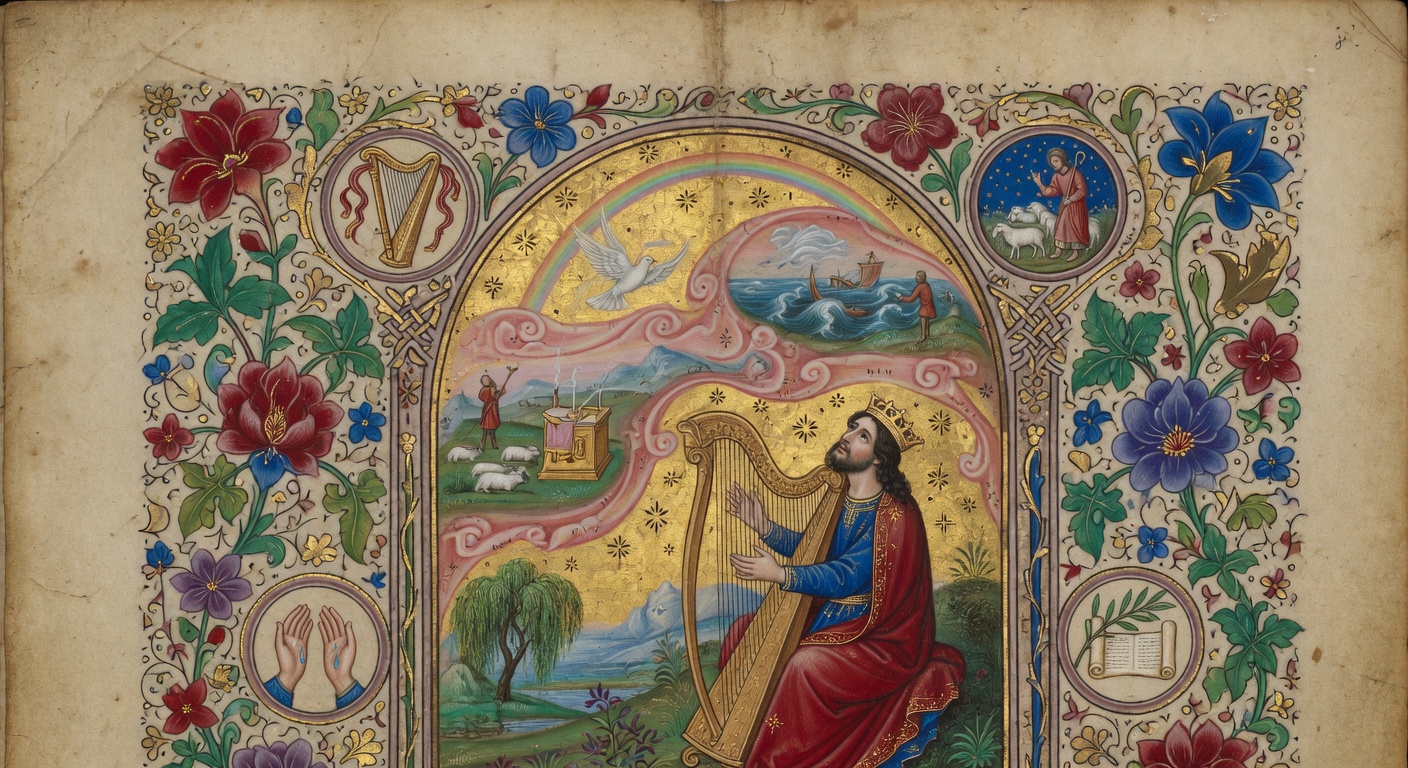
 1hen Israel went out of Egypt, the house of Jacob from a people of strange language;
2 Judah was his sanctuary, and Israel his dominion.
3 The sea saw it, and fled: Jordan was driven back.
4 The mountains skipped like rams, and the little hills like lambs.
5 What ailed thee, O thou sea, that thou fleddest? thou Jordan, that thou wast driven back?
6 Ye mountains, that ye skipped like rams; and ye little hills, like lambs?
7 Tremble, thou earth, at the presence of the Lord, at the presence of the God of Jacob;
8 Which turned the rock into a standing water, the flint into a fountain of waters.
← → arrow keys to navigate chapters · spacebar to play/pause audio
Did You Know?
The psalm's reference to "the God of Jacob" in verse 7 deliberately connects the Exodus wonders to the patriarchal promises, framing national deliverance as fulfillment of the covenant made centuries earlier at Bethel and elsewhere.
Its sequence of water barriers (sea and Jordan) yielding before land features (mountains and hills) skipping creates a chiastic literary structure that mirrors the full geographic arc from Egypt to Canaan, symbolizing total cosmic realignment under divine presence.
The personification of nature as actively fleeing or dancing draws on ancient Near Eastern chaos-battle motifs (such as Baal versus Yam) but subverts them into willing submission, presenting creation's response as joyful recognition rather than defeated combat.
In Jewish liturgical tradition this psalm is assigned to the seventh day of Passover, specifically commemorating the Red Sea crossing, while its placement among the Egyptian Hallel (113-118) underscores the ongoing reenactment of exodus in temple worship.
By omitting any mention of Moses, Aaron, or human leaders, the text presents the Exodus as an unmediated theophany in which God's presence alone provokes the reactions of both water and earth, a perspective unique among historical psalms.
In old age David could not keep warm even under heavy blankets, prompting his officials to bring the young Shunammite Abishag to lie beside him as a human heat source without becoming his wife.
Despite completing the temple, Solomon later built shrines to foreign deities like Ashtoreth, Chemosh, and Molech on the Mount of Olives for his 700 wives and 300 concubines, directly contributing to the kingdom's division after his death.
This location became the focal point of national worship and divine promises, later extending symbolically to encompass the Temple Mount where Solomon built the house of the Lord.
Jerusalem sits at about 2,500 feet elevation. Higher than most surrounding areas.
Commentary & Study Notes Jamieson-Fausset-Brown (1871) · Public Domain of strange language — (compare Ps 81:5).
Classic verse-by-verse commentary on Psalms 114 from Jamieson, Fausset & Brown (1871). Covers: The writer briefly and beautifully celebrates God's former care of his people, to whose benefit nature was miraculously made to contribute.
- 1-4
- of strange language — (compare Ps 81:5).
- 4
- skipped... rams — (Ps 29:6), describes the waving of mountain forests, poetically representing the motion of the mountains. The poetical description of the effect of God's presence on the sea and Jordan alludes to the history (Ex 14:21; Jos 3:14-17). Judah is put as a parallel to Israel, because of the destined, as well as real, prominence of that tribe.
Read all 4 notes on Psalms 114 →