Psalms 122 KJV
A Prayer for Jerusalem
About This Psalm
I was glad when they said, Let us go to the house of the LORD. The joy of worshiping together in community.
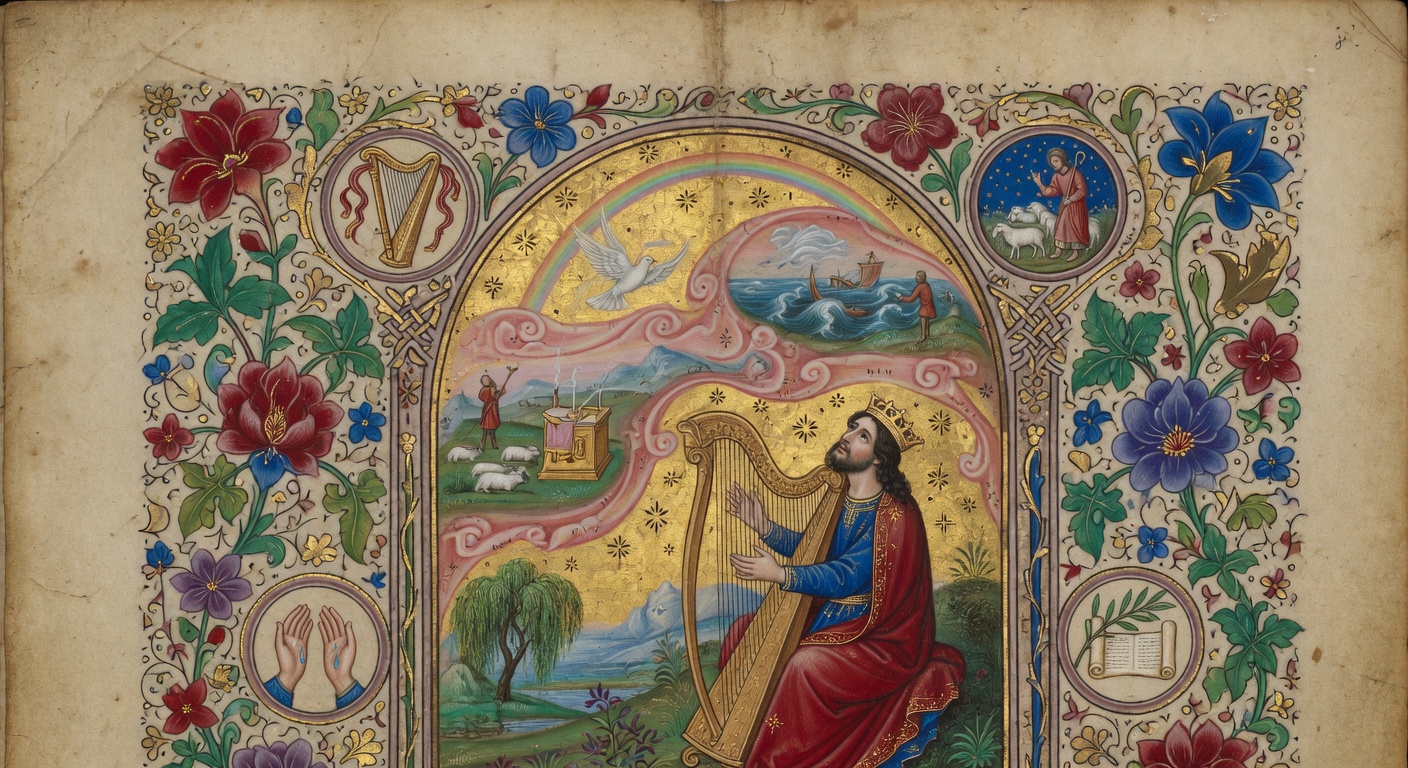
 1 was glad when they said unto me, Let us go into the house of the LORD.
2 Our feet shall stand within thy gates, O Jerusalem.
3 Jerusalem is builded as a city that is compact together:
4 Whither the tribes go up, the tribes of the LORD, unto the testimony of Israel, to give thanks unto the name of the LORD.
5 For there are set thrones of judgment, the thrones of the house of David.
6 Pray for the peace of Jerusalem: they shall prosper that love thee.
7 Peace be within thy walls, and prosperity within thy palaces.
8 For my brethren and companions’ sakes, I will now say, Peace be within thee.
9 Because of the house of the LORD our God I will seek thy good.
← → arrow keys to navigate chapters · spacebar to play/pause audio
Did You Know?
The psalm's superscription attributes it to David despite Jerusalem's capture occurring late in his reign, creating a theological tension that frames the city as both a historical achievement and a future-oriented divine promise.
Verse 4's reference to the 'testimony of Israel' alludes to the covenant renewal ceremonies at the three pilgrimage festivals, linking the ascent to Jerusalem with the Deuteronomic requirement for tribal unity under Torah rather than mere geography.
The chiastic structure pivots on 'shalom' in verses 6-8, where the Hebrew root echoes the city's etymology (yeru-shalem) to portray peace not as absence of war but as the active restoration of covenantal wholeness extending from temple to gates.
Its placement among the Songs of Ascents (120-134) positions it as the central Jerusalem-focused hymn in the collection, mirroring the geographic and spiritual climax of the pilgrimage journey from distant lands back to Zion.
The reference to 'thrones of judgment' in verse 5 connects the Davidic line to pre-exilic judicial practices at the city gate, implying that Jerusalem's security is tied to righteous governance rather than solely to cultic worship.
Jonathan sealed his covenant with David by giving him his royal robe, armor, sword, bow, and belt, ritually transferring symbols of kingship despite being Saul's heir.
Solomon's throne, overlaid with gold and ivory, featured six steps flanked by twelve lions symbolizing the tribes of Israel and incorporated a calf-shaped seat back, making it a unique artifact unmatched by any other royal throne of the era.
The New Testament further develops this imagery to portray the heavenly Jerusalem where believers gather to the living God.
Jerusalem sits at about 2,500 feet elevation. Higher than most surrounding areas.
Commentary & Study Notes Jamieson-Fausset-Brown (1871) · Public Domain Our feet shall stand — literally, "are standing."
Classic verse-by-verse commentary on Psalms 122 from Jamieson, Fausset & Brown (1871). Covers: This psalm might well express the sacred joy of the pilgrims on entering the holy city, where praise, as the religious as well as civil metropolis, is celebrated, and for whose prosperity, as representing the church, prayer is offered.
- 1,2
- Our feet shall stand — literally, "are standing."
- 2
- gates — (Compare Ps 9:14; 87:2).
Read all 8 notes on Psalms 122 →