Psalms 123 KJV
A Prayer for Mercy
About This Psalm
Our eyes look to the LORD as servants look to their master. Waiting for mercy when surrounded by contempt.
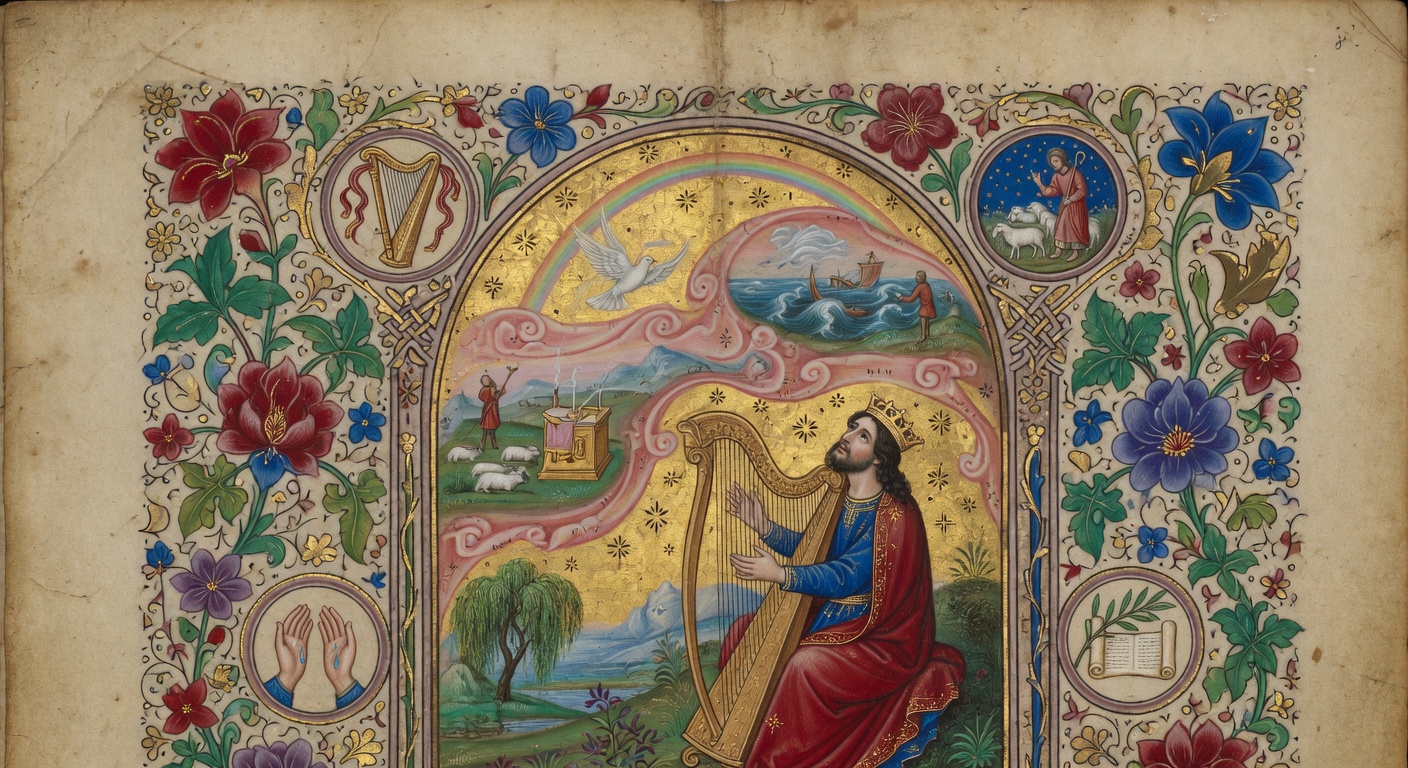
 1nto thee lift I up mine eyes, O thou that dwellest in the heavens.
2 Behold, as the eyes of servants look unto the hand of their masters, and as the eyes of a maiden unto the hand of her mistress; so our eyes wait upon the LORD our God, until that he have mercy upon us.
3 Have mercy upon us, O LORD, have mercy upon us: for we are exceedingly filled with contempt.
4 Our soul is exceedingly filled with the scorning of those that are at ease, and with the contempt of the proud.
← → arrow keys to navigate chapters · spacebar to play/pause audio
Did You Know?
Psalm 123's servant-master imagery draws from ancient Near Eastern legal customs where slaves monitored subtle hand signals for instructions or relief, transforming a mundane observation into a theological statement on attentive dependence rather than mere petition.
As the fourth Song of Ascents, it forms a deliberate pivot in the collection by shifting from external threats in Psalms 120-122 to internalized scorn from 'the proud,' mirroring the social tensions faced by returning exiles under Persian rule.
The psalm uniquely pairs the masculine 'masters' with feminine 'mistresses' in its metaphor, a rare biblical inclusio that underscores comprehensive societal observation of authority figures, extending the plea beyond patriarchal structures.
Its abrupt ending without a traditional vow of praise or confidence formula leaves the prayer unresolved, a literary device that invites ongoing liturgical recitation during pilgrimage rather than narrative closure.
The repeated 'have mercy upon us' echoes the exact phrasing of the Aaronic blessing's 'be gracious' in Numbers 6 but inverts it from priestly pronouncement to communal lament, highlighting a reversal in post-exilic worship dynamics.
David twice spared Saul's life in the wilderness, once cutting off a piece of his robe in the En Gedi cave and later removing his spear and water jug while he slept, demonstrating restraint amid pursuit.
The Queen of Sheba traveled roughly 1,200 miles from her Arabian kingdom with a caravan of camels carrying spices, gold, and stones to test Solomon's wisdom with riddles, then exchanged lavish gifts including 120 talents of gold that funded further temple adornments.
This location became the focal point of national worship and divine promises, later extending symbolically to encompass the Temple Mount where Solomon built the house of the Lord.
Three major world religions consider Jerusalem a holy city.
Commentary & Study Notes Jamieson-Fausset-Brown (1871) · Public Domain (Compare Ps 121:1). thou that dwellest — literally, "sittest as enthroned" (compare Ps 2:4; 113:4, 5).
Classic verse-by-verse commentary on Psalms 123 from Jamieson, Fausset & Brown (1871). Covers: An earnest and expecting prayer for divine aid in distress.
- 1
- (Compare Ps 121:1). thou that dwellest — literally, "sittest as enthroned" (compare Ps 2:4; 113:4, 5).
- 2
- Deference, submission, and trust, are all expressed by the figure. In the East, servants in attending on their masters are almost wholly directed by signs, which require the closest observance of the hands of the latter. The servants of God should look (1) to His directing hand, to appoint them their work; (2) to His supplying hand (Ps 104:28), to give them their portion in due season; (3) to His protecting hand, to right them when wronged; (4) to His correcting hand (Isa 9:13; 1Pe 5:6; compare Ge 16:6); (5) to His rewarding hand.
Read all 4 notes on Psalms 123 →