Psalms 124 KJV
God Is on Our Side
About This Psalm
If the LORD had not been on our side... A grateful 'what if' - imagining how bad it could have been without God.
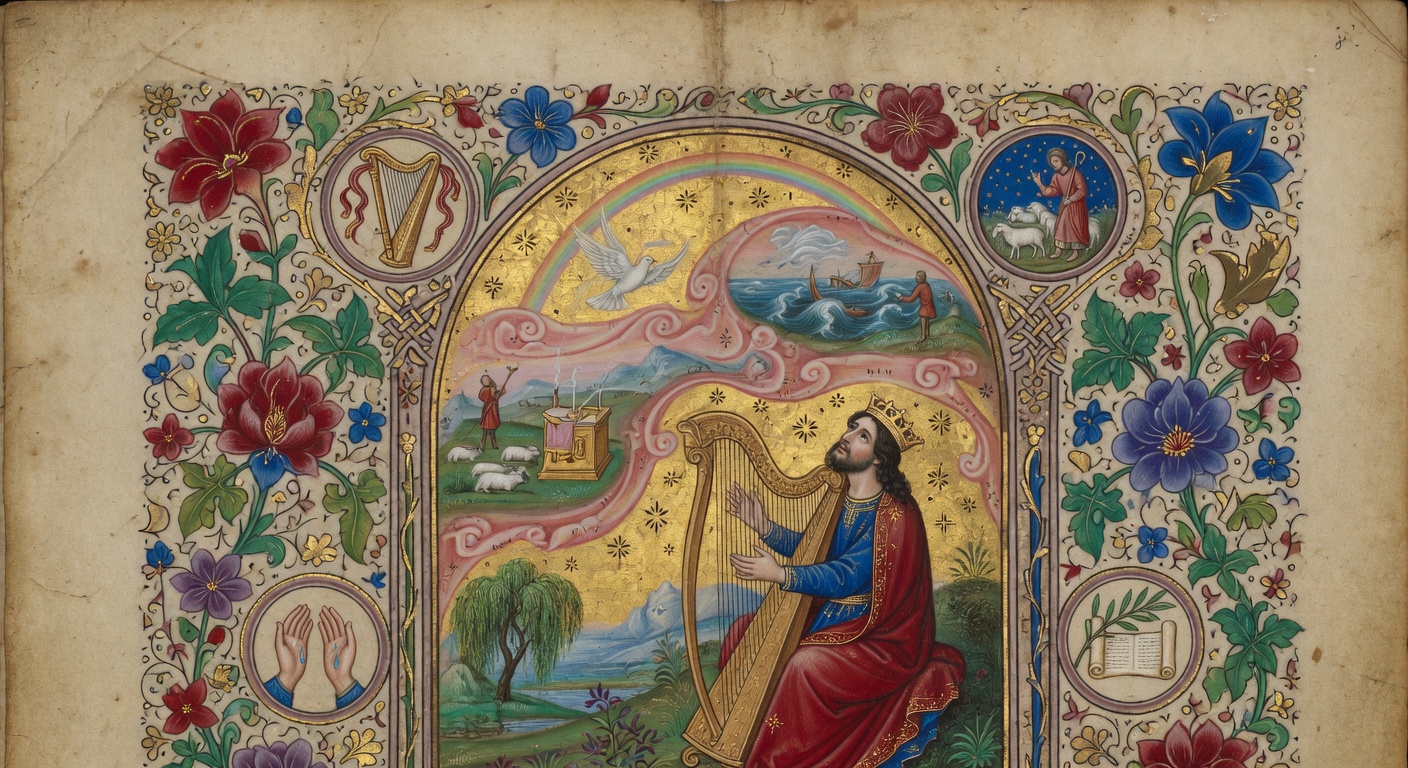
 1f it had not been the LORD who was on our side, now may Israel say;
2 If it had not been the LORD who was on our side, when men rose up against us:
3 Then they had swallowed us up quick, when their wrath was kindled against us:
4 Then the waters had overwhelmed us, the stream had gone over our soul:
5 Then the proud waters had gone over our soul.
6 Blessed be the LORD, who hath not given us as a prey to their teeth.
7 Our soul is escaped as a bird out of the snare of the fowlers: the snare is broken, and we are escaped.
8 Our help is in the name of the LORD, who made heaven and earth.
← → arrow keys to navigate chapters · spacebar to play/pause audio
Did You Know?
Psalm 124's opening conditional clause mirrors ancient Near Eastern victory hymns where a hypothetical negation underscores divine agency in battle, a device also seen in Ugaritic texts praising Baal's interventions.
The 'proud waters' imagery invokes the Canaanite chaos monster motif (Yam or Lotan), recast here as historical enemies, demonstrating how the psalm polemicizes against polytheistic cosmologies by crediting Yahweh alone with restraining primordial forces.
Its bird-from-snare metaphor parallels but inverts the individual escape in Psalm 91, shifting focus to corporate liberation and possibly alluding to fowler guilds in Iron Age Judah whose broken traps served as legal metaphors for annulled treaties.
As one of only two Davidic Songs of Ascents, the psalm's communal 'we' voice suggests it was adapted from a personal royal thanksgiving into a pilgrimage liturgy for post-exilic returnees reenacting national deliverance.
The final invocation of help 'in the name of the LORD' directly echoes the tetragrammaton's protective power in Exodus 3 and anticipates its use in early Jewish amulets and the Christian baptismal formula, linking the psalm to onomastic theology.
In old age David could not keep warm even under heavy blankets, prompting his officials to bring the young Shunammite Abishag to lie beside him as a human heat source without becoming his wife.
Despite completing the temple, Solomon later built shrines to foreign deities like Ashtoreth, Chemosh, and Molech on the Mount of Olives for his 700 wives and 300 concubines, directly contributing to the kingdom's division after his death.
In the prophetic writings it stands as the center of God's redemptive plan, embodying covenant faithfulness and the expectation of a coming Messiah who would rule from Zion in justice and peace.
Jerusalem is mentioned over 800 times in the Bible. More than any other city.
Commentary & Study Notes Jamieson-Fausset-Brown (1871) · Public Domain on our side — for us (Ps 56:9). now — or, "oh! let Israel"
Classic verse-by-verse commentary on Psalms 124 from Jamieson, Fausset & Brown (1871). Covers: The writer, for the church, praises God for past, and expresses trust for future, deliverance from foes.
- 1,2
- on our side — for us (Ps 56:9). now — or, "oh! let Israel"
- 2
- rose... against, &c. — (Ps 3:1; 56:11).
Read all 7 notes on Psalms 124 →