Psalms 128 KJV
The Blessings of the Home
About This Psalm
Blessed is everyone who fears the LORD. A picture of domestic happiness - fruitful work, happy family, long life.
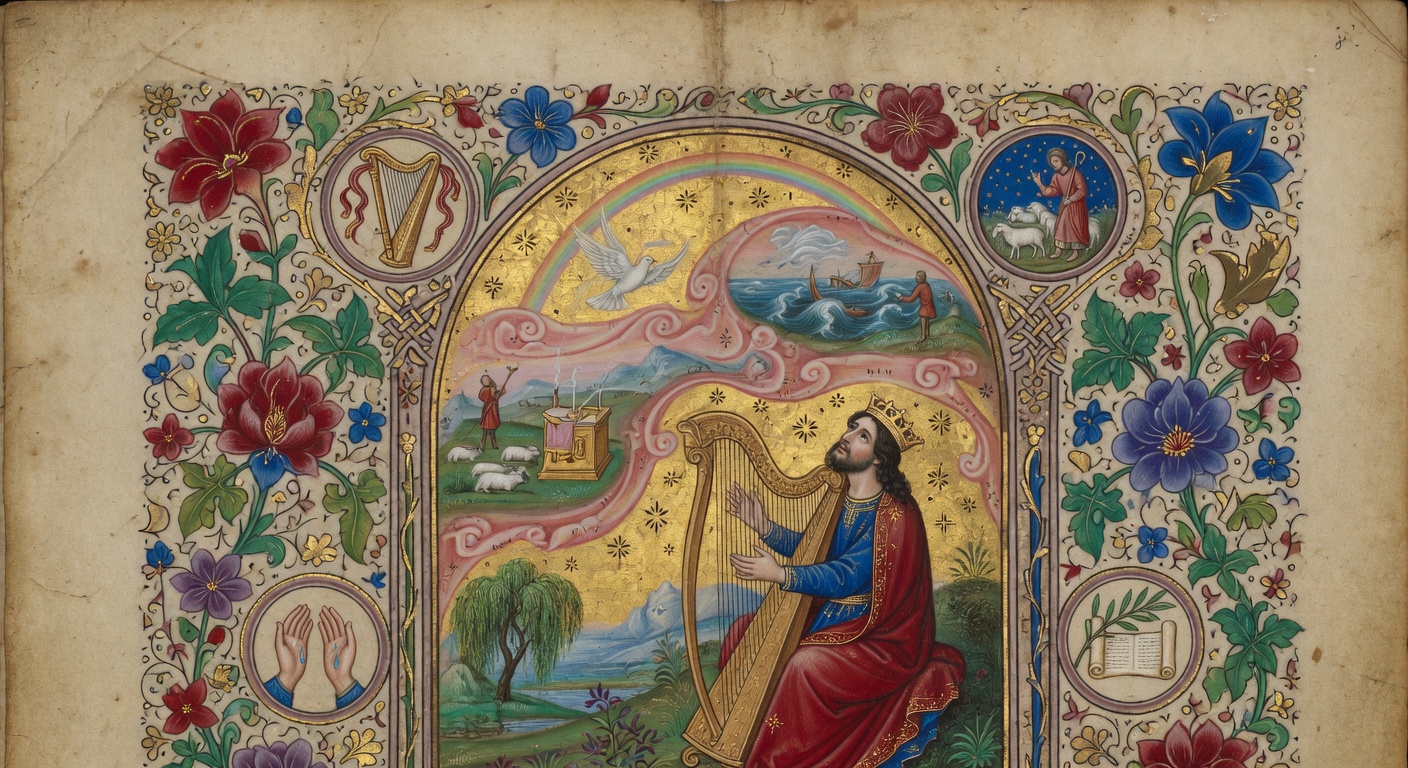
 1lessed is every one that feareth the LORD; that walketh in his ways.
2 For thou shalt eat the labour of thine hands: happy shalt thou be, and it shall be well with thee.
3 Thy wife shall be as a fruitful vine by the sides of thine house: thy children like olive plants round about thy table.
4 Behold, that thus shall the man be blessed that feareth the LORD.
5 The LORD shall bless thee out of Zion: and thou shalt see the good of Jerusalem all the days of thy life.
6 Yea, thou shalt see thy children’s children, and peace upon Israel.
← → arrow keys to navigate chapters · spacebar to play/pause audio
Did You Know?
Psalm 128 pairs with 127 as Songs of Ascents that together contrast anxious human striving with the fear of the Lord, moving from architectural imagery of house-building to the organic growth of vine and olive plants as signs of covenant blessing.
The wife depicted as a fruitful vine 'by the sides of thine house' alludes to the enclosed courtyard of Iron Age Israelite dwellings where grapevines were trained, symbolizing both fertility and protected domestic intimacy rather than public display.
Its closing petition for peace upon Israel shifts the focus from individual household prosperity to national restoration, revealing an eschatological dimension in which personal piety anticipates the renewal of Zion after exile.
The repeated motif of 'eating the labour of thine hands' echoes Deuteronomy's blessings for covenant obedience while subverting ancient Near Eastern royal ideology that reserved such rewards for kings alone, democratizing them for every God-fearer.
Though untitled in the Masoretic Text, the Septuagint ascribes the psalm to David, creating a literary tension with its post-exilic setting and underscoring how later readers reframed Songs of Ascents as Davidic prophecy of future temple pilgrimage.
David twice spared Saul's life in the wilderness, once cutting off a piece of his robe in the En Gedi cave and later removing his spear and water jug while he slept, demonstrating restraint amid pursuit.
The Queen of Sheba traveled roughly 1,200 miles from her Arabian kingdom with a caravan of camels carrying spices, gold, and stones to test Solomon's wisdom with riddles, then exchanged lavish gifts including 120 talents of gold that funded further temple adornments.
The New Testament further develops this imagery to portray the heavenly Jerusalem where believers gather to the living God.
Jerusalem is mentioned over 800 times in the Bible. More than any other city.
Commentary & Study Notes Jamieson-Fausset-Brown (1871) · Public Domain (Compare Ps 1:1).
Classic verse-by-verse commentary on Psalms 128 from Jamieson, Fausset & Brown (1871). Covers: The temporal blessings of true piety. The eighth chapter of zecariah is a virtual commentary on this psalm. Compare ps 128:3 with zec 8:5; And ps 128:2 with le 26:16; De 28:33; Zec 8:10; And ps 128:6 with zec 8:4.
- 1
- (Compare Ps 1:1).
- 2
- For thou shalt eat — that is, It is a blessing to live on the fruits of one's own industry.
Read all 5 notes on Psalms 128 →