Psalms 129 KJV
A Prayer Against Oppressors
About This Psalm
They have afflicted me from my youth - but have not prevailed. Survival testimony. Still standing despite everything.
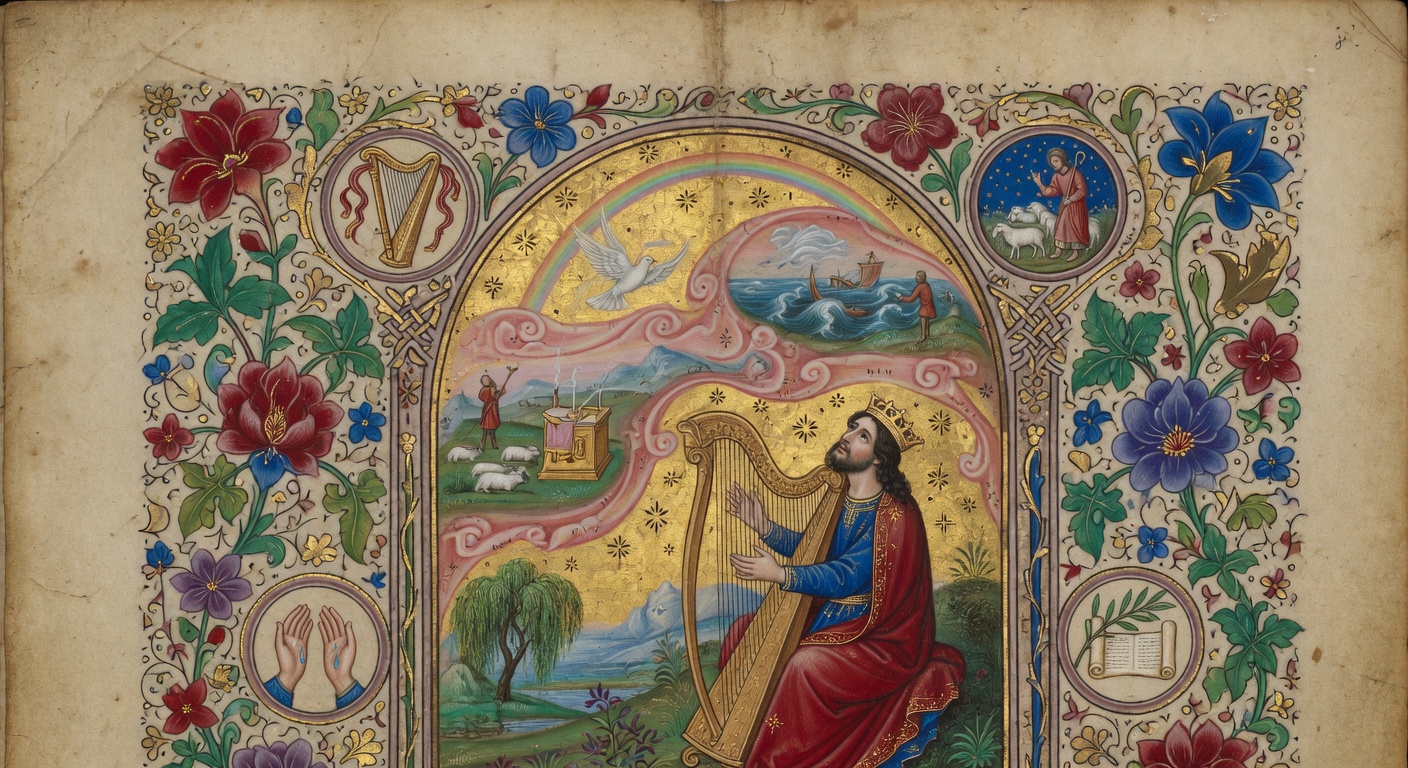
 1any a time have they afflicted me from my youth, may Israel now say:
2 Many a time have they afflicted me from my youth: yet they have not prevailed against me.
3 The plowers plowed upon my back: they made long their furrows.
4 The LORD is righteous: he hath cut asunder the cords of the wicked.
5 Let them all be confounded and turned back that hate Zion.
6 Let them be as the grass upon the housetops, which withereth afore it groweth up:
7 Wherewith the mower filleth not his hand; nor he that bindeth sheaves his bosom.
8 Neither do they which go by say, The blessing of the LORD be upon you: we bless you in the name of the LORD.
← → arrow keys to navigate chapters · spacebar to play/pause audio
Did You Know?
The psalm's opening reference to affliction 'from my youth' frames Israel's national identity as forged in perpetual oppression beginning with the Exodus, linking personal lament to corporate historical memory rather than individual experience.
The 'cords of the wicked' evoke the leather traces or harnesses of ancient plow teams, so that God's cutting them functions as both agricultural sabotage and liberation from forced labor, inverting the oppressors' own tools against them.
Its closing refusal to pronounce the standard greeting 'The blessing of the LORD be upon you' deliberately withholds the covenantal benediction customarily exchanged by harvesters in Ruth 2:4, marking a liturgical boundary between the righteous and their enemies.
The rooftop grass that 'withereth afore it groweth up' draws on a rare Levantine phenomenon where shallow soil on flat roofs produced quick-sprouting but rootless shoots, serving as a botanical emblem of enemies whose apparent strength lacks any sustaining depth.
Positioned among the Songs of Ascents, the psalm's agricultural violence imagery would have been recited by pilgrims climbing to Jerusalem during harvest festivals, transforming a march of celebration into a sober rehearsal of past bondage now overcome.
In old age David could not keep warm even under heavy blankets, prompting his officials to bring the young Shunammite Abishag to lie beside him as a human heat source without becoming his wife.
Despite completing the temple, Solomon later built shrines to foreign deities like Ashtoreth, Chemosh, and Molech on the Mount of Olives for his 700 wives and 300 concubines, directly contributing to the kingdom's division after his death.
This location became the focal point of national worship and divine promises, later extending symbolically to encompass the Temple Mount where Solomon built the house of the Lord.
The city has been destroyed at least twice, besieged 23 times, and captured 44 times.
Commentary & Study Notes Jamieson-Fausset-Brown (1871) · Public Domain may Israel now say — or, "oh! let Israel say" (Ps 124:1). Israel's youth was the sojourn in Egypt (Jer 2:2; Ho 2:15).
Classic verse-by-verse commentary on Psalms 129 from Jamieson, Fausset & Brown (1871). Covers: The people of God, often delivered from enemies, are confident of his favor, by their overthrow in the future.
- 1,2
- may Israel now say — or, "oh! let Israel say" (Ps 124:1). Israel's youth was the sojourn in Egypt (Jer 2:2; Ho 2:15).
- 2
- prevailed — literally, "been able," that is, to accomplish their purpose against me (Ps 13:4).
Read all 5 notes on Psalms 129 →