Psalms 131 KJV
A Psalm of Humble Trust
About This Psalm
A quiet, humble psalm - like a weaned child with its mother. Choosing not to concern yourself with things too great for you.
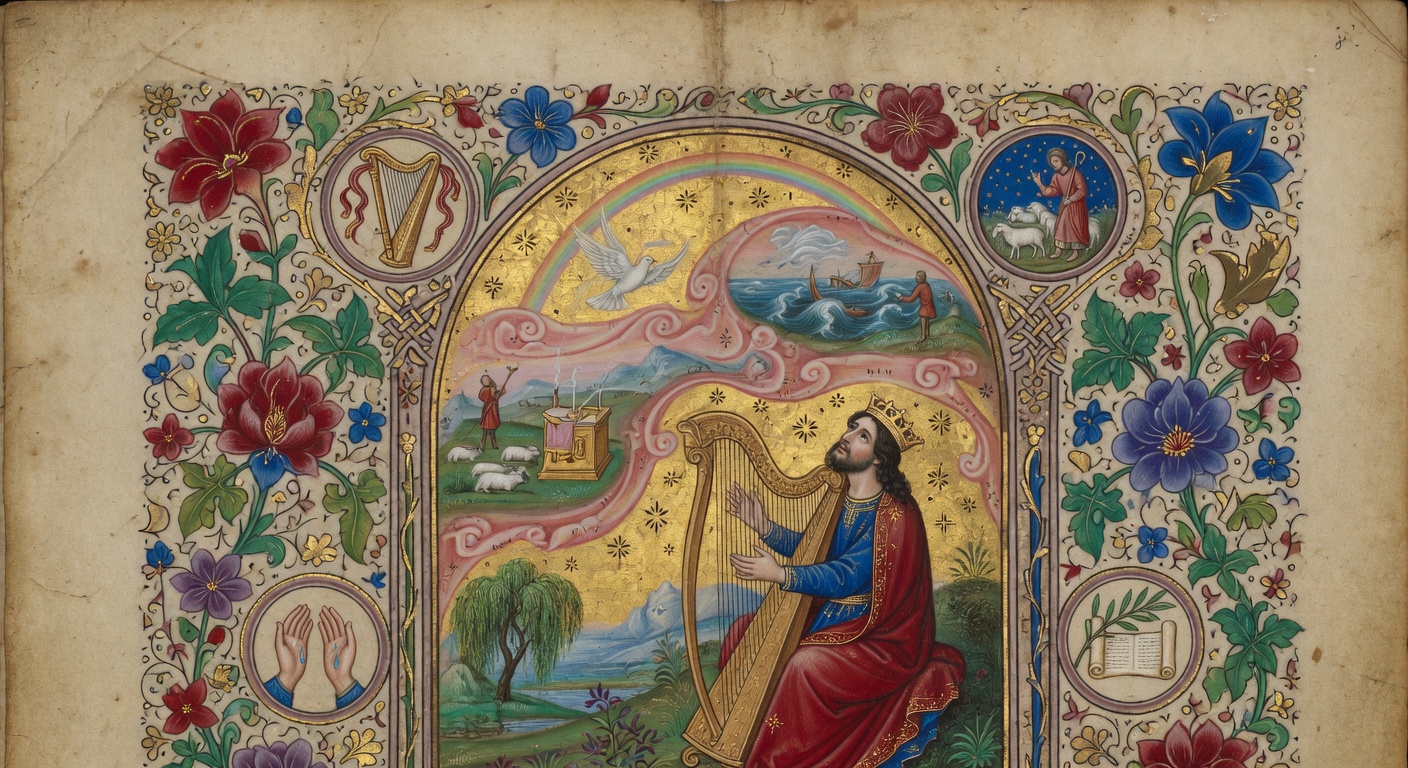
 1ord, my heart is not haughty, nor mine eyes lofty: neither do I exercise myself in great matters, or in things too high for me.
2 Surely I have behaved and quieted myself, as a child that is weaned of his mother: my soul is even as a weaned child.
3 Let Israel hope in the LORD from henceforth and for ever.
← → arrow keys to navigate chapters · spacebar to play/pause audio
Did You Know?
The psalm's weaned-child metaphor draws on the ancient Near Eastern practice of weaning around age three, marking not infantile innocence but the deliberate renunciation of former cravings, thereby modeling a mature contentment with God's provision rather than perpetual spiritual infancy.
Its attribution to David within the Songs of Ascents collection creates an anachronistic bridge between the monarchic era and post-exilic pilgrimage, presenting David as the archetypal humble king whose personal piety authorizes the community's ascent to Zion.
Theologically, Psalm 131 functions as an implicit critique of speculative wisdom traditions (compare Job 38-41 or Ecclesiastes), advocating instead a disciplined restraint that trusts divine sovereignty precisely by refusing to probe matters 'too high' for human grasp.
The concluding shift from first-person singular to an eternal summons for Israel to hope mirrors the movement from individual Songs of Ascents to corporate liturgy, preparing pilgrims to transition from personal reflection to collective temple worship.
Literarily, the psalm echoes David's refusal to seize Saul's kingship in 1 Samuel 24-26, where the same non-haughty posture before 'great matters' preserves covenant order and prefigures the messianic king who likewise refuses self-exaltation.
David purchased Araunah the Jebusite's threshing floor for fifty shekels of silver after the plague halted, establishing the exact site that later became the Temple Mount under Solomon.
Biblical tradition attributes 3,000 proverbs and 1,005 songs to Solomon, along with expertise in botany and zoology covering everything from cedar trees to hyssop and from livestock to birds, fish, and reptiles, yet only fragments survive in Proverbs, Ecclesiastes, and Song of Songs.
The New Testament further develops this imagery to portray the heavenly Jerusalem where believers gather to the living God.
Three major world religions consider Jerusalem a holy city.
Commentary & Study Notes Jamieson-Fausset-Brown (1871) · Public Domain eyes lofty — a sign of pride (Ps 18:27). exercise myself — literally, "walk in," or "meddle with."
Classic verse-by-verse commentary on Psalms 131 from Jamieson, Fausset & Brown (1871). Covers: This psalm, while expressive of David's pious feelings on assuming the royal office, teaches the humble, submissive temper of a true child of God.
- 1
- eyes lofty — a sign of pride (Ps 18:27). exercise myself — literally, "walk in," or "meddle with."
- 2
- Surely, &c. — The form is that of an oath or strongest assertion. Submission is denoted by the figure of a weaned child. As the child weaned by his mother from the breast, so I still the motions of pride in me (Mt 18:3, 4; Isa 11:8; 28:9). Hebrew children were often not weaned till three years old. soul — may be taken for desire, which gives a more definite sense, though one included in the idea conveyed by the usual meaning, myself.
Open full commentary page →