Psalms 16 KJV
A Psalm of Confidence
Echoes & Connections 1 connections
About This Psalm
Pure contentment and joy in God's presence. David has found that God himself is the ultimate inheritance - better than any possession.
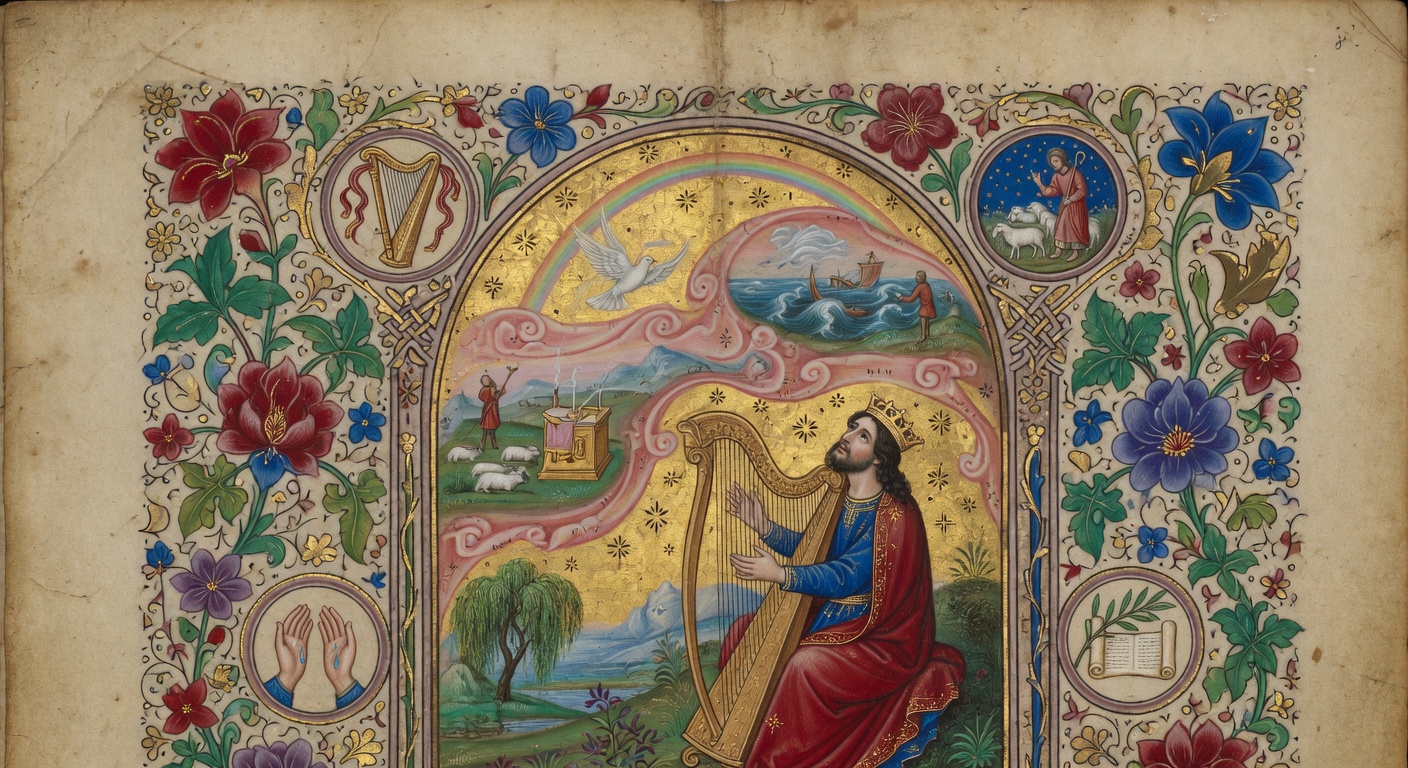
 1reserve me, O God: for in thee do I put my trust.
2 O my soul, thou hast said unto the LORD, Thou art my Lord: my goodness extendeth not to thee;
3 But to the saints that are in the earth, and to the excellent, in whom is all my delight.
4 Their sorrows shall be multiplied that hasten after another god: their drink offerings of blood will I not offer, nor take up their names into my lips.
5 The LORD is the portion of mine inheritance and of my cup: thou maintainest my lot.
6 The lines are fallen unto me in pleasant places; yea, I have a goodly heritage.
7 I will bless the LORD, who hath given me counsel: my reins also instruct me in the night seasons.
8 I have set the LORD always before me: because he is at my right hand, I shall not be moved.
9 Therefore my heart is glad, and my glory rejoiceth: my flesh also shall rest in hope.
10 For thou wilt not leave my soul in hell; neither wilt thou suffer thine Holy One to see corruption.
11 Thou wilt shew me the path of life: in thy presence is fulness of joy; at thy right hand there are pleasures for evermore.
← → arrow keys to navigate chapters · spacebar to play/pause audio
Did You Know?
Psalm 16 belongs to the rare category of Miktam psalms (along with 56-60), a term possibly denoting 'golden' or atonement-related compositions associated with David's periods of peril.
Verse 10's declaration that God will not allow His Holy One to see corruption is directly applied in the New Testament (Acts 2:27, 13:35) as a prophecy of Christ's resurrection rather than David's own experience.
The psalm reinterprets the Levitical inheritance principle. Where priests received no land allotment but God as their portion (Numbers 18:20). By applying it universally to all believers who find their ultimate inheritance in the Lord.
It contrasts the 'sorrows' multiplied for those chasing other gods with the 'fullness of joy' at God's right hand, highlighting a theological pivot from idolatry's consequences to eschatological bliss.
The imagery of the 'cup' in verse 5 connects to both the land division lots in Joshua and later Eucharistic themes, symbolizing one's divinely appointed destiny or portion in life.
David purchased Araunah the Jebusite's threshing floor for fifty shekels of silver after the plague halted, establishing the exact site that later became the Temple Mount under Solomon.
Biblical tradition attributes 3,000 proverbs and 1,005 songs to Solomon, along with expertise in botany and zoology covering everything from cedar trees to hyssop and from livestock to birds, fish, and reptiles, yet only fragments survive in Proverbs, Ecclesiastes, and Song of Songs.
In the prophetic writings it stands as the center of God's redemptive plan, embodying covenant faithfulness and the expectation of a coming Messiah who would rule from Zion in justice and peace.
Jerusalem is mentioned over 800 times in the Bible. More than any other city.
Commentary & Study Notes Jamieson-Fausset-Brown (1871) · Public Domain Preserve me, &c. — keep or watch over my interests. in thee... I... trust — as one seeking shelter from pressing danger.
Classic verse-by-verse commentary on Psalms 16 from Jamieson, Fausset & Brown (1871). Covers: Michtam, or, by the change of one letter, michtab--a "writing," such as a poem or song (compare isa 38:9). Such a change of the letter m for b was not unusual. The position of this word in connection with the author's name, being that usually occupied by some term, such as psalm or song, denoting the style or matter of the composition, favors this view of its meaning, though we know not why this and psalms 56-60 should be specially, called "a writing." "a golden (psalm)," or "a memorial" are explanations proposed by some--neither of which, however applicable here, appears adapted to the other psalms where the term occurs. According to peter (ac 2:25) and paul (ac 13:35), this psalm relates to Christ and expresses the feelings of his human nature, in view of his sufferings and victory over death and the grave, including his subsequent exaltation at the right hand of God. Such was the exposition of the best earlier christian interpreters. Some moderns have held that the psalm relates exclusively to David; But this view is expressly contradicted by the apostles; Others hold that the language of the psalm is applicable to David as a type of Christ, capable of the higher sense assigned it in the new testament. But then the language of ps 16:10 cannot be used of David in any sense, for "he saw corruption." others again propose to refer the first part to David, and the last to Christ; But it is evident that no change in the subject of the psalm is indicated. Indeed, the person who appeals to God for help is evidently the same who rejoices in having found it. In referring the whole psalm to Christ, it is, however, by no means denied that much of its language is expressive of the feelings of his people, so far as in their humble measure they have the feelings of trust in God expressed by him, their head and representative. Such use of his language, as recorded in his last prayer (joh 17:1-26), and even that which he used in gethsemane, under similar modifications, is equally proper. The propriety of this reference of the psalm to Christ will appear in the scope and interpretation. In view of the sufferings before him, the saviour, with that instinctive dread of death manifested in gethsemane, calls on God to "preserve" him; He avows his delight in holiness and abhorrence of the wicked and their wickedness; And for "the joy that was set before him, despising the shame" [heb 12:2], encourages himself; Contemplating the glories of the heritage appointed him. Thus even death and the grave lose their terrors in the assurance of the victory to be attained and "the glory that should follow" [1pe 1:11].
- 1
- Preserve me, &c. — keep or watch over my interests. in thee... I... trust — as one seeking shelter from pressing danger.
- 2
- my soul — must be supplied; expressed in similar cases (Ps 42:5, 11). my goodness... thee — This obscure passage is variously expounded. Either one of two expositions falls in with the context. "My goodness" or merit is not on account of Thee — that is, is not for Thy benefit. Then follows the contrast of Ps 16:3 (but is), in respect, or for the saints, &c. — that is, it enures to them. Or, my goodness — or happiness is not besides Thee — that is, without Thee I have no other source of happiness. Then, "to the saints," &c., means that the same privilege of deriving happiness from God only is theirs. The first is the most consonant with the Messianic character of the Psalm, though the latter is not inconsistent with it.
Read all 10 notes on Psalms 16 →