Psalms 20 KJV
A Prayer for the King
About This Psalm
A prayer for someone heading into battle. The ancient equivalent of 'I'm praying for you' before someone faces their biggest challenge.
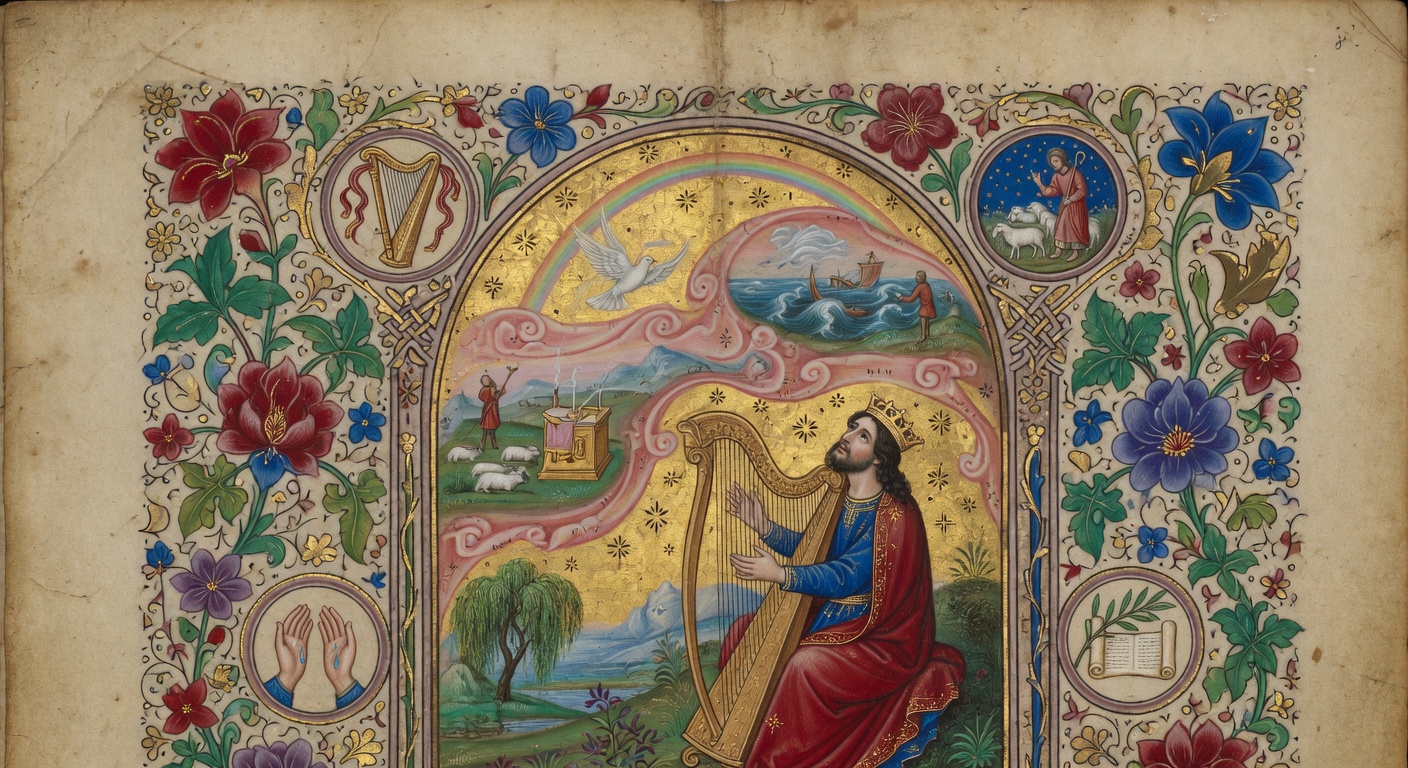
 1he LORD hear thee in the day of trouble; the name of the God of Jacob defend thee;
2 Send thee help from the sanctuary, and strengthen thee out of Zion;
3 Remember all thy offerings, and accept thy burnt sacrifice; Selah.
4 Grant thee according to thine own heart, and fulfil all thy counsel.
5 We will rejoice in thy salvation, and in the name of our God we will set up our banners: the LORD fulfil all thy petitions.
6 Now know I that the LORD saveth his anointed; he will hear him from his holy heaven with the saving strength of his right hand.
7 Some trust in chariots, and some in horses: but we will remember the name of the LORD our God.
8 They are brought down and fallen: but we are risen, and stand upright.
9 Save, LORD: let the king hear us when we call.
← → arrow keys to navigate chapters · spacebar to play/pause audio
Did You Know?
The psalm's invocation of 'the God of Jacob' specifically recalls the patriarch's vow-making at Bethel and his nocturnal wrestling, framing the king's impending battle as a site of similar divine renaming and protection rather than mere military aid.
Verse 6 functions as an embedded oracular response within the prayer, shifting from communal petition to priestly or prophetic assurance that the Lord 'hath heard,' suggesting an antiphonal temple ritual where divine confirmation interrupts human supplication.
The explicit contrast between 'chariots' and 'horses' versus 'the name of the Lord' draws on exodus motifs of Pharaoh's defeated forces, positioning the psalm as an early theological critique of imperial technology that later echoes in prophetic texts like Isaiah.
Psalm 20 and 21 operate as a deliberate liturgical pair reflecting ancient Near Eastern pre- and post-battle ceremonies, with 20's intercession for the anointed one answered by 21's celebration of the king's divine strength and longevity.
The phrase 'we will set up our banners' in verse 5 links military standards to the declarative power of the divine name, implying that Israel's battle insignia were understood as visible extensions of covenantal trust rather than independent talismans.
While fleeing Saul, David sought refuge among the Philistines and feigned madness before King Achish of Gath by scribbling on the city gates and letting saliva run down his beard, successfully avoiding recognition.
Solomon conscripted 30,000 Israelite men for monthly rotations of forced labor in Lebanon to harvest cedar and cypress timber for the temple, while assigning an additional 150,000 Canaanite laborers to quarry and transport stone, reflecting the ancient Near Eastern practice of corvée labor systems.
The New Testament further develops this imagery to portray the heavenly Jerusalem where believers gather to the living God.
Jerusalem is mentioned over 800 times in the Bible. More than any other city.
Commentary & Study Notes Jamieson-Fausset-Brown (1871) · Public Domain hear thee — graciously (Ps 4:1). name of — or manifested perfections, as power, wisdom, &c. defend thee — set thee on high from danger (Ps 9:9; 18:3).
Classic verse-by-verse commentary on Psalms 20 from Jamieson, Fausset & Brown (1871). Covers: David probably composed this psalm to express the prayers of the pious for his success as at once the head of the church and nation. Like other compositions of which David in such relations is the subject, its sentiments have a permanent value--the prosperity of Christ's kingdom being involved, as well as typified, in that of Israel and its king.
- 1
- hear thee — graciously (Ps 4:1). name of — or manifested perfections, as power, wisdom, &c. defend thee — set thee on high from danger (Ps 9:9; 18:3).
- 2
- strengthen thee — sustain in conflict; even physical benefits may be included, as courage for war, &c., as such may proceed from a sense of divine favor, secured in the use of spiritual privileges.
Read all 9 notes on Psalms 20 →