Psalms 46 KJV
God Is Our Refuge
Echoes & Connections 1 connections
About This Psalm
God is our refuge and strength. Though the earth be removed, we will not fear. Martin Luther's 'A Mighty Fortress' was inspired by this.
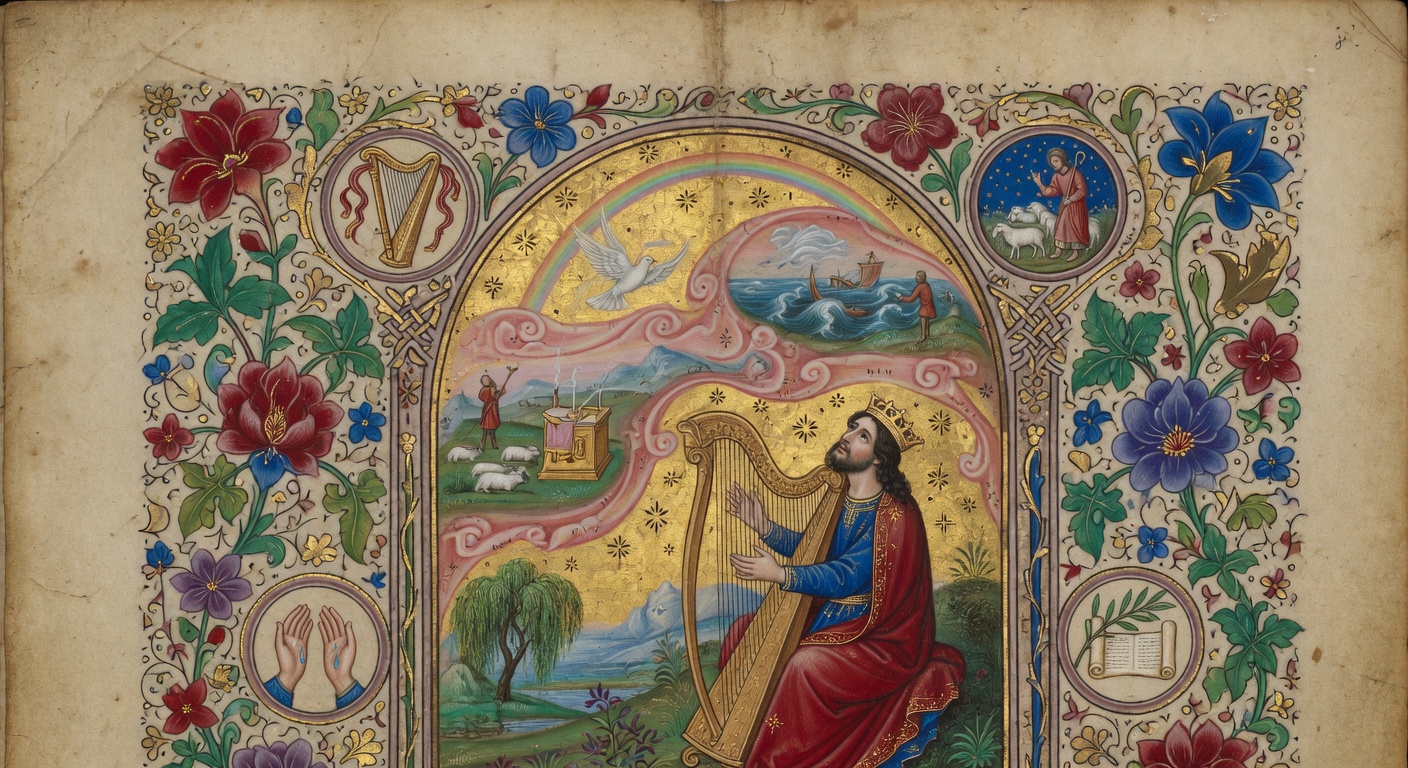
 1od is our refuge and strength, a very present help in trouble.
2 Therefore will not we fear, though the earth be removed, and though the mountains be carried into the midst of the sea;
3 Though the waters thereof roar and be troubled, though the mountains shake with the swelling thereof. Selah.
4 There is a river, the streams whereof shall make glad the city of God, the holy place of the tabernacles of the most High.cf.
5 God is in the midst of her; she shall not be moved: God shall help her, and that right early.cf.
6 The heathen raged, the kingdoms were moved: he uttered his voice, the earth melted.cf.
7 The LORD of hosts is with us; the God of Jacob is our refuge. Selah.cf.
8 Come, behold the works of the LORD, what desolations he hath made in the earth.
9 He maketh wars to cease unto the end of the earth; he breaketh the bow, and cutteth the spear in sunder; he burneth the chariot in the fire.
10 Be still, and know that I am God: I will be exalted among the heathen, I will be exalted in the earth.
11 The LORD of hosts is with us; the God of Jacob is our refuge. Selah.
← → arrow keys to navigate chapters · spacebar to play/pause audio
Did You Know?
Psalm 46 is traditionally associated with the sons of Korah and may commemorate Hezekiah's deliverance from Sennacherib, where the Assyrian threat is framed as raging nations brought to desolation by God's intervention alone.
The river in verse 4 whose streams gladden the city of God contrasts the chaotic primordial waters of verses 2-3 and alludes to Edenic or eschatological rivers of life, underscoring Zion as the ordered center of divine presence amid cosmic upheaval.
The Hebrew imperative 'raphah' in 'Be still' (v. 10) carries connotations of releasing grip or ceasing frantic effort rather than passive meditation, directing the command toward warring nations or anxious believers to recognize God's sole exaltation.
Its themes directly shaped Martin Luther's Reformation hymn 'A Mighty Fortress,' yet the psalm's original setting emphasizes God's voice thundering over geopolitical turmoil rather than individual piety.
Verse 9's reference to God making wars cease to the end of the earth subtly reverses typical ancient Near Eastern victory hymns by portraying disarmament as an act of divine judgment on human militarism, not merely Israelite triumph.
David purchased Araunah the Jebusite's threshing floor for fifty shekels of silver after the plague halted, establishing the exact site that later became the Temple Mount under Solomon.
Biblical tradition attributes 3,000 proverbs and 1,005 songs to Solomon, along with expertise in botany and zoology covering everything from cedar trees to hyssop and from livestock to birds, fish, and reptiles, yet only fragments survive in Proverbs, Ecclesiastes, and Song of Songs.
In the prophetic writings it stands as the center of God's redemptive plan, embodying covenant faithfulness and the expectation of a coming Messiah who would rule from Zion in justice and peace.
Jerusalem sits at about 2,500 feet elevation. Higher than most surrounding areas.
Commentary & Study Notes Jamieson-Fausset-Brown (1871) · Public Domain refuge — literally, "a place of trust" (Ps 2:12). strength — (Ps 18:2). present help — literally, "a help He has been found exceedingly." trouble — as in Ps 18:7.
Classic verse-by-verse commentary on Psalms 46 from Jamieson, Fausset & Brown (1871). Covers: Upon alamoth--most probably denotes the treble, or part sung by female voices, the word meaning "virgins"; And which was sung with some appropriately keyed instrument (compare 1ch 15:19-21; See on ps 6:1, title). The theme may be stated in luther's well-known words, "a mighty fortress is our God." the great deliverance (2ki 19:35; Isa 37:36) may have occasioned its composition.
- 1
- refuge — literally, "a place of trust" (Ps 2:12). strength — (Ps 18:2). present help — literally, "a help He has been found exceedingly." trouble — as in Ps 18:7.
- 2,3
- The most violent civil commotions are illustrated by the greatest physical commotions.
Read all 10 notes on Psalms 46 →